


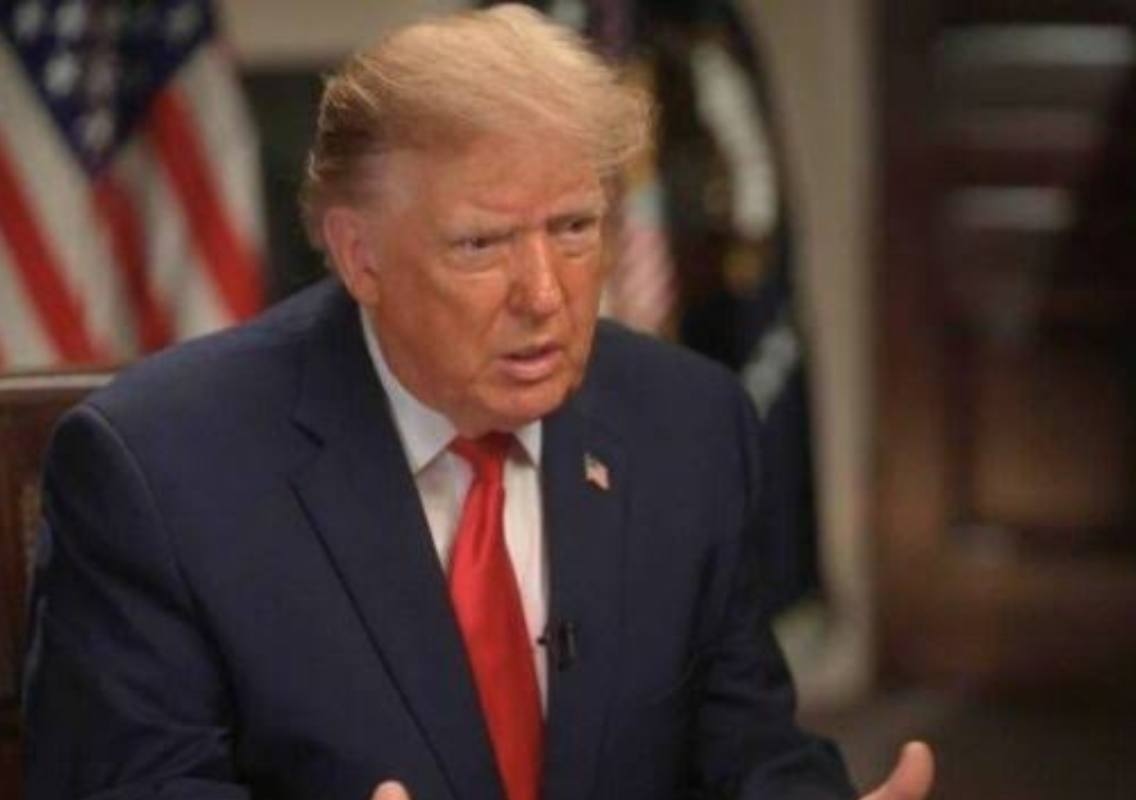


Washington: US President Donald Trump has acknowledged that his administration’s deportation policy may have been excessively harsh, particularly towards undocumented immigrants who were employed and contributing to the economy. The admission comes after Republicans lost control of both chambers of Congress in the November 3 midterm elections.
However, Trump’s decision to appoint immigration hardliner Stephen Miller as his Chief of Staff has raised doubts about whether the administration intends to soften its approach to immigration enforcement.
In an interview broadcast on Sunday evening, Trump conceded that the crackdown may have gone too far in some cases. His comments marked a rare acknowledgement of the political consequences of his immigration policies, which had been a central feature of his administration.
“I think it was too tough. I think it might be too tough,” Trump said.
The President indicated that his administration had succeeded in securing the US border and removing people he considered serious offenders. However, he acknowledged that the deportation drive had also affected individuals who had jobs and whose primary violation was entering the country illegally.
The remarks come at a difficult political moment for Trump, with the Republican Party suffering a major setback in the midterm elections. The President has also acknowledged that the Iran war and rising petrol prices contributed to voter dissatisfaction.
Trump admits deportation drive affected working immigrants
Trump offered a mixed assessment of his immigration record during the interview. He awarded himself an “A+” for closing the US border and said his administration had received “very high marks for getting the bad ones out”.
However, he acknowledged that the policy had caused political damage when enforcement extended to undocumented immigrants who were employed.
He said some people had entered the country illegally but were subsequently working in hotels, landscaping businesses and other sectors. Some were also paying taxes and contributing to the economy.
Trump suggested that Americans were divided over what should happen to such individuals. While one section of the population wanted all undocumented immigrants deported, others believed that people who were working and supporting businesses should be allowed to remain.
His comments indicated that the administration’s broad enforcement approach had become a political liability, particularly when it affected people who were not viewed by some voters as serious criminals.
The President said the crackdown had gone beyond what some Americans considered acceptable. He repeated that the policy might have been too tough, suggesting that the administration’s immigration record required a more nuanced assessment.
However, he did not announce a specific policy change or provide details of any proposed exemptions for undocumented workers.
Stephen Miller appointment raises questions over policy shift
Trump’s decision to appoint Stephen Miller as Chief of Staff has complicated expectations of a possible change in immigration policy.
Miller is widely regarded as one of the most influential hardliners on immigration within Trump’s political circle. His appointment comes shortly after the President acknowledged that the deportation drive may have been too aggressive.
The choice has raised questions about whether Trump’s remarks represent the beginning of a policy reassessment or are primarily an acknowledgement of the political damage caused by the crackdown.
Miller’s position in the administration could be significant in determining how immigration enforcement priorities are shaped. His appointment does not, by itself, establish that the existing deportation strategy will continue unchanged, but it offers little immediate indication of a retreat from the hard-line approach.
The contrast between Trump’s comments and his personnel decision has therefore become a central issue in assessing the administration’s direction.
The President has not outlined whether his government will distinguish more clearly between undocumented immigrants accused of serious crimes and those who entered the country illegally but have since found employment.
Such a distinction could become politically important as the administration responds to the concerns raised by voters.
Iran war and rising petrol prices hurt Republicans
Trump also identified foreign policy and economic concerns as factors behind the Republican Party’s midterm defeat.
He said voters were unhappy with the Iran war and the increase in petrol prices. According to the President, fuel costs had risen after previously falling to a low level.
“They didn’t like the war,” he said, referring to voters’ reaction to the conflict. He also acknowledged that higher gasoline prices had become a source of dissatisfaction.
Trump further pointed to what he described as a “great dislike” for Israel, indicating that public attitudes towards the wider conflict in the Middle East had also influenced the political environment.
The comments suggest that the Republican setback cannot be attributed to immigration alone. The cost of living, fuel prices and the administration’s handling of international conflicts appear to have contributed to voter concerns.
Despite acknowledging these difficulties, Trump continued to present himself as a leader who had worked to resolve international conflicts. He repeated his claim that he had settled eight wars during his political career.
The President’s comments reflect an effort to defend his broader foreign policy record while recognising that some decisions may have carried electoral costs.
Trump repeats claim of preventing India-Pakistan nuclear war
During the interview, Trump again included the India-Pakistan conflict among the international disputes he claimed to have resolved.
He asserted that his intervention had prevented a possible nuclear war between the two neighbouring countries.
“India-Pakistan would’ve been a nuclear war. I got it settled before it got going,” Trump said.
He also claimed that 11 aircraft had been shot down during the conflict and referred to remarks by Pakistan’s Prime Minister, who he said had credited him with saving millions of lives.
India has consistently rejected Trump’s account of American mediation in the military confrontation.
The conflict followed the April 22, 2025, terrorist attack in Pahalgam, Jammu and Kashmir, in which 26 people were killed. India subsequently launched Operation Sindoor on May 7, targeting terrorist infrastructure in Pakistan and Pakistan-occupied Kashmir.
The military confrontation escalated before the two countries reached an understanding to stop military action on May 10.
New Delhi has maintained that the understanding was reached directly between the Directors General of Military Operations of India and Pakistan. It has repeatedly rejected claims that a third country mediated the agreement.
India has also denied that trade negotiations with Washington played any role in the understanding to end military action.
Trump’s latest remarks therefore revive a diplomatic disagreement over the extent of the United States’ role in the India-Pakistan de-escalation.
Midterm setback puts Trump’s political strategy under scrutiny
The Republican Party’s loss of control of both the House of Representatives and the Senate in the November 3 elections has placed additional pressure on Trump to address voter concerns.
The results have raised questions about the political impact of his domestic and foreign policy decisions, including immigration enforcement, the Iran war and the rising cost of fuel.
Trump’s admission that deportations may have been too tough suggests that his administration recognises the need to consider how its policies are perceived beyond its core supporters.
However, the appointment of Miller indicates that immigration remains a priority for the President and that a major change in direction cannot yet be assumed.
The coming months will show whether Trump’s comments translate into a more selective deportation strategy or remain an acknowledgement of electoral dissatisfaction.
For now, the President faces the challenge of balancing his promise to enforce immigration laws with concerns among voters about the treatment of working undocumented immigrants. His administration must also contend with the political consequences of the Iran conflict and economic pressures.
The contrast between Trump’s admission and Miller’s appointment leaves the direction of US immigration policy uncertain.