







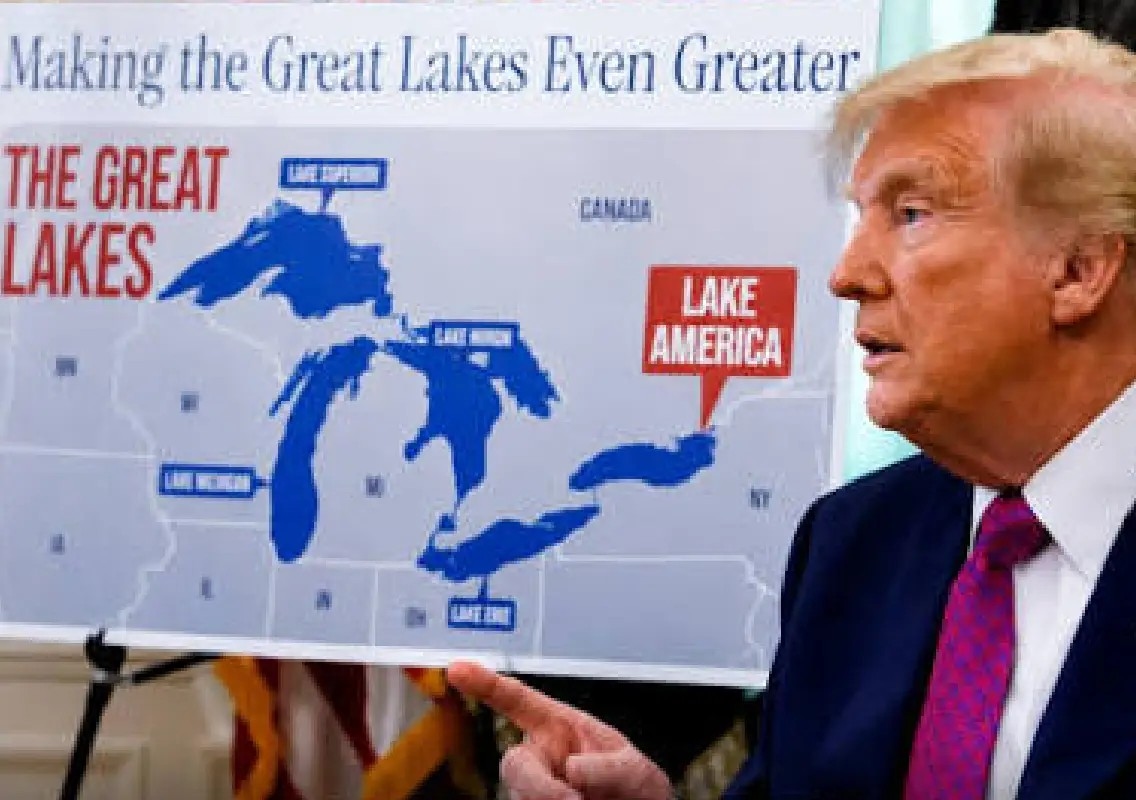


Washington: US President Donald Trump has asked Apple to change the name of Lake Ontario to “Lake America” on its Maps application, adding another unusual dimension to the growing tensions between the United States and Canada.
US Interior Secretary Doug Burgum said Trump had contacted Apple directly and expressed confidence that the technology company could soon update the name on its mapping service. Apple had not publicly commented on the request as of Monday.
The request comes days after Trump signed an executive order directing the US Interior Department to rename Lake Ontario in the country’s official geographic naming system. The lake lies along the border between the US state of New York and Canada’s Ontario province.
Why Trump wants the name changed
Trump’s decision is part of a broader dispute with Canada that has intensified following a breakdown in trade negotiations and the imposition of tariffs by both countries.
Trump announced the proposed change last week, saying the United States was considering renaming Lake Ontario as “Lake America”. He subsequently signed an executive order directing the Interior Department to update the name in the US Geographic Names Information System (GNIS).
The federal system establishes geographic names used by US government agencies and on official federal maps. However, the executive order does not have the power to force Canada or other countries to adopt the new name.
That has already resulted in different names being used on either side of the border.
Google has already made the change
Google Maps has already begun displaying “Lake America” for users in the United States.
The company said the change followed the update made by the US Geographic Names Information System. Google also clarified that users in Canada would continue to see “Lake Ontario”, while users outside the United States and Canada would see both names.
The approach follows Google’s existing practice for geographical features whose names differ between countries.
Apple Maps, however, was still displaying Lake Ontario as of Monday afternoon in the United States. That prompted the latest intervention from the Trump administration.
Burgum said Trump had reached out to Apple personally and suggested that a change could soon appear on the company’s mapping platform.
Apple has not yet agreed
Despite the request from Trump, Apple had not announced that it would change the name.
The company had also not immediately responded publicly to questions about whether it would follow the US government’s updated geographic designation.
Apple previously changed the name of the Gulf of Mexico to “Gulf of America” on its US mapping services following a similar Trump administration order. The latest request therefore raises the possibility that the company could again adopt the US government’s terminology.
For now, however, Apple Maps continues to show Lake Ontario.
Canada is not changing the name
The US decision does not alter Canada’s official geographic naming system.
Canadian authorities continue to recognise the body of water as Lake Ontario, a name that has been used for centuries. Canadian Prime Minister Mark Carney has rejected Trump’s renaming initiative, while Ontario Premier Doug Ford has also strongly defended the traditional name.
Ford has even displayed a large sign near the lake stating that it is “Lake Ontario, now and always”, underscoring Canada’s rejection of the US designation.
The dispute is particularly striking because the lake itself is shared by the two countries. Its northern shore is in Ontario, while its southern shore borders New York.
Indigenous history has entered the debate
The controversy is not only about the US and Canada.
A leader of the Seneca Nation in upstate New York criticised the renaming, saying it showed disrespect towards Indigenous people whose history is closely connected with the lake and arguing that it conflicts with a treaty dating back more than 225 years.
Lake Ontario is one of North America’s five Great Lakes and is the smallest of them by surface area. Its name has a long history predating the current political dispute between Washington and Ottawa.
The criticism therefore reflects concerns that geographic names can carry cultural and historical significance that goes well beyond their use on modern maps.
A name change cannot change the border
Despite the attention surrounding the decision, the US renaming does not change the lake’s geographic location, international boundary or ownership arrangements.
It simply changes the terminology used by the US federal government and, potentially, by companies that rely on American geographic databases.
Canada remains free to use its own official name, and there is no mechanism through which a US executive order can compel Canadian authorities to adopt “Lake America”.
International map users could therefore continue to encounter different names depending on where they are located or which mapping service they use.
The trade dispute is adding to the symbolism
The timing of the renaming has made it particularly controversial.
The United States and Canada have been involved in an increasingly tense trade dispute, with reciprocal tariffs affecting billions of dollars in goods. The failure of recent negotiations has further strained relations between the two long-standing allies.
Against that background, the Lake America proposal has been interpreted as more than a simple administrative change.
For the Trump administration, the move is an assertion of US authority over the terminology used in its own federal systems. For Canadian officials and critics, it is seen as another provocative gesture during an already difficult period in bilateral relations.
One lake, two names for now
The immediate outcome may be a situation in which the same body of water has different names depending on the country and platform being used.
US users could increasingly see Lake America, while Canadians continue to see Lake Ontario. International users may see both names.
Whether Apple ultimately follows Google remains to be seen.
For now, Trump’s request has turned an ordinary map label into an unexpected symbol of the wider US-Canada dispute. What began as a geographic naming decision has become a debate involving national identity, Indigenous history, technology companies and diplomacy.
The lake itself remains exactly where it has always been. The disagreement is over what millions of people will call it.