







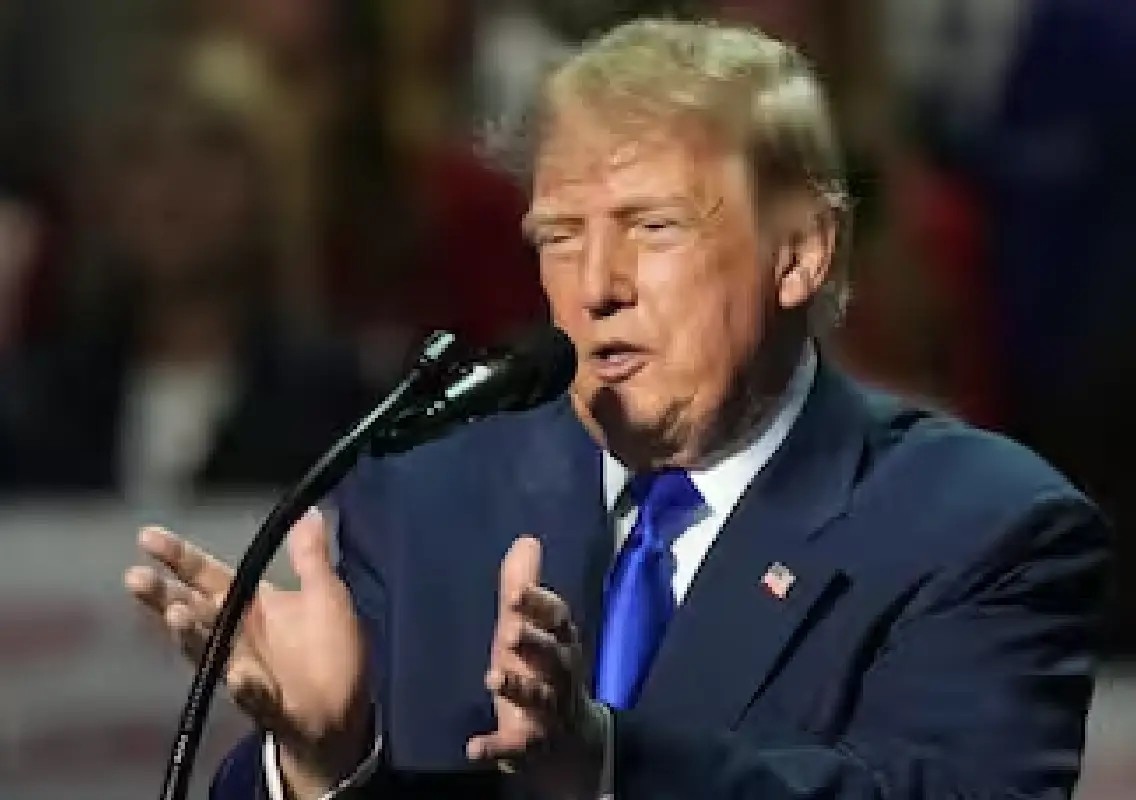


Washington : US President Donald Trump has called for the United States to have the world’s lowest interest rates, intensifying pressure on the Federal Reserve ahead of its upcoming policy meeting. His comments come as financial markets increasingly expect the central bank to raise borrowing costs in response to persistent inflation.
Speaking while attending the Irish Open golf tournament in Ireland, Trump argued that the United States should not have higher interest rates than other countries. His remarks come at a politically sensitive moment, with the Federal Reserve facing competing pressures from inflation, energy prices and economic growth.
The US central bank’s current federal funds target range is 3.5% to 3.75%. Markets are now closely watching the Fed’s forthcoming decision after recent economic data indicated that price pressures have not eased as quickly as policymakers had hoped.
Trump pushes for lower borrowing costs
Trump has repeatedly advocated lower interest rates, arguing that cheaper borrowing would support economic activity and reduce the cost of financing for businesses and consumers.
His latest comments were particularly significant because they came only days before the Federal Reserve’s policy meeting. The president’s preference puts him at odds with the immediate direction expected by financial markets, which have increasingly priced in the possibility of a rate increase.
Trump also criticised the existing US interest-rate structure, arguing that other countries should not have lower rates than the United States. He linked the issue to America’s economic position and trade relationships.
The president has previously been vocal about monetary policy and the level of interest rates, although the Federal Reserve is institutionally independent and its decisions are based on its assessment of economic conditions.
Inflation complicates the Fed’s decision
The pressure on the Fed comes as inflation remains above its long-term target.
Recent US consumer-price data showed stronger-than-expected inflation in August. Core consumer prices increased 0.3% month-on-month, compared with economists’ expectations of 0.2%, while annual core inflation reached 2.4%. Overall consumer inflation rose to 3.4%.
The figures have strengthened expectations that the Federal Reserve may need to tighten monetary policy rather than reduce rates.
The inflation outlook has also been complicated by higher energy prices. Oil prices have climbed sharply amid continuing conflict and disruption around key Middle Eastern energy and shipping routes. Brent crude has moved above $100 a barrel, creating additional concerns about future inflation.
Oil prices add to inflation concerns
The rise in crude oil prices represents a particular challenge for the Federal Reserve.
Higher energy costs can feed into transportation, manufacturing and household expenses, potentially slowing progress towards price stability. Recent attacks and disruptions affecting important energy infrastructure have added further uncertainty to the outlook.
Reuters reported that Brent crude rose above $107 a barrel amid fresh regional tensions. The increase has contributed to renewed concerns that inflation could remain elevated for longer.
For the Fed, this creates a difficult policy environment. Raising interest rates could help contain inflationary pressure but may also increase borrowing costs and weigh on economic activity. Keeping rates unchanged or cutting them could provide greater support to growth but risks allowing inflation to remain persistent.
Markets increasingly expect a rate hike
Financial markets have moved noticeably towards expecting a Federal Reserve rate increase.
A Reuters report published ahead of the meeting said markets had been pricing an increasingly high probability of a 25-basis-point increase following the latest inflation figures. By September 14, market expectations had risen to about 86% for a hike.
Goldman Sachs and JPMorgan have also shifted towards expecting a September rate increase, citing stronger inflation and higher energy prices. Goldman Sachs expects a 25-basis-point hike, while JPMorgan has projected further tightening later in the year.
The changing expectations have already affected financial markets, including US Treasury yields and the dollar.
Political pressure on the Federal Reserve
Trump’s latest remarks also highlight the continuing political sensitivity surrounding US monetary policy.
The president has supported Federal Reserve Chair Kevin Warsh, but his administration remains interested in lower borrowing costs. National Economic Council Director Kevin Hassett has acknowledged Trump’s preference for lower rates while stressing continued support for the Fed chair’s independence.
The issue carries additional political significance with the US midterm elections approaching.
Persistently high prices can affect voters’ perceptions of the economy, while high interest rates can increase mortgage, credit-card and business borrowing costs. Policymakers therefore face pressure from different directions as they attempt to balance inflation control with economic growth.
A difficult choice for the Fed
The central bank’s upcoming decision will be closely watched globally because changes in US interest rates can influence currencies, bonds, stock markets and borrowing costs well beyond the United States.
A rate increase could strengthen expectations that the Fed is prioritising inflation control. It could also increase pressure on borrowers and potentially support the US dollar.
A decision not to raise rates, meanwhile, could be interpreted by markets as a sign that policymakers remain concerned about economic growth.
Trump’s call for the lowest rates adds another dimension to an already complicated policy debate. However, the Fed’s mandate requires policymakers to assess economic conditions independently rather than respond directly to political demands.
With inflation still above target, oil prices elevated and financial markets preparing for a possible rate increase, the forthcoming Federal Reserve meeting is likely to be one of the most closely watched economic events of the month.