







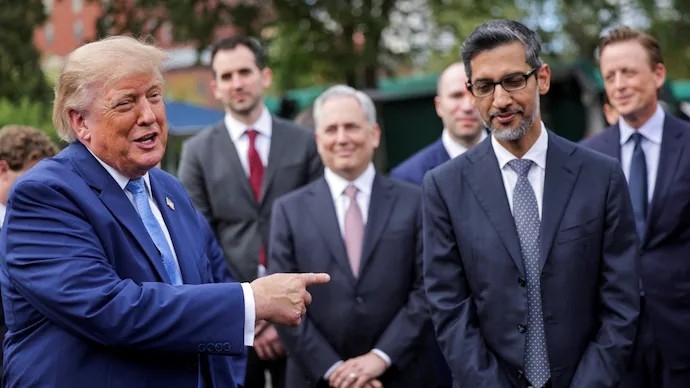


Washington: US President Donald Trump called Google CEO Sundar Pichai a “monster” during a lighthearted interaction with technology and artificial intelligence leaders at the White House.
Trump made the remark while speaking to reporters after a lunch attended by several prominent figures from the technology industry. As he introduced Pichai to the media, the US president praised the Google chief while joking that people outside the technology industry may not know who some of the industry’s most influential leaders are.
Trump’s comments came as he hosted senior technology executives at the White House and discussed artificial intelligence, safety and the industry’s approach to managing potential risks.
Trump introduces Sundar Pichai to reporters
During the interaction at the White House driveway, Trump called on Pichai to speak.
“Sundar, you want to say something?” Trump asked.
Pichai began responding, saying, “First of all, thanks—”, but Trump interrupted before the Google CEO could complete his sentence.
The US president then turned his attention to the technology leaders standing alongside him and highlighted their influence.
“You have no idea who these people are. These are the biggest people in the world. You have no idea who they are,” Trump told reporters.
He then singled out Pichai and described him as a “monster”.
“This guy is a monster and nobody knows,” Trump said.
Pichai smiled as Trump continued speaking about the Google chief and other technology executives present at the White House.
Trump jokes about Pichai’s low public profile
Trump went on to contrast the lives of major technology executives with his own experience of dealing with the media.
“What a great life. To be a monster and not have to go through this,” Trump said, referring to the frequency with which he speaks to reporters.
The US president then returned to Pichai and told the media to remember his first name.
“All you have to know is Sundar. Sundar is his name,” Trump said.
The comment appeared to be intended as a humorous introduction rather than a formal description of Pichai’s role or influence. Pichai, who has led Google and its parent company Alphabet for years, is already a widely recognised figure in the global technology industry.
Pichai responds with a joke
Pichai responded to Trump’s comments in a similarly lighthearted manner.
“Hopefully a better tagline than I’m a monster!” the Google CEO said.
The exchange prompted laughter and added a humorous moment to an otherwise significant gathering focused on artificial intelligence.
Trump’s use of the word “monster” appeared to refer to the scale of influence held by leading technology executives and their companies rather than describing Pichai personally.
Google is among the world’s largest technology companies and has been heavily involved in the development and deployment of artificial intelligence through its Gemini models and other AI products.
Trump tells Dario Amodei to ‘be careful’
Pichai was not the only technology executive who received a playful remark from Trump.
The US president also called Anthropic CEO Dario Amodei over during the interaction with reporters.
Trump referred to Amodei’s brief response and then jokingly told the Anthropic chief to “be careful”.
The remark appeared to reference Amodei’s previous public comments about the potential risks associated with increasingly capable artificial intelligence systems.
Amodei has spoken publicly about the possibility of advanced AI creating serious risks, including scenarios that could threaten humanity. Such warnings have become part of the broader debate within the technology industry over how quickly AI systems should be developed and what safeguards should accompany them.
Amodei highlights AI race and safety
Amodei laughed along with the other executives following Trump’s remark.
He subsequently said he agreed with Trump’s view that the global AI competition was significant.
“As the president has said, you know, whoever wins AI wins. I think that’s very important,” Amodei said.
At the same time, the Anthropic CEO stressed that the development of AI needed to be accompanied by safety measures.
“We all need to work, we all need to work together to make sure that we can win, and we can win safely,” he said.
His comments reflected a central theme of the White House discussions: balancing competition and technological development with efforts to manage potential risks associated with advanced AI systems.
Major technology leaders attend White House lunch
The interaction with Pichai and Amodei came during a gathering of prominent technology executives at the White House.
Among those attending were Meta CEO Mark Zuckerberg, Nvidia CEO Jensen Huang, OpenAI President Greg Brockman, Pichai and Amodei, according to the source.
The meeting brought together executives from some of the world’s most influential AI and technology companies at a time when governments and businesses are debating how artificial intelligence should be developed and regulated.
The discussions reportedly covered AI safety, corporate controls and the role of technology companies in managing risks associated with increasingly powerful AI systems.
White House unveils voluntary AI accord
The gathering also coincided with the unveiling of a one-page AI accord focused on safety.
The voluntary agreement calls for participating companies to adopt multiple layers of controls around their AI systems. These include independent audits and internal monitoring of models during training and deployment.
Trump had described the agreement as “morally binding”, although it does not constitute government regulation.
Instead, the framework relies on participating companies adopting safety measures voluntarily.
The accord comes amid an ongoing debate in the United States over the appropriate balance between AI innovation, competition and regulation.
AI safety remains a major industry debate
The discussion comes as technology companies face growing questions about the potential consequences of increasingly capable AI systems.
Companies including Anthropic and OpenAI have previously supported various forms of government involvement and safeguards around AI development, while the wider industry continues to debate the extent and form of regulation.
AI researchers have also raised concerns about extreme risks from highly advanced systems. Some researchers have warned that future AI could create severe societal or existential risks, although the probability and timing of such scenarios remain subjects of significant debate.
Trump, meanwhile, has previously expressed opposition to slowing US AI development, emphasising competition with other countries in the race to develop advanced systems.
The voluntary accord therefore represents an approach centred on company-level safety commitments rather than a new government regulatory regime.
Pichai interaction highlights changing role of tech CEOs
Trump’s exchange with Pichai offered a lighter moment during a meeting focused on some of the most consequential questions facing the technology industry.
By calling Pichai a “monster” and joking about his relative lack of daily interaction with reporters, Trump drew attention to the enormous influence wielded by technology executives.
Pichai’s response kept the exchange humorous, while Amodei’s comments returned the discussion to the central issue of AI safety.
With companies racing to develop increasingly advanced AI systems, the White House gathering highlighted the competing priorities of technological leadership, corporate responsibility and risk management.
The discussions also showed the growing importance of technology executives in policy conversations surrounding artificial intelligence, while the newly announced voluntary accord represents another attempt to establish safety practices without imposing a formal regulatory framework.