




Washington: US President Donald Trump has claimed that he deserved a Pulitzer Prize for his writing, adding to his repeated complaints about missing out on major international honours. Speaking at a rally in South Carolina on Wednesday, Trump criticised journalists who won Pulitzer Prizes for their reporting on the Russia investigation, arguing that their coverage was inaccurate.
Addressing supporters at the T. Ed Garrison Arena in Pendleton, Trump said he had been denied both the Nobel Peace Prize and the Pulitzer Prize. He also reiterated his claim that he deserved the Nobel for allegedly helping stop multiple wars.
“I didn’t get the Nobel Prize. I didn’t get the Pulitzer. I should have gotten the Pulitzer for writing, too,” Trump told the crowd.
He then questioned the recognition received by journalists who reported on the Russia investigation, saying their work had been wrong.
“The people that got it shouldn’t have gotten it, you know? They got a Pulitzer Prize for their accurate and wonderful writing on the subject of Russia, Russia, Russia. But they had it wrong. They all had it wrong,” he added.
His remarks quickly attracted attention online, where social media users mocked his claim to the journalism award and questioned his criticism of the reporters who received it.
Trump renews complaints over Nobel Peace Prize
Trump’s comments about the Pulitzer Prize came amid his ongoing complaints about not receiving the Nobel Peace Prize. He has repeatedly argued that his diplomatic efforts and claims of helping end conflicts should have earned him the honour.
At the South Carolina rally, he returned to that grievance after criticising the journalists recognised for their work on the Russia investigation.
The Nobel Peace Prize and the Pulitzer Prize recognise different forms of achievement. The Nobel Peace Prize honours contributions to peace, while the Pulitzer Prizes recognise excellence in journalism, literature, music and other categories.
Trump’s latest remarks brought both awards into the same speech, with the president arguing that he deserved recognition for his diplomatic claims as well as his writing.
His criticism of the Russia investigation coverage also reflects a long-running dispute between Trump and several news organisations over their reporting on his political career and administration.
During his first presidency, the Russia investigation examined Russian interference in the 2016 US presidential election and possible links between Russia and Trump’s campaign. News organisations covered the investigation extensively, and some of that reporting received Pulitzer recognition.
Trump has consistently criticised coverage related to the investigation. At the South Carolina rally, he again argued that the journalists who received awards for their work should not have been honoured.
Social media users mock Trump’s Pulitzer claim
Trump’s assertion that he deserved the Pulitzer Prize for writing became a subject of online ridicule following the rally.
Some social media users questioned his writing credentials, while others focused on his public speaking style and his repeated attacks on journalists.
One commenter wrote: “A man who couldn’t write a children’s book thinks he deserves the Pulitzer?”
Another mocked Trump’s speaking style, saying: “Trump wants a Pulitzer for writing? The man treats the English language like a hostage and his sentences need a search party.”
A third commenter on X wrote: “As if he meant to say ‘Pulitzer’. The orange loon’s mind is mush and his attempts to save face are beyond ridiculous.”
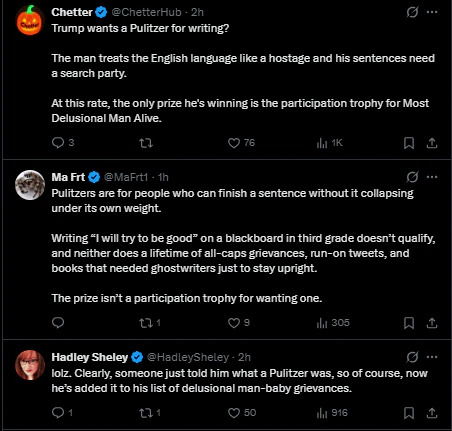
The comments reflected criticism and sarcasm directed at the president’s claim. However, social media reactions do not establish whether an individual meets the criteria for a literary or journalism award.
Trump’s remarks also drew attention because the Pulitzer Prizes are awarded through a formal selection process involving independent juries and the Pulitzer Board. The awards are not granted on the basis of a public figure’s request for recognition.
What did Trump say about Russia investigation reporting?
At the rally, Trump singled out journalists whose reporting on the Russia investigation had received Pulitzer recognition. He argued that their work was inaccurate and that they should not have won the awards.
The Russia investigation became a major subject of US political debate following the 2016 presidential election. Reporting on Russian interference, the investigation into possible links between Russia and Trump’s campaign, and the subsequent legal and political developments generated extensive coverage.
Trump repeatedly rejected the reporting and investigations associated with the issue. His latest remarks continued that criticism, with the president using the Pulitzer Prize as another point of contention with the media.
The awards themselves recognise specific journalistic work rather than endorsing every statement made by a news organisation or reporter. Disputes over individual stories, findings and interpretations are separate from the award process.
Trump did not identify a particular Pulitzer-winning article at the rally that he believed demonstrated the alleged inaccuracies. His comments were directed broadly at the reporting on Russia.
2026 Pulitzer winners recognised reporting on Trump administration
The 2026 Pulitzer Prizes included awards for journalism examining the Trump administration, federal policy changes and other major public issues.
The Washington Post was recognised for reporting on the administration’s overhaul of federal agencies. The coverage documented the human impact of cuts and their consequences for the country.
The Wall Street Journal received recognition for investigative reporting that helped prompt the release of millions of Justice Department files concerning Jeffrey Epstein’s network.
The Chicago Tribune was recognised for its coverage of the Trump administration’s immigration enforcement operation in Chicago. Its reporting examined the impact of the operation and how it brought residents together in resistance. The Pulitzer Board placed the award in the Local Reporting category.
These awards highlighted the role of investigative and local journalism in examining government decisions and their effects on communities.
The recognition of reporting on the Trump administration also provides context for the president’s criticism of the media. Trump has frequently attacked news organisations whose coverage challenges his claims or scrutinises his policies.
However, the fact that a publication receives a Pulitzer for a particular body of work does not mean that every article it publishes is necessarily beyond criticism. Individual claims can be assessed against evidence, and corrections or disputes can be considered separately.
Pulitzer Prize remains a recognition of journalistic achievement
The Pulitzer Prizes are among the most prominent honours in American journalism. They recognise work across categories including public service, investigative reporting, breaking news, local reporting, commentary and criticism, as well as selected forms of literature and music.
The awards are administered by Columbia University and decided through a process involving category juries and the Pulitzer Board. Winners are selected for particular works or bodies of work rather than simply for their public profile.
Trump’s statement that he deserved a Pulitzer for writing did not refer to a specific book, article or other published work submitted for consideration. Instead, he used the rally to criticise journalists whose reporting he disputes and to argue that they had received recognition they did not deserve.
His comments have added another episode to his public conflict with sections of the American media. They also illustrate how prestigious awards have become part of his wider complaints about how his presidency and political record are assessed.
For now, Trump’s claim has generated online mockery and renewed discussion of his relationship with journalists. The Pulitzer Prize, however, remains governed by its established selection process, and his remarks at the rally do not constitute an award nomination or decision.