







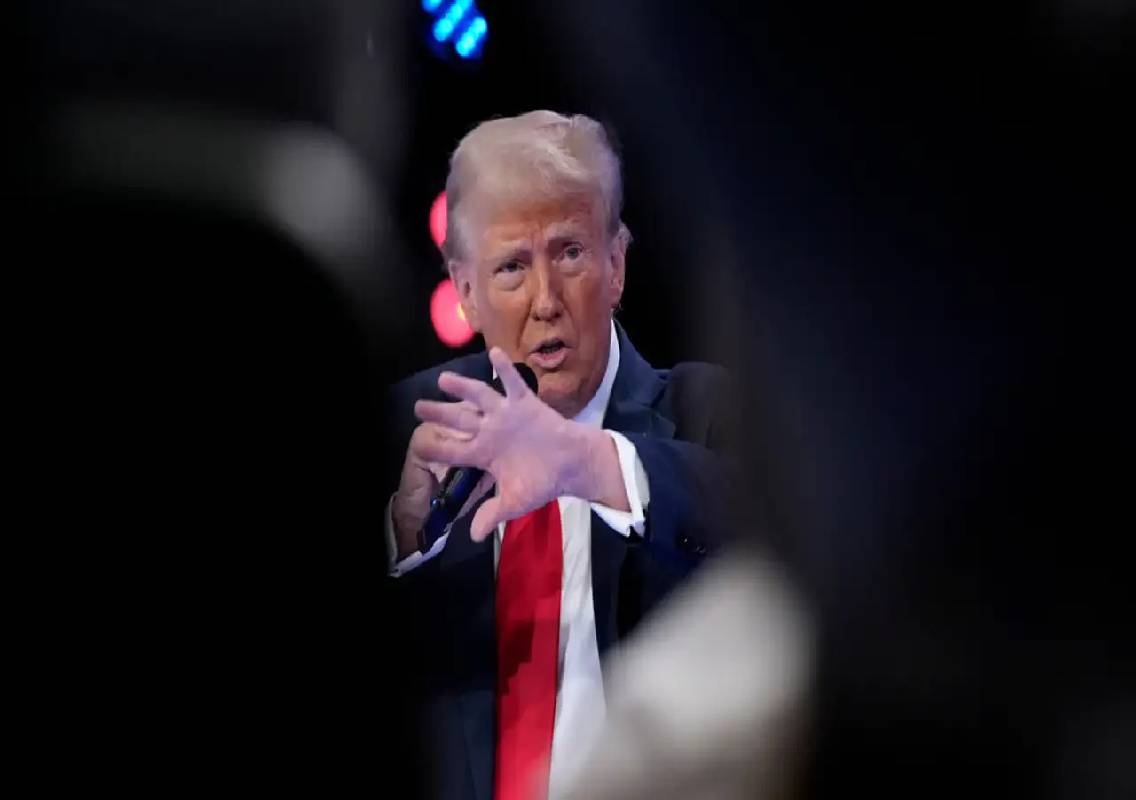


Washington, DC: US President Donald Trump has suggested that the United States could explore a model that gives ordinary Americans a stake in leading artificial intelligence companies, signalling a potentially significant shift in how the government approaches the rapidly expanding AI sector.
The proposal remains at a preliminary stage, with no formal policy framework announced. However, Trump’s remarks have sparked discussion about whether public participation in AI companies could become part of a broader strategy to balance innovation, national competitiveness and public benefit.
The comments come as the administration prepares for discussions with executives from some of the world’s most influential AI companies and continues to evaluate regulatory measures for the fast-growing industry.
Trump proposes a public partnership model
Speaking to reporters aboard Air Force One, Trump suggested that AI development could eventually involve a form of partnership with the American public.
According to reports, the US President said the concept was worth examining and described it as an idea with significant potential.
“There’s something very interesting about it, where it almost becomes a partnership with the American public,” Trump said while discussing the future of the AI industry.
Although the administration has not released specific details, the remarks indicate that officials are considering alternative approaches to ensuring that the benefits of AI growth are shared more broadly.
The idea could involve government participation, public investment mechanisms or other structures that would allow citizens to indirectly benefit from the success of AI companies.
Reports suggest discussions already underway
The comments follow reports that senior US officials have held preliminary discussions with artificial intelligence firms regarding potential government ownership stakes in selected companies.
While neither the White House nor the companies involved have publicly confirmed the details of such discussions, the reports have intensified debate about the future relationship between government and private technology firms.
Several major AI players, including OpenAI, Google, Anthropic, Meta and SpaceX, have not publicly commented on the reported conversations.
It also remains unclear whether the topic will feature prominently during upcoming meetings between administration officials and AI industry leaders.
What could a public stake in AI mean?
If implemented, the concept could take several forms.
One possibility is direct government investment in strategic AI firms, with returns ultimately benefiting taxpayers. Another option could involve the creation of a sovereign investment structure that acquires stakes in key technology companies on behalf of the public.
Some analysts have also suggested models similar to public wealth funds used in certain countries, where profits generated by strategic investments contribute to national development programmes.
Supporters argue that such an approach could ensure that the economic gains generated by AI are distributed more widely rather than being concentrated among a small number of corporations and investors.
Critics, however, may raise concerns about government involvement in private companies, market distortions and potential conflicts between regulation and ownership.
Balancing innovation and oversight
The Trump administration has faced increasing pressure to establish a regulatory framework for artificial intelligence while preserving America’s leadership position in the global technology race.
The challenge has become more complex as AI systems grow more powerful and influential across industries ranging from healthcare and education to finance and national security.
An earlier executive order focused on AI regulation was reportedly delayed amid concerns from technology companies about measures that could restrict innovation.
Trump has repeatedly emphasised the importance of ensuring that the United States remains ahead of competitors such as China in the development of advanced AI technologies.
The administration has therefore sought to strike a balance between oversight and encouraging technological progress.
Security concerns driving policy discussions
Concerns about cybersecurity and national security have also become central to the AI debate.
Recent advances in artificial intelligence have prompted warnings from security experts who fear that highly capable systems could be exploited for sophisticated cyberattacks.
Industries such as banking, financial services and critical infrastructure are viewed as particularly vulnerable because of their reliance on interconnected networks and legacy technology systems.
In response, the administration recently introduced a revised AI framework that encourages leading developers to voluntarily submit advanced models for government-led cybersecurity testing before public release.
Officials believe such measures could help identify risks before powerful AI systems become widely available.
Conclusion
Trump’s suggestion that Americans could receive a stake in leading AI companies represents an unconventional idea that could reshape discussions around technology, public ownership and economic participation. While no formal proposal has been announced, the remarks highlight the growing importance of artificial intelligence in government policy and the search for ways to ensure that the benefits of the AI revolution are shared more broadly. As Washington continues discussions with industry leaders, the concept is likely to remain a subject of intense debate among policymakers, businesses and the public.