







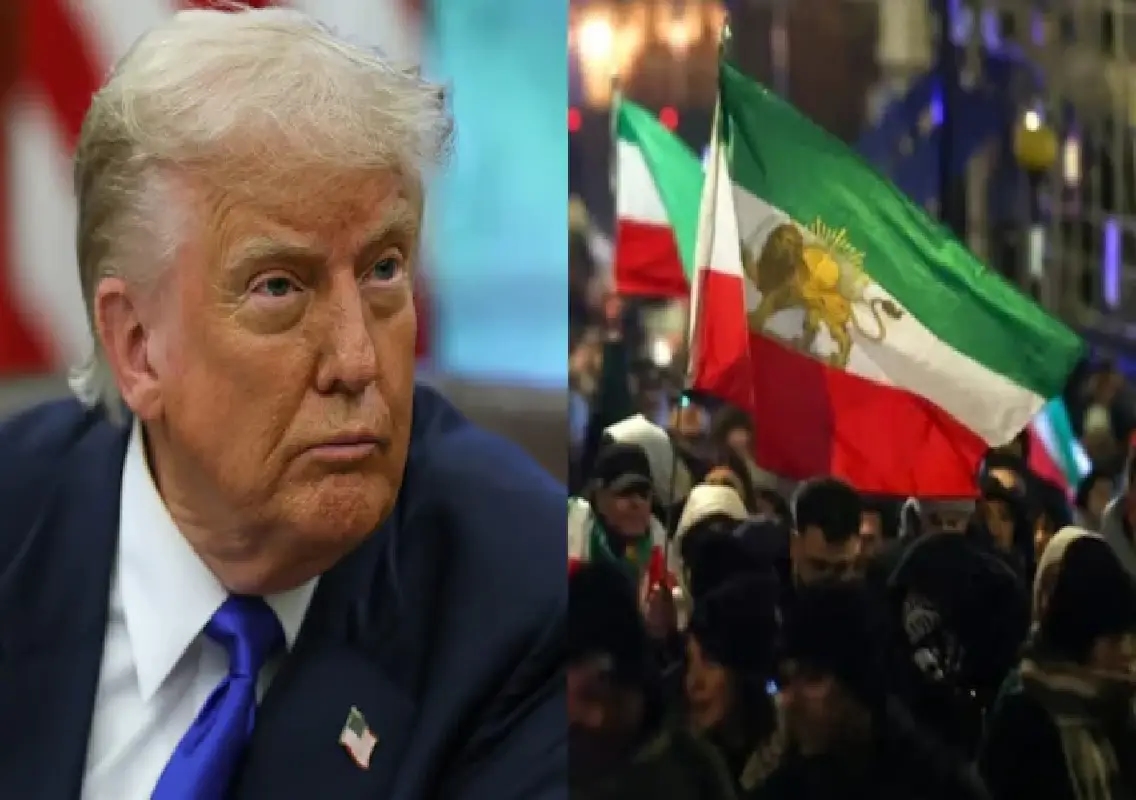


After days of threats, warnings and rising fears of escalation, US President Donald Trump said the killing of anti-government protesters in Iran has stopped, signalling a noticeably more cautious tone after a week of sharply escalating rhetoric that included hints of possible US military action. His remarks came amid international concern over reports of mass detentions, rising death tolls and the potential execution of detained protesters.
Speaking to reporters in Washington, Trump said he had received information indicating that both protest-related killings and planned executions in Iran had been halted. His comments followed growing alarm over the fate of 26-year-old Iranian protester Erfan Soltani, who was believed to be facing imminent execution after being detained less than a week earlier.
“But that’s just gotten to me, some information, that the killing has stopped,” Trump said. “That the executions have stopped and not going to have an execution, which a lot of people were talking about for the last couple of days.”
Concerns over detained protesters
The case of Erfan Soltani had drawn particular attention from rights groups and foreign governments, who warned that Iranian authorities were preparing to make an example of detained protesters through swift executions. Late on Wednesday, the Norway-based Hengaw Organisation for Human Rights reported that Soltani’s execution had been postponed, offering a measure of relief to activists who had feared the worst.
Human rights organisations say Soltani is one of thousands detained during the latest wave of protests sweeping Iran. According to rights groups, more than 18,000 people have been arrested across the country since demonstrations erupted, many of them young men and women accused of participating in anti-government rallies.
Trump cites unnamed sources
When asked who had informed him of the apparent halt in killings and executions, Trump declined to provide details, saying only that the information came from “very important sources on the other side”. He did not elaborate on whether the sources were official Iranian channels, intermediaries, or intelligence inputs.
Trump said his administration would now take a wait-and-see approach. “We are going to watch what the process is,” he said, adding that the White House had received what he described as a “very good statement” from Iran, without disclosing its contents.
Despite the softer tone, Trump stopped short of ruling out military action. His comments came as the US reportedly began withdrawing some personnel from an airbase in Qatar, a move seen as a precaution amid fears of a broader US–Iran confrontation.
Iran denies plans for executions
Iran’s Foreign Minister Abbas Araghchi sought to play down concerns over executions, denying that Tehran intended to carry out hangings in connection with the protests. Speaking in an interview with Fox News, Araghchi said such punishment was “out of the question”.
“There is no plan for hanging,” he said, adding that claims about imminent executions were exaggerated. Hanging has historically been one of the methods used for executions in Iran, particularly in politically sensitive cases, which has heightened fears among activists and observers.
Judiciary signals hardline stance
Despite the foreign minister’s remarks, Iran’s judiciary has sent mixed and, at times, alarming signals. According to an Associated Press report, senior judicial officials have spoken openly about fast-tracking trials for those arrested during the unrest.
Judiciary chief Gholamhossein Mohseni-Ejei was quoted as saying authorities must act swiftly against detainees. “If we want to do a job, we should do it now,” he said. “If it becomes late, two months, three months later, it doesn’t have the same effect.”
Such statements have fuelled fears that Iran could move quickly to impose harsh sentences, including the death penalty, to deter further protests.
Rising death toll and mass unrest
Iran has been gripped by widespread protests in recent weeks against the rule of Supreme Leader Ayatollah Ali Khamenei. The demonstrations have been driven by a mix of economic hardship, political repression, corruption allegations and deep public anger over governance.
According to the Human Rights Activists News Agency, more than 2,600 people have been killed in the crackdown so far. Other estimates place the death toll above 3,000, making it one of the deadliest episodes of unrest in Iran since the 1979 Islamic Revolution. Security forces have been accused of using live ammunition, mass arrests and heavy-handed tactics to suppress demonstrations.
US response and diplomatic pressure
Trump and senior US officials have repeatedly voiced support for the protesters. Earlier this week, Trump said he had cancelled all meetings with Iranian officials and warned Tehran to halt the violence immediately.
“I have cancelled all meetings with Iranian Officials until the senseless killing of protesters STOPS,” Trump wrote on Truth Social. “HELP IS ON ITS WAY.”
The White House has confirmed that military options were being considered if the violence continued, though press secretary Karoline Leavitt said diplomacy remained Trump’s preferred path. US officials have also been coordinating with allies in Europe and the Middle East to increase pressure on Tehran through diplomatic and economic means.
Conclusion
While Trump’s statement that killings and executions have stopped offers a glimmer of hope, the situation in Iran remains volatile and uncertain. Conflicting signals from Iranian officials, continued mass detentions and a soaring death toll underscore the fragility of the moment. As Washington adopts a cautious wait-and-watch approach, the coming days are likely to be critical in determining whether Iran de-escalates its crackdown or resumes harsher measures against protesters.