







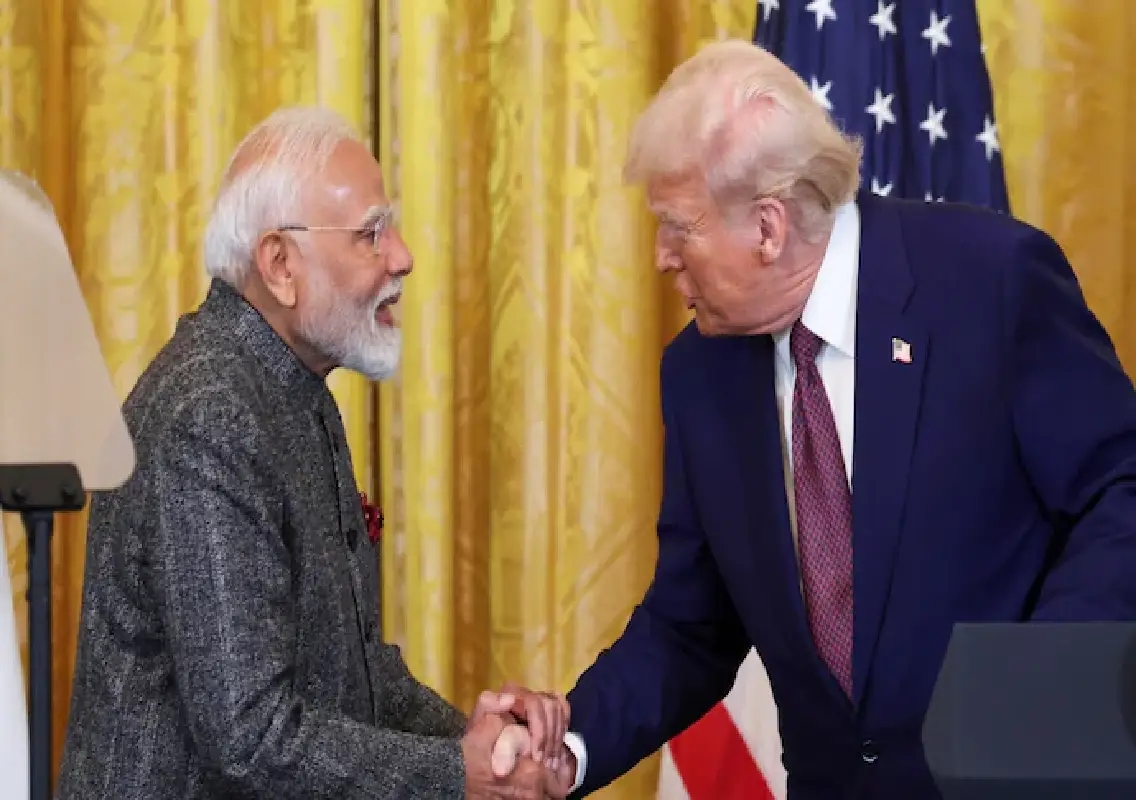


US President Donald Trump has claimed that Prime Minister Narendra Modi personally approached him to discuss India’s pending defence purchases and ongoing trade issues, including delays in the delivery of Apache attack helicopters. Speaking at the House GOP Member Retreat, Trump said the Indian Prime Minister sought a meeting with him and addressed concerns related to long-standing defence deals and tariffs.
Recalling the interaction, Trump said, “India ordered Apache helicopters and didn’t get them for five years. Prime Minister Modi came to see me. ‘Sir, may I see you please?’ Yes!” He added that he shares a strong personal rapport with the Indian leader, stating, “I have a very good relationship with him.”
Trump’s remarks have drawn attention as they touch upon sensitive areas of India–US relations, including defence cooperation, trade tariffs, and India’s energy purchases from Russia.
Defence procurement and Apache helicopter delay
Addressing defence ties between the two countries, Trump referred specifically to the delayed delivery of Apache helicopters ordered by India. According to him, India had been waiting for the helicopters for several years, which prompted Prime Minister Modi to raise the issue directly.
“We’re changing it. India ordered 68 Apaches,” Trump said, though he did not provide further details on timelines or the current status of the deliveries.
India and the United States have a long-standing defence partnership, with several major procurement deals signed over the past decade. Apache attack helicopters form a crucial part of India’s Army Aviation Corps and Air Force modernisation plans. Delays in delivery have been a point of concern for Indian defence planners, particularly amid evolving regional security challenges.
Trade tensions and tariffs
While highlighting his personal rapport with PM Modi, Trump also acknowledged that the Indian leader was unhappy with him over tariffs imposed by the United States. “He’s not that happy with me because, you know, they’re paying a lot of tariffs now,” Trump said.
He linked the tariff issue to India’s energy trade, particularly oil purchases. “Because they’re not doing the oil,” Trump remarked, before adding that India had significantly reduced its oil imports from Russia. “But they are, they’ve reduced it very substantially, as you know, from Russia,” he said.
Trump has repeatedly used tariffs as a central tool of his economic policy, arguing that they benefit the US economy. At the GOP retreat, he claimed that tariffs were generating massive revenues for the United States.
“We’re getting rich because of tariffs, by the way. Hope everyone understands,” Trump said. He further claimed that the US would see over 650 billion dollars being invested or flowing into the country as a result of tariff measures.
Pressure over Russian oil purchases
India’s continued purchase of Russian oil has been a key point of friction in its trade relations with the United States. Trump has openly linked tariffs on Indian goods to New Delhi’s energy dealings with Moscow.
Earlier this week, speaking to reporters aboard Air Force One, Trump reiterated that higher tariffs on India remain an option. “We could raise tariffs on India if they don’t help on the Russian oil issue,” he said.
Trump has already imposed a 50 per cent tariff on Indian goods, which includes a 25 per cent levy specifically linked to India’s purchase of Russian oil. These measures form part of Washington’s broader pressure campaign aimed at discouraging countries from maintaining economic and energy ties with Russia.
Mixed tone towards PM Modi
Despite the tough stance on tariffs, Trump struck a conciliatory tone when speaking about Prime Minister Modi. He described the Indian leader as a “very good man” and praised his efforts to maintain strong bilateral ties.
“PM Modi’s a very good man. He’s a good guy. He knew I was not happy. It was important to make me happy,” Trump said. He added that while India engages in trade with the US, Washington retains the ability to quickly raise tariffs if needed.
These remarks underline the complex and often transactional nature of India–US relations under Trump, where personal diplomacy coexists with hard bargaining on trade and strategic issues.
Broader implications for India–US ties
Analysts say Trump’s comments highlight both the strengths and strains in the India–US partnership. On one hand, close personal engagement between leaders has helped advance defence cooperation and strategic alignment. On the other, trade disputes and differing positions on global issues such as Russia continue to create friction.
India has maintained that its energy purchases are guided by national interest and affordability, while also stressing its strategic partnership with the United States. New Delhi has not officially responded to Trump’s latest remarks.
Conclusion
Trump’s claims about Prime Minister Modi personally raising defence and trade issues underscore the high-level engagement between India and the United States, even amid disagreements. While the two leaders appear to share a strong personal rapport, unresolved issues related to defence deliveries, tariffs, and energy trade continue to test the relationship. How these matters are addressed in the coming months will be crucial in shaping the future trajectory of India–US ties.