







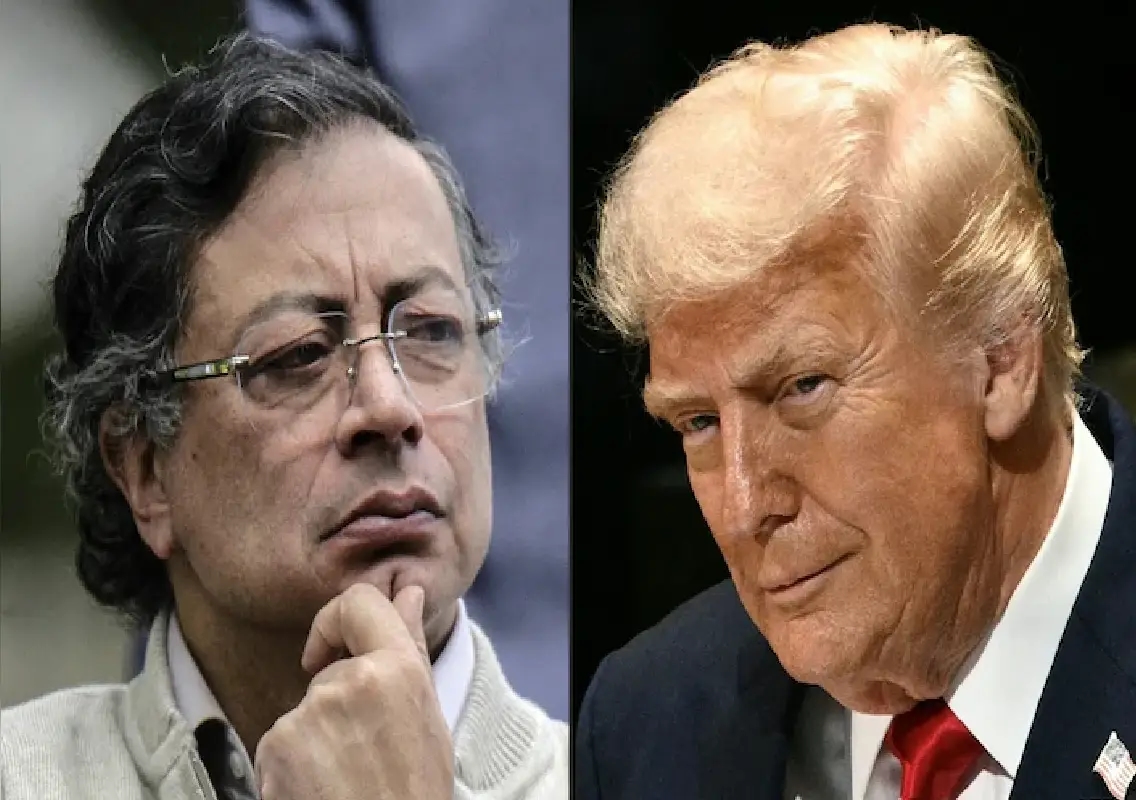


Tensions in Latin America escalated sharply after US President Donald Trump issued a blunt warning to Colombian President Gustavo Petro, telling him to “watch his a**”, even as deposed Venezuelan leader Nicolas Maduro was transferred to a high-security prison in New York following a dramatic American military operation in Caracas.
The warning came amid growing regional unease over Operation Absolute Resolve, the US-led military action that resulted in the capture of Maduro and his wife, Cilia Flores, and effectively ended more than a decade of his rule in Venezuela. Washington has described the operation as necessary to counter narcotics trafficking and restore stability, while several Latin American leaders have condemned it as a violation of sovereignty.
Trump’s warning to Colombia
Speaking to reporters, President Trump accused Colombia of being a major source of illegal drugs entering the United States and directly linked the issue to President Petro’s leadership.
“He’s making cocaine and they’re sending it into the United States, so he does have to watch his a**,” Trump said, without elaborating on specific actions Colombia had taken.
The remarks marked a significant deterioration in relations between Washington and Bogotá, traditionally one of the US’s closest allies in South America. Petro, a former guerrilla and Colombia’s first left-wing president, has repeatedly criticised US military strategies in the region, particularly those tied to counter-narcotics operations.
Petro condemns US action in Venezuela
Without naming Maduro directly, Petro strongly criticised the US intervention in Venezuela, calling it an “assault on the sovereignty” of Latin America. He warned that the military takeover would trigger a humanitarian crisis and further destabilise an already fragile region.
Petro has been one of the most vocal critics of Trump’s renewed military posture in the Caribbean, especially naval deployments aimed at intercepting vessels suspected of drug trafficking. As part of his aggressive anti-drug agenda, Trump has recently stated that he would not rule out airstrikes on drug-production laboratories inside Colombia — a suggestion Petro has condemned as an implicit threat of invasion.
US to ‘run’ Venezuela temporarily
Hours after Maduro and Cilia Flores were extracted from Caracas and flown to the United States, President Trump announced that Washington would temporarily assume control of Venezuela’s administration.
“We’re going to run the country until such time as we can do a safe, proper and judicious transition,” Trump said, adding that the US was prepared to launch a second, much larger military operation if required.
He reiterated that American forces remained on high alert in the region, signalling that Washington was willing to escalate further should its demands not be met.
Oil, sanctions and military pressure
Trump outlined an ambitious — and controversial — economic vision for Venezuela’s future under US oversight. He said American oil majors would be sent into the country to revive its crumbling energy sector.
“We’re going to have our very large United States oil companies, the biggest anywhere in the world, go in, spend billions of dollars, fix the badly broken infrastructure, the oil infrastructure, and start making money for the country,” he said.
At the same time, Trump made it clear that sanctions would remain firmly in place. “The embargo on all Venezuelan oil remains in full effect. The American armada remains poised in position, and the United States retains all military options until United States demands have been fully met and fully satisfied,” he added.
Venezuela possesses the world’s largest proven oil reserves, a factor that has long made it strategically important to Washington.
Views on Venezuelan leadership
Trump expressed confidence in Venezuelan Vice President Delcy Rodríguez, suggesting she would cooperate with US plans to stabilise and rebuild the country. However, he cast doubt on the domestic support enjoyed by opposition leader Maria Corina Machado.
“I think it would be very tough for her to be the leader. She doesn’t have the support within or the respect within the country. She’s a very nice woman, but she doesn’t have the respect,” Trump said.
His remarks appeared to undercut international expectations that Machado might quickly emerge as Venezuela’s new leader following Maduro’s removal.
Signals to Mexico and Cuba
The Trump administration also sent clear signals to other governments in the region. US Secretary of State Marco Rubio hinted that Cuba could be the next focus of Washington’s attention.
“If I lived in Havana and I was in the government, I’d be concerned at least a little bit,” Rubio said, referencing his long-standing hardline stance against Havana.
Trump himself turned his attention to Mexico, saying that “something will have to be done” about the country’s powerful drug cartels. While describing Mexican President Claudia Sheinbaum as “a good woman”, he claimed she was not truly in control.
“The cartels are running Mexico. She’s not running Mexico,” Trump said, adding that he had repeatedly offered US assistance to “take out the cartels”, proposals that Sheinbaum has rejected.
Conclusion
The capture of Nicolas Maduro and the sharp rhetoric directed at Colombia, Mexico and Cuba underscore a dramatic shift in US policy towards Latin America under President Trump’s leadership. While Washington frames its actions as necessary to combat drug trafficking and restore regional stability, critics warn that the approach risks igniting humanitarian crises, undermining sovereignty and plunging the hemisphere into prolonged instability. As the United States tightens its grip on Venezuela, the broader consequences for Latin America — and global geopolitics — remain uncertain.