







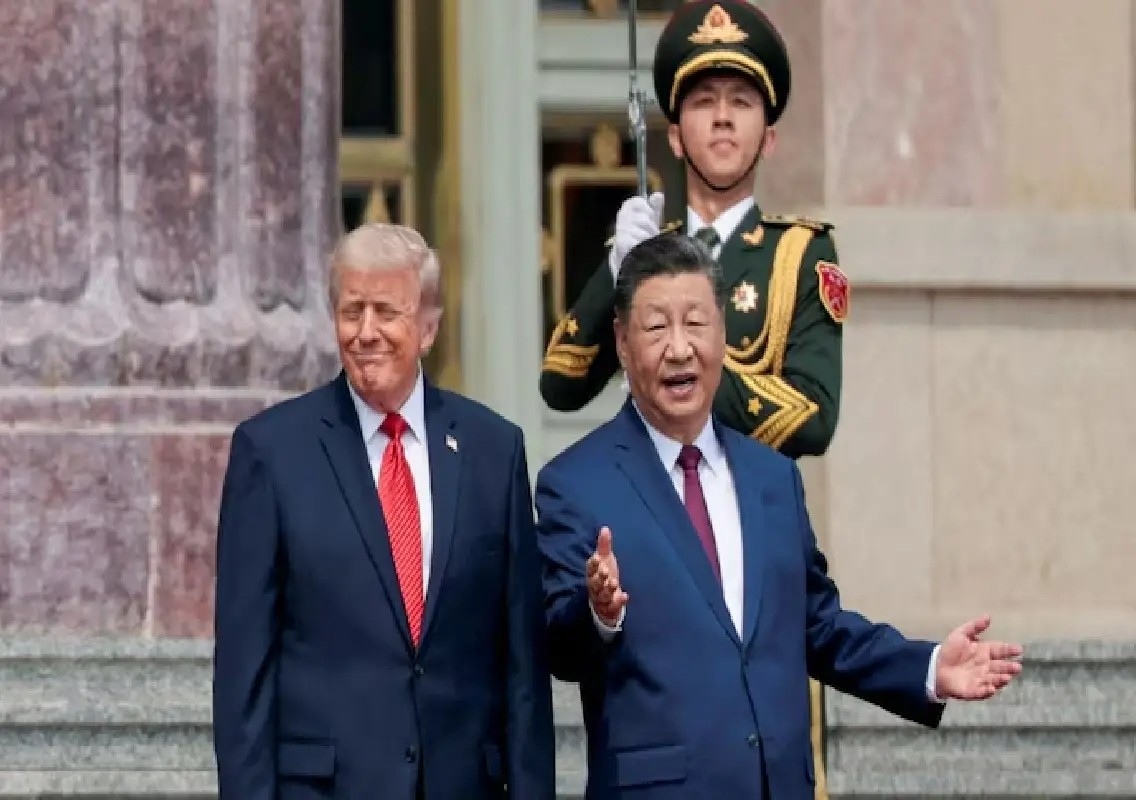


Beijing/Washington: The visit of US President Donald Trump to China for a high-stakes summit with Chinese President Xi Jinping has drawn global attention amid rising geopolitical tensions, the ongoing Iran conflict and intensifying strategic competition between the world’s two largest economies.
While trade, tariffs and global supply chains dominated formal discussions, analysts said the optics and messaging surrounding the summit reflected a broader shift in global power dynamics, with Beijing increasingly projecting itself as an equal power centre alongside Washington.
China rolls out grand welcome for Trump
China organised an elaborate ceremonial reception for Donald Trump, complete with military pageantry, a 21-gun salute and a tightly choreographed welcome at Tiananmen Square.
Chinese state media extensively covered the visit, highlighting the arrival of a powerful American business delegation that reportedly included major technology and corporate figures such as Elon Musk, Tim Cook and Jensen Huang.
Political observers noted that the scale of the welcome appeared designed to project confidence and reinforce Beijing’s message that China no longer sees itself merely as a competitor to the United States but as a parallel global power.
Ahead of Trump’s arrival, Chinese state-run newspaper China Daily published editorials stressing “equality”, “mutual respect” and “win-win cooperation” in bilateral ties.
Chinese Foreign Ministry spokesperson Guo Jiakun stated that China was ready to work with the United States in a spirit of equality, respect and mutual benefit.
Summit focused on trade, Taiwan and Iran
Discussions between Trump and Xi Jinping reportedly covered several sensitive global issues including tariffs, artificial intelligence, Taiwan, supply chains and the Iran conflict.
Xi reportedly warned that mishandling the Taiwan issue could trigger major confrontation, while Trump pushed for improved market access for American companies operating in China.
The US side also sought Chinese cooperation regarding Middle East stability and energy security as tensions linked to Iran continue to affect global oil markets.
Despite longstanding strategic rivalry between the two countries, both leaders publicly projected a cooperative tone and signalled willingness to stabilise bilateral relations after years of tariff disputes and geopolitical friction.
Iran war adding pressure on US economy
The summit comes at a time when the ongoing conflict involving Iran is placing increasing economic and political pressure on the United States.
Reports citing Pentagon assessments indicate that the US has spent nearly $29 billion on operations linked to the Iran conflict so far.
Rising fuel prices and prolonged military involvement have reportedly affected domestic public opinion and added strain to the US economy.
Meanwhile, American intelligence assessments reportedly suggest that China is quietly leveraging the situation to expand its influence diplomatically, economically and strategically while the United States remains occupied with Middle East tensions.
According to reports, a confidential US intelligence review analysed China’s growing influence through the DIME framework covering diplomatic, informational, military and economic dimensions.
China increasingly asserting itself globally
Analysts believe China’s growing confidence was visible during both the summit and official messaging around it.
Observers recalled the 2021 Alaska meeting between the US and China, where senior Chinese diplomat Yang Jiechi publicly challenged the United States and rejected Washington’s “position of strength” approach.
That confrontation was widely viewed as a symbolic turning point in China’s diplomatic posture, signalling Beijing’s increasing willingness to openly challenge American dominance.
Chinese state media portrayed the current summit in similar terms, emphasising that the world order was no longer unipolar and that China expected to be treated as an equal global power.
US and China competing across sectors
The rivalry between the United States and China now extends across trade, military power, technology, artificial intelligence, energy and strategic resources.
According to global economic estimates, China has overtaken the United States in exports, with Chinese exports reaching approximately $3.59 trillion in 2024 compared to America’s $1.9 trillion.
However, the United States continues to dominate in military spending, advanced semiconductor technologies and global financial influence.
China, meanwhile, has rapidly expanded its position in manufacturing, electric vehicles, renewable energy investments and rare earth mineral processing.
The country reportedly controls a major share of global rare earth refining capacity, giving Beijing strategic leverage in sectors linked to semiconductors, electric vehicles and defence technology.
Different models shaping global order
Experts say the competition between the two nations now represents a clash between two different economic and geopolitical systems.
China continues to rely heavily on state-led industrial policy, infrastructure spending and export-driven growth, while the United States has increasingly focused on protectionist trade measures, technological dominance and supply chain diversification.
Despite deep tensions, both countries remain economically interconnected, making outright confrontation difficult while ensuring continued strategic rivalry.
Political analysts believe the Trump-Xi summit demonstrated that the relationship between the two powers has entered a new phase where competition and cooperation coexist simultaneously.
Global balance of power evolving
The summit has reinforced growing international recognition that global power dynamics are shifting towards a more multipolar order.
While the United States still retains significant military and financial superiority, China’s rise in trade, manufacturing, energy and strategic technologies has narrowed the gap considerably.
Observers said Beijing’s carefully staged welcome for Trump symbolised China’s effort to present itself not as a subordinate power but as an equal stakeholder shaping the future global order.