







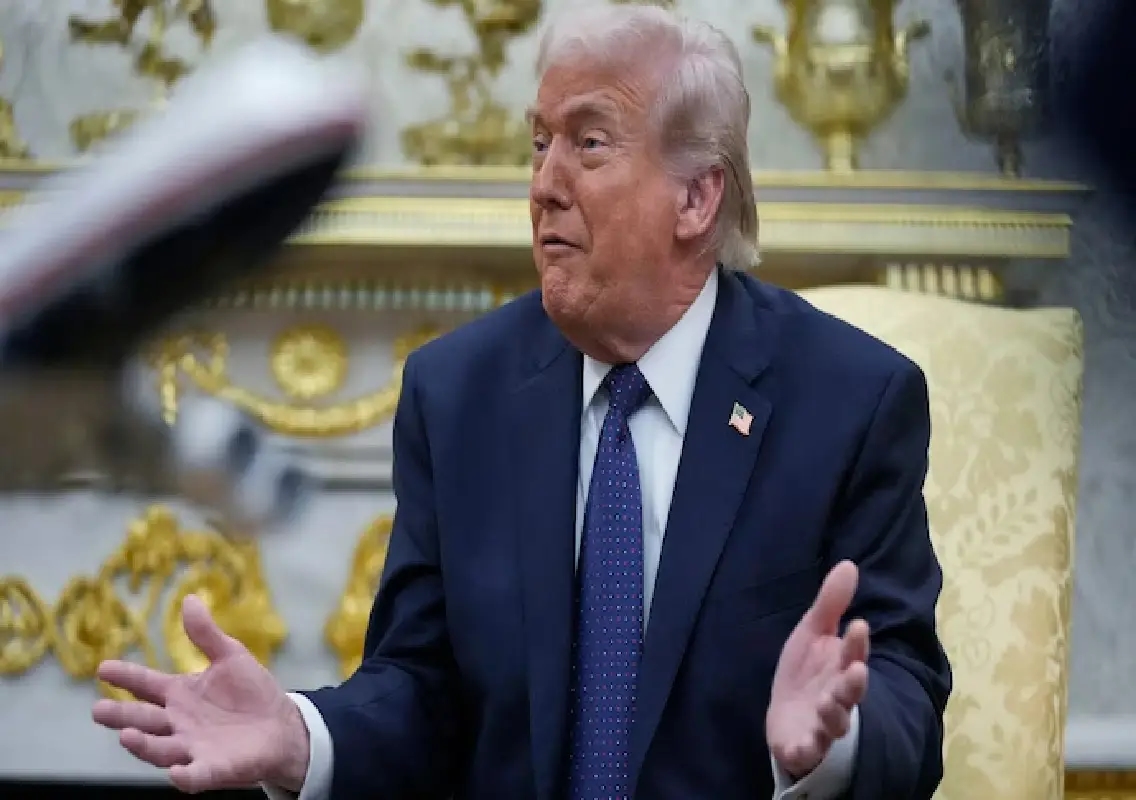


US President Donald Trump is facing mounting scrutiny over a series of contradictory statements regarding the ongoing conflict with Iran, ranging from war objectives and weapons stockpiles to regime change and intelligence assessments.
Since US and Israeli forces launched strikes on Iran on February 28, Trump’s public remarks have frequently shifted in tone and substance. Critics argue that the inconsistencies have created confusion over Washington’s strategic goals and raised concerns about clarity within the US administration.
Contradictions over US weapons stockpiles
One of the latest flashpoints relates to Trump’s statements on American military supplies. On Tuesday, Trump asserted that the US possessed an “unlimited supply” of munitions and could continue military operations “forever” if necessary.
However, within hours, he stated that US defence companies were operating under emergency directives to ramp up production of weapons. The juxtaposition of these claims — unlimited supply versus urgent expansion of output — has drawn attention.
Foreign media reports and remarks from US senators have suggested that interceptor missile stockpiles, used to counter incoming threats, may be under strain amid sustained Iranian missile barrages. Iran’s arsenal of ballistic missiles and drones, developed over years with reported foreign assistance, continues to be deployed against regional targets.
Trump has also claimed that Iran is “running out of launchers,” even as Tehran has maintained missile operations across the Gulf region.
Claims about Iranian leadership
Trump further stated that US strikes had eliminated key figures within Iran’s leadership structure, claiming that 48 senior leaders were killed, significantly weakening the regime’s succession plans.
Yet developments within Iran appear to contradict the notion of a leadership vacuum. On Wednesday, Iran’s Assembly of Experts selected Mojtaba Khamenei, son of Ali Khamenei, as the country’s new Supreme Leader.
Despite reported losses, Iran has continued missile strikes targeting US military assets in Bahrain, Iraq, the UAE, Qatar and Kuwait. Analysts note that the sustained operational capability suggests that Tehran’s command structure remains functional.
Journalist Mehdi Hasan, speaking to Indian media, questioned the coherence of US messaging, highlighting Trump’s own remarks that potential successors had been killed in earlier strikes.
Nuclear programme narrative questioned
Another area of inconsistency concerns the Iranian nuclear threat. In June last year, following a brief 12-day conflict, Trump claimed that US strikes had “obliterated” Iran’s nuclear programme.
However, on March 2, Trump stated that a key objective of the renewed campaign was to destroy Iran’s nuclear capabilities and end its nuclear ambitions. Observers have pointed out the apparent contradiction between declaring a programme destroyed and later citing it as a continuing threat.
The lack of clarity has fuelled debate among policymakers and international observers over the actual status of Iran’s nuclear infrastructure.
Disagreement with US officials
Further confusion arose from differing accounts within the US leadership. Trump stated that he authorised US involvement because Iran was preparing to strike first.
In contrast, Marco Rubio reportedly told reporters that imminent Israeli action prompted US engagement to deter retaliatory attacks on American forces. Additionally, Pentagon briefings to Congress indicated there was no intelligence suggesting Iran was about to attack US forces pre-emptively.
The divergent explanations have intensified debate over the justification for US intervention.
Regime change and war timeline
Trump’s position on regime change has also appeared to evolve. Immediately after the first wave of strikes, he publicly encouraged the Iranian people to “take over” their government, signalling support for regime change.
Subsequently, Pete Hegseth stated that the conflict was “not a so-called regime change war,” even as he argued that the world was better off following leadership changes in Iran.
The timeframe of the conflict has likewise shifted in Trump’s public remarks — initially projected at two to three days, then a week, later four to five weeks, and most recently described without a defined endpoint.
“We haven’t even started hitting them hard. The big wave hasn’t even happened,” Trump said in a recent interview, suggesting further escalation could be forthcoming.
Public opinion and strategic clarity
Amid the mixed messaging, public support appears divided. A Reuters survey indicated that only one in four Americans backed the strikes on Iran, reflecting uncertainty among voters about the war’s objectives and potential consequences.
As the conflict continues, questions persist over the coherence of US strategy, the accuracy of intelligence assessments and the long-term implications for regional stability. For now, Trump’s shifting statements remain a focal point of domestic and international debate, underscoring the need for greater clarity at a time of heightened geopolitical tension.