







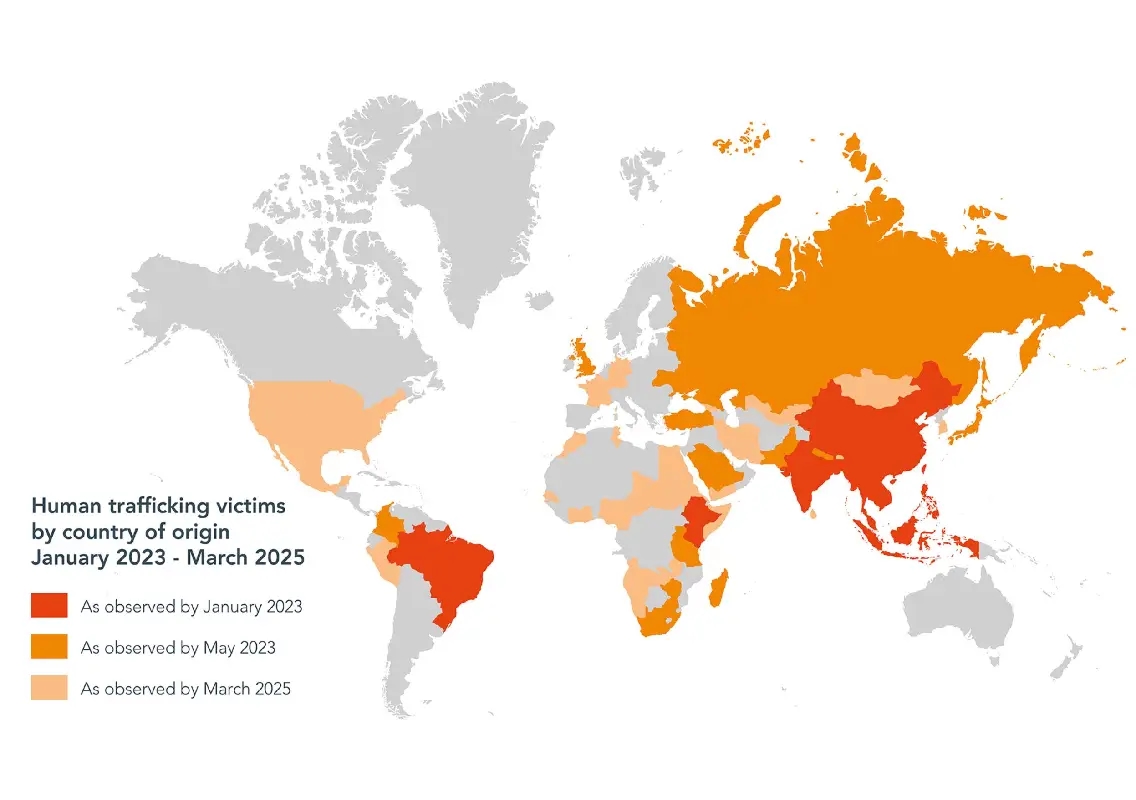


A damning new report by the Office of the United Nations High Commissioner for Human Rights (OHCHR) has exposed what it describes as a “litany of abuse” inside a rapidly expanding global online scam industry worth an estimated $64 billion annually.
The report, titled A wicked problem, documents how hundreds of thousands of people from at least 66 countries were trafficked into scam compounds, primarily across Southeast Asia’s Mekong region.
Industrial-scale exploitation
According to OHCHR, credible estimates suggest at least 300,000 people are currently forced to work in scam centres in the region. Satellite imagery indicates that 74% of scam compounds are located in the Mekong area.
Victims were lured abroad with promises of legitimate jobs, only to have passports confiscated and be detained in heavily guarded compounds surrounded by barbed wire. Survivors described the sites as “prisons” resembling self-contained towns with casinos, supermarkets and brothels.
UN High Commissioner for Human Rights Volker Türk called the scale of abuse “staggering and heart-breaking”.
Torture, sexual violence and forced crime
Victims reported being forced to conduct cryptocurrency scams, romance fraud and impersonation schemes under threat of torture. Those failing to meet daily or monthly quotas were beaten, electrocuted, confined in dark rooms or immersed in “water prisons”.
Women described rape, forced prostitution and forced abortions. Male victims also reported sexual humiliation and assault. Some families were coerced into paying large ransoms after being shown video evidence of abuse.
Many survivors worked up to 19 hours a day, often without adequate food or rest.
Calls for urgent reform
The report urges governments to embed the “non-punishment principle” in law, ensuring trafficking victims are not prosecuted for crimes they were forced to commit. It also calls for stronger cross-border cooperation, tighter oversight of recruitment agencies and crackdowns on corruption.
Without coordinated, rights-based action, OHCHR warns the convergence of cybercrime, corruption and human trafficking will continue to expand globally.