







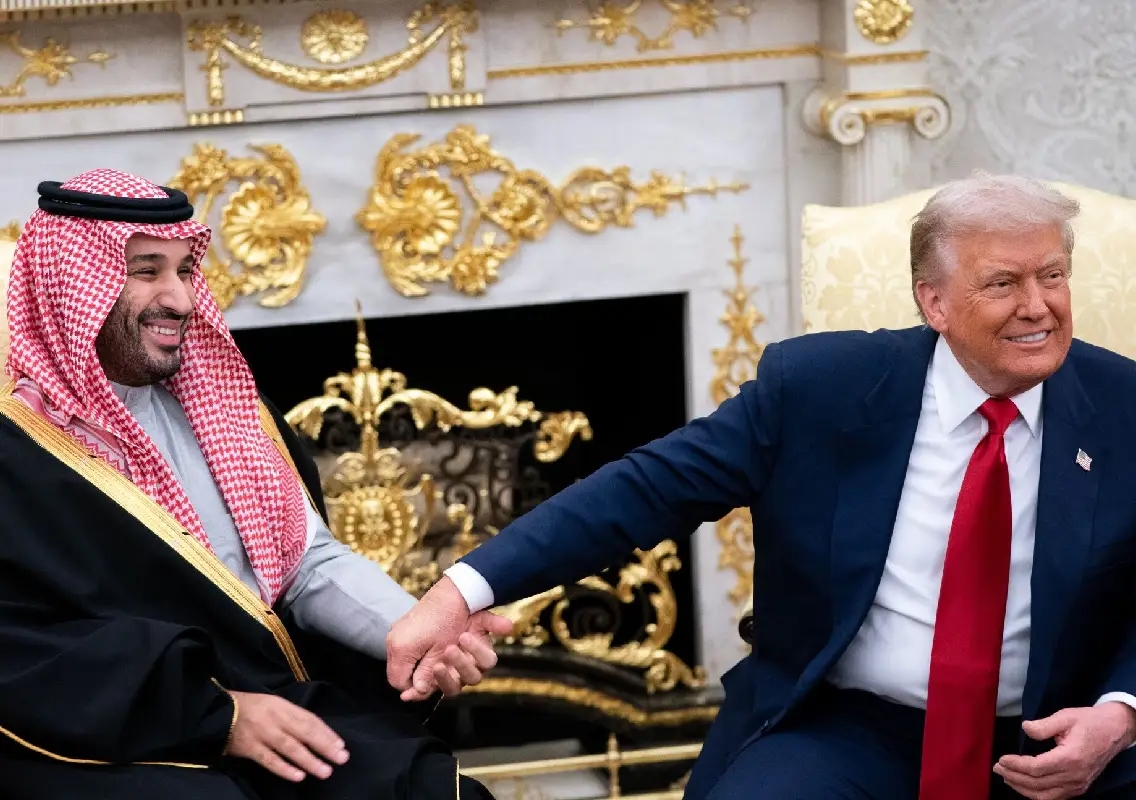


In a high-profile White House dinner that merged geopolitics with celebrity glamour, President Donald Trump formally designated Saudi Arabia as a Major non-NATO Ally (MNNA) on Tuesday night. The move came after Crown Prince Mohammed bin Salman committed to a nearly $1 trillion investment in the United States—an unprecedented figure that cements a renewed strategic alignment between Washington and Riyadh.
The event drew global attention not only for the policy shift but also for the star-studded guest list: Elon Musk, Cristiano Ronaldo, Nvidia’s Jensen Huang, and OpenAI’s Greg Brockman were among the roughly 140 high-profile attendees.
A major strategic reset in West Asia
The MNNA designation brings Saudi Arabia on par with Israel in terms of military and economic privileges. While 20 countries—including Pakistan, Kenya, Tunisia, and Brazil—already hold MNNA status, Riyadh’s inclusion marks a transformational recalibration of American engagement in West Asia.
President Trump hailed the announcement as a “leap forward” for bilateral defense ties. The status opens doors for advanced military sales such as the F-35, and collaboration across civil nuclear technology, critical minerals, and artificial intelligence.
A White House fact sheet framed the agreements as part of an “America First” strategy expected to bolster US coffers, expand defense-sector opportunities, and galvanise the American economy.
High-powered guest list underscores tech-finance push
The East Room dinner resembled a summit of business titans. Among the attendees were Apple CEO Tim Cook, IBM CEO Arvind Krishna, Coinbase CEO Brian Armstrong, Dell CEO Michael Dell, Citigroup CEO Jane Fraser, Pershing Square’s Bill Ackman, and Blackstone CEO Stephen Schwarzman.
The presence of technology and finance leaders highlighted the administration’s push to align national security policy with economic and technological partnerships.
Saudi Arabia’s changing image in Washington
The agreements also mark a remarkable turnaround for a nation long viewed with scepticism in Washington due to the involvement of Saudi nationals in the 9/11 attacks and concerns over the kingdom’s conservative social framework. Analysts note that Crown Prince Mohammed bin Salman has spent years attempting to reshape this image through reforms and strategic investments.
The new defence agreement reportedly secures significant burden-sharing funds from Saudi Arabia—offsetting America’s security costs—and simplifies pathways for US defence firms to operate inside the kingdom.
Prince Salman’s unusual appearance and Trump’s protocol breach
Dressed in the traditional dishdasha and ghutra/egal, the Crown Prince lightheartedly quipped that bettors expecting him in a black suit had backed the wrong option. President Trump, in a characteristically genial but protocol-defying manner, touched the Prince repeatedly, including a widely circulated light slap on the knee—moments that quickly went viral.
Prince Salman reaffirmed a staggering $1 trillion investment pledge, though experts noted that the funds would be deployed over several years.
Questions over scale of investment
Sceptics pointed out that Saudi Arabia’s GDP is roughly $1.1 trillion, raising doubts about the feasibility of such an enormous commitment. However, supporters noted the deep pockets of the Saudi Public Investment Fund (PIF), one of the world’s largest sovereign wealth funds with assets exceeding $1 trillion.
The new pledge marks a steep jump from the $600 billion commitment announced earlier this year. Analysts believe this could constrain Riyadh’s existing global investment promises, including in India, where the PIF recently increased its planned investment from $10 billion to $100 billion.
Global geopolitical implications
The US-Saudi strategic embrace is expected to generate ripple effects across Asia and beyond. India and China—both of which have strengthened ties with Gulf monarchies—may now see their regional calculus shift.
China, in particular, has invested heavily in the Gulf as part of its Belt and Road Initiative. Washington’s renewed closeness with Riyadh could dilute Beijing’s influence in a region that has been vital to its trade, energy, and infrastructure ambitions.
The fact sheet also mentioned enhanced cooperation with Pakistan, a move that analysts say strengthens the US’s broader regional strategy.
Conclusion
The designation of Saudi Arabia as a Major non-NATO Ally is far more than a symbolic gesture. It represents a sweeping strategic reset, intertwining defence, economics, and global power politics. While questions remain about the scale and pace of Saudi investments, the shift marks a new era in US-Saudi cooperation—one that will resonate across geopolitical theatres from West Asia to South Asia and beyond.