







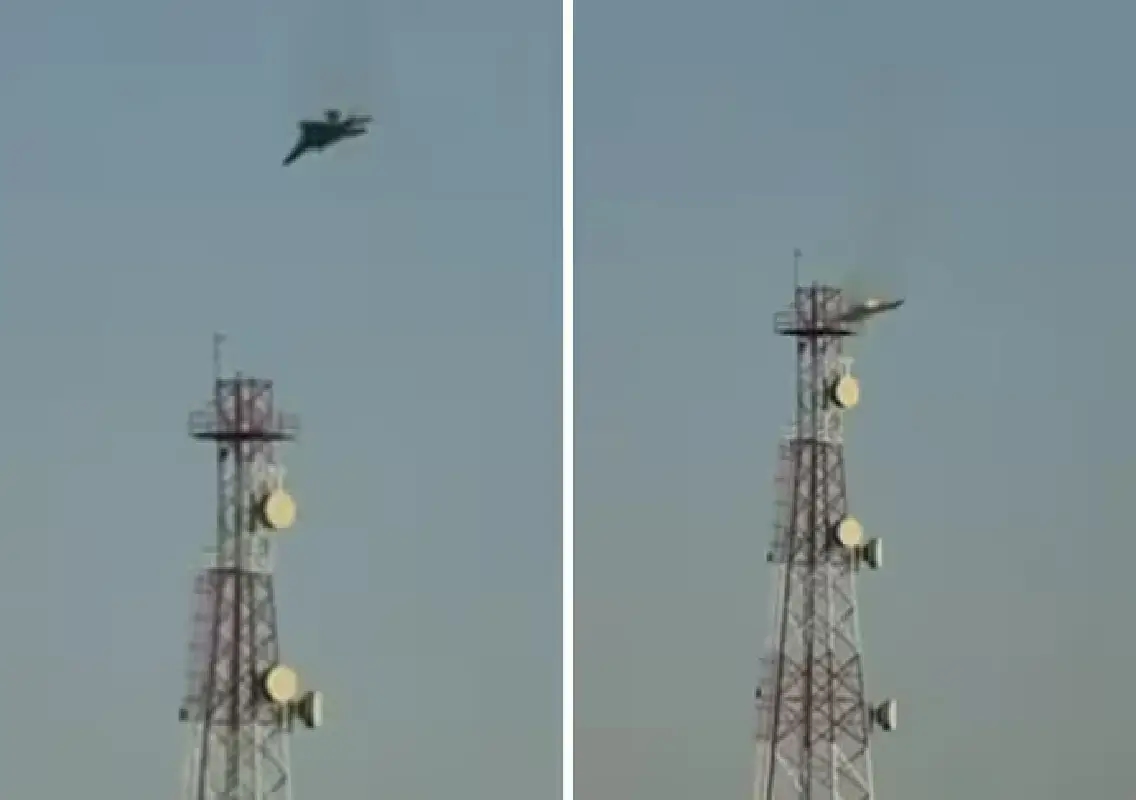


Kuwait City: Three American fighter jets participating in ongoing operations against Iran were mistakenly shot down by Kuwaiti air defence systems on Monday morning in what the Pentagon described as an “apparent friendly fire incident.” All six crew members aboard the three F-15 Strike Eagle aircraft ejected safely and are reported to be in stable condition, according to United States Central Command (CENTCOM), which is overseeing the anti-Iran operations.
The incident occurred on Day 3 of intensified US and Israeli military action against Iran, a confrontation that has rapidly expanded into a region-wide conflict across West Asia.
Video shows jet plunging from sky
Confirmation from CENTCOM came hours after dramatic footage circulated online showing at least one fighter jet engulfed in flames before spiralling downward. In the video, a pilot can be seen ejecting moments before the aircraft descends rapidly.
The crash site has been geolocated by international media outlets to an area within approximately 10 kilometres of Ali Al Salem Air Base, a key American military installation in Kuwait.
While US officials did not specify which air defence system was responsible, defence analysts believe it was likely the MIM-104 Patriot missile battery, which is operated by the United States and allied nations including Kuwait. The Patriot system relies on advanced radar tracking and encrypted identification systems to distinguish between friendly and hostile aircraft.
Friendly fire incidents, though rare, are not unprecedented during high-intensity military engagements when airspace is congested and defence systems operate under maximum alert.
Debris falls inside refinery
Kuwaiti authorities confirmed that debris from one of the downed aircraft fell within the premises of the Mina Al Ahmadi refinery, operated by Kuwait Integrated Petroleum Industries Company (KIPIC). Two refinery workers sustained injuries and were treated at a nearby hospital. Emergency response teams were deployed immediately to secure the site and assess potential damage.
Officials stated that refinery operations were not significantly disrupted, though heightened security protocols remain in place.
The Pentagon said a joint US-Kuwaiti investigation has been launched to determine the precise sequence of events that led to the misidentification and missile engagement.
Echoes of past incidents
Military analysts noted similarities to past friendly fire tragedies, including India’s 2019 incident following the Balakot airstrike, when an Indian Air Force Mi-17 helicopter was mistakenly shot down by its own air defence unit over Jammu and Kashmir, resulting in the deaths of six personnel.
Such incidents often occur during periods of extreme operational pressure, when radar signatures, transponder signals or communication links may be compromised or misread.
Conflict spreads across region
The jet crashes came amid a sharp escalation in hostilities across the Middle East. Israel launched fresh air strikes targeting Tehran on Monday, while expanding military operations against Iran-backed Hezbollah militants in Lebanon. Explosions were reported in southern suburbs of Beirut controlled by Hezbollah.
Air raid sirens sounded across Israeli cities including Tel Aviv and Jerusalem after Iran’s state media announced a new wave of missile launches from central Iran toward what it described as “enemy locations”.
Kuwait said its air defences intercepted multiple hostile drones for a third consecutive day amid retaliatory attacks targeting Gulf states. Britain also reported a suspected drone strike overnight at its RAF Akrotiri base in Cyprus, which caused limited structural damage but no casualties.
Operation to continue
A senior White House official said the ongoing US–Israeli military campaign, dubbed “Operation Epic Fury”, could continue for several weeks. President Donald Trump indicated that while Washington may eventually consider engagement with potential new Iranian leadership, military operations would proceed for now.
Iranian President Masoud Pezeshkian confirmed that a temporary leadership council has assumed the duties of Supreme Leader following the reported death of Ali Khamenei in earlier strikes.
Senior Iranian officials have signalled that negotiations with Washington are unlikely in the immediate term.
First US casualties and global disruption
The United States also confirmed its first casualties of the campaign, with three American service personnel killed at a military base in Kuwait. Iran’s Revolutionary Guards claimed responsibility for targeting military installations and oil tankers in the Gulf region.
The conflict has severely disrupted global aviation networks, with major Middle Eastern airports temporarily shutting down and international air routes diverted. Oil prices surged sharply in early trading amid fears of prolonged instability in and around the Strait of Hormuz, through which a significant portion of the world’s crude oil supplies transit.
With both sides intensifying operations and regional actors increasingly drawn into the confrontation, concerns are mounting over a prolonged and wider conflict that could reshape geopolitical dynamics in West Asia.