







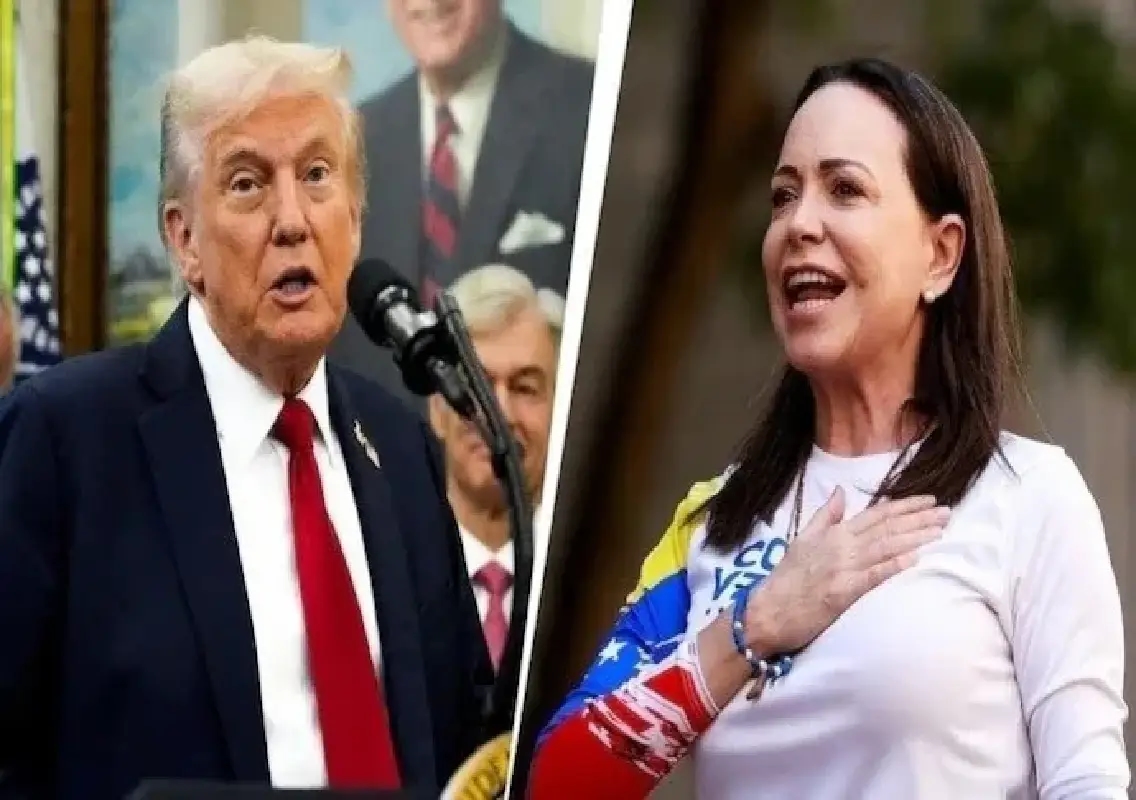


Venezuelan opposition leader Maria Corina Machado has offered to share her Nobel Peace Prize with former US President Donald Trump, praising his role in the dramatic capture of deposed leader Nicolas Maduro, even as Trump publicly distanced himself from her future role in Venezu00287
ela’s leadership.
Machado hails US raid as turning point
Hours after Nicolas Maduro was captured in a high-risk US operation earlier this month, Machado declared that “the hour of freedom has arrived”, raising expectations that Venezuela’s long-marginalised opposition could finally play a central role in steering the oil-rich nation after years of authoritarian rule.
Maduro’s capture marked one of the most extraordinary episodes in recent Latin American political history. The former president, who had clung to power amid allegations of election fraud, repression and corruption, was taken into US custody following what American officials described as a targeted operation aimed at enforcing international arrest warrants.
For Machado and her supporters, the development appeared to signal the collapse of a regime they have long opposed. However, optimism within the opposition camp was short-lived.
Trump distances himself from Machado
Despite the opposition leader’s enthusiastic endorsement of Trump’s actions, the former US President made it clear that he did not see Machado as a viable leader for Venezuela’s future. Speaking to American media, Trump said she lacked sufficient support and respect within the country.
“She doesn’t have the support within or the respect within the country,” Trump said, dampening speculation that Washington would back Machado as the face of a post-Maduro transition.
His remarks surprised many observers, particularly given Machado’s international profile and her recent Nobel Peace Prize win for what the Norwegian Nobel Committee described as her courageous resistance against dictatorship.
Nobel Peace Prize dedicated to Trump
In an interview with Fox News on Monday night, Machado revealed that she had already dedicated her Nobel Peace Prize to Trump, whom she credited with achieving what many believed was impossible.
“As soon as I learnt we had been awarded the Nobel Peace Prize, I dedicated it to President Trump because I believed he deserved it,” she said. “A lot of people said it was impossible to achieve what he did on January 3.”
She described the capture of Maduro as a historic milestone not just for Venezuela, but for the world at large. “January 3 will go down in history as the day justice defeated tyranny. It’s not only huge for Venezuelans, but a huge step for humanity,” Machado said, adding that she wanted to formally share the prize with Trump.
Her comments quickly went viral on social media, drawing both praise and criticism. Supporters hailed her for acknowledging US intervention, while critics accused her of undermining the independence of the Nobel Prize by offering to share it with a political figure.
Limited contact with Trump
When asked whether she had spoken to Trump since winning the Nobel Prize, Machado said her interaction with him had been limited. According to her, she last spoke to Trump on October 10, the day the Nobel Peace Prize was announced.
“Actually, I spoke with President Trump on October 10, the same day the Prize was announced, but not since then,” she said.
Machado left Venezuela last month to travel to Norway to accept the award but has not yet returned. She said she was planning to go back home soon, though analysts say her return could be politically sensitive given the rapidly evolving power dynamics in the country.
Trump dismisses Nobel-related speculation
Trump, meanwhile, dismissed reports suggesting that Machado’s Nobel Peace Prize played any role in his decision to sideline her from leadership considerations. Responding to a Washington Post report, he rejected the idea that personal resentment influenced his stance.
“She should not have won it. But no, that has nothing to do with my decision,” Trump told NBC News, reiterating that his assessment was based on political realities within Venezuela rather than international accolades.
Trump has long been vocal about his own desire to win the Nobel Peace Prize, frequently citing his role in various international negotiations during his presidency.
Interim leadership takes shape
Speculation over Venezuela’s leadership trajectory ended on Monday after Vice President Delcy Rodríguez was sworn in as the country’s interim president. Her appointment followed Trump’s indication that Washington might be willing to work with Maduro’s long-time deputy to ensure stability during a transitional phase.
Rodríguez, a key figure in the previous administration, offered words of support for Maduro but stopped short of condemning the US action that led to his capture. She also did not signal any immediate intent to challenge Washington’s involvement.
Her elevation has complicated the opposition’s hopes of quickly assuming power. While some view her interim presidency as a pragmatic step to prevent chaos, others see it as a continuation of the old power structure under a different name.
Opposition faces uncertain road ahead
Machado’s sidelining highlights the fragile position of Venezuela’s opposition despite years of international backing. While Maduro’s capture has removed a central figure of repression, it has not automatically translated into political control for opposition forces.
Analysts say the coming weeks will be critical in determining whether Venezuela moves towards a genuine democratic transition or settles into another phase of managed continuity under familiar faces.
Conclusion
Maria Corina Machado’s offer to share her Nobel Peace Prize with Donald Trump underscores both her gratitude for US intervention and the complex geopolitics shaping Venezuela’s future. With Trump distancing himself from her leadership ambitions and an interim president already in place, the opposition leader now faces the challenge of translating symbolic victories into tangible political influence in a deeply divided nation.