







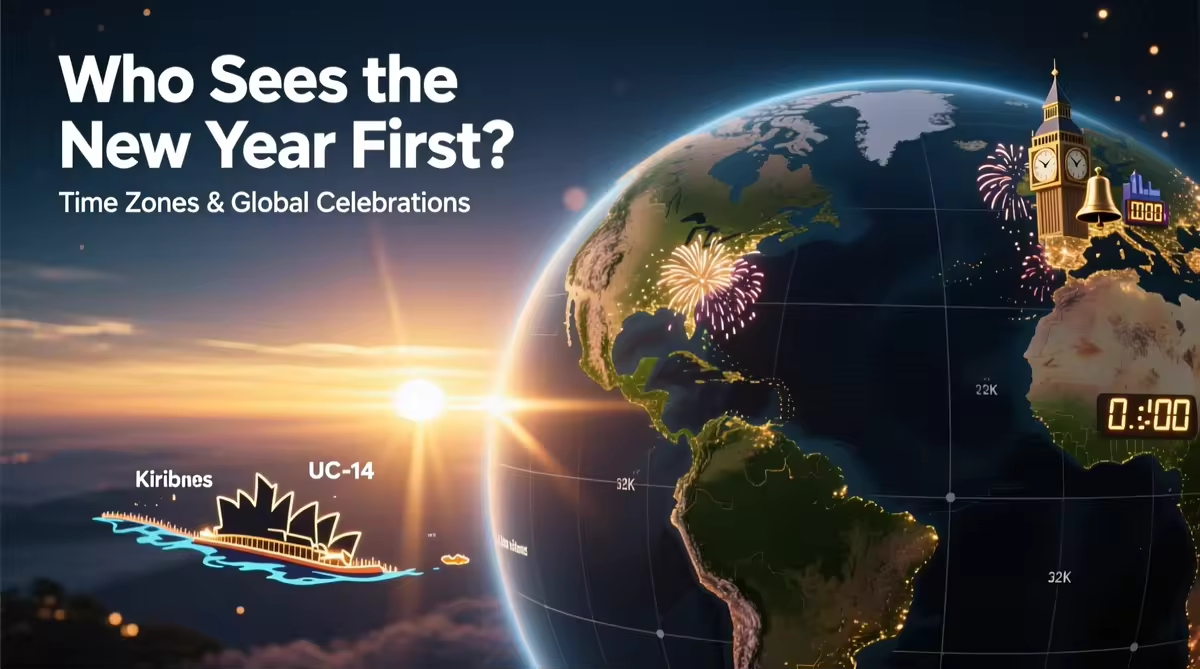


As the world prepares to step into a brand new year, celebrations unfold at different moments across the globe due to time zones and the Earth’s rotation. While some countries are already counting down, others still have hours to go—highlighting how geography shapes one global moment in many local ways.
Why the New Year arrives at different times
Although Earth takes about 365 days to complete one revolution around the Sun, it is the planet’s 24-hour rotation that creates time zones. As Earth spins from west to east, regions experience midnight—and the New Year—at different times.
The key reference point is the International Date Line, an imaginary line in the Pacific Ocean that separates one calendar day from the next. Countries located just west of this line are the first to welcome January 1.
First to ring in the New Year
The honour of celebrating the New Year first goes to the Kiribati, specifically its Line Islands. Since shifting its time zone east of the International Date Line in 1995, Kiribati has ensured that it greets the New Year ahead of the rest of the world. Notably, Kiribati is the only country that spans all four hemispheres.
Soon after, other Pacific nations such as Samoa, Tonga, Tokelau, and New Zealand join the celebrations. Parts of Russia’s Far East, Fiji, and several Pacific island territories follow.
When India joins the celebration
India welcomes the New Year at 3.30 pm UTC on December 31, placing it well after much of East and Southeast Asia. By the time midnight strikes in cities like Bengaluru, large parts of the Pacific and East Asia have already entered the New Year.
The last to celebrate
At the other end of the timeline are the Cook Islands, which are the last inhabited places to welcome the New Year, nearly a full day after Kiribati.
A shared moment, many midnights
Despite the staggered celebrations, the arrival of the New Year remains a shared global milestone—experienced through many clocks, cultures and time zones, yet united by the same hope for fresh beginnings.