







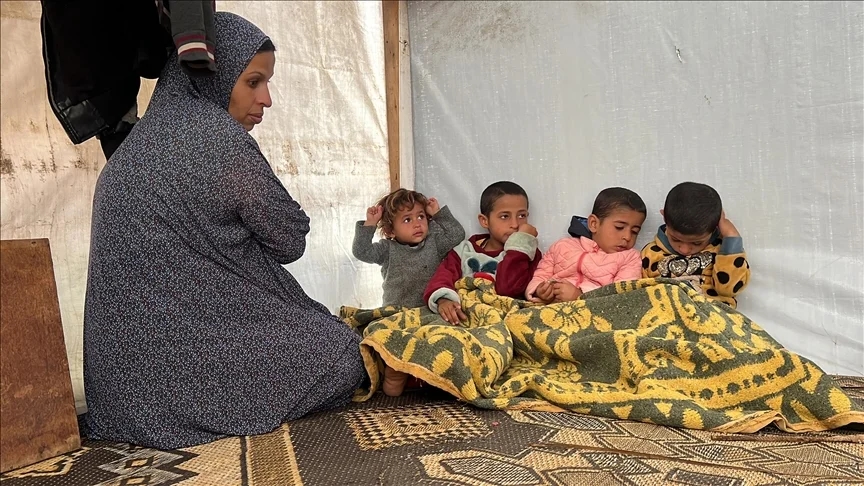


Flooded tents and freezing nights
Winter has brought renewed suffering to Gaza’s displaced population, as powerful storms have flooded tent settlements and exposed the fragility of life without proper shelter. For families already exhausted by months of conflict and displacement, heavy rain and strong winds have turned makeshift camps into swamps, destroying belongings and leaving children and the elderly shivering through freezing nights.
In one such tent, home to a family of seven, water rushed in during the night, soaking mattresses, clothes and cooking utensils. Neighbouring families faced the same ordeal, with children standing outside in the rain, lips blue from the cold, as their shelters collapsed or filled with water.
Scale of devastation
According to local authorities, recent storms have destroyed at least 27,000 tents, leaving tens of thousands of families without any form of shelter. Damaged buildings, already weakened by bombardment, collapsed during the storms, killing at least 11 people. Across Gaza, an estimated 1.4 million displaced Palestinians are now facing winter conditions with little to no protection.
Repeated storms, including the recent Storm Byron, have overwhelmed all attempts to reinforce tents. The ground, saturated by rain, no longer absorbs water, and entire areas have turned into muddy pools. With nowhere else to go, families remain in place, trying to dry what little they have.
Children and elderly most at risk
Conditions are particularly dire for children and the elderly. Families sleep on thin mattresses laid directly on cold, wet ground, with limited blankets and no heating or electricity. Older people struggle to endure the cold, while young children face rising risks of illness and hypothermia.
Medical sources have already reported deaths linked to hypothermia, including infants and a nine-year-old child, raising fears that more fatalities may follow as winter intensifies.
Aid falling far short
Despite international assurances, aid reaching Gaza remains limited. The United Nations reported distributing only 300 tents in November, while around 230,000 families received just a single food parcel each. Many families received nothing at all.
Food prices remain prohibitively high, with protein-rich items such as meat and eggs largely inaccessible. Most displaced families have not had a nutritious meal in months. Meanwhile, rubble clearance and ground levelling for safer shelter placement have not begun, citing equipment shortages.
A bleak “new normal”
For many in Gaza, the end of large-scale bombardment has not brought relief. Instead, families now confront a grim reality where life in unstable, flood-prone tents may become permanent. Aid groups and residents warn that without urgent action to provide adequate shelter, food and medical care, the humanitarian toll of winter could prove devastating.