







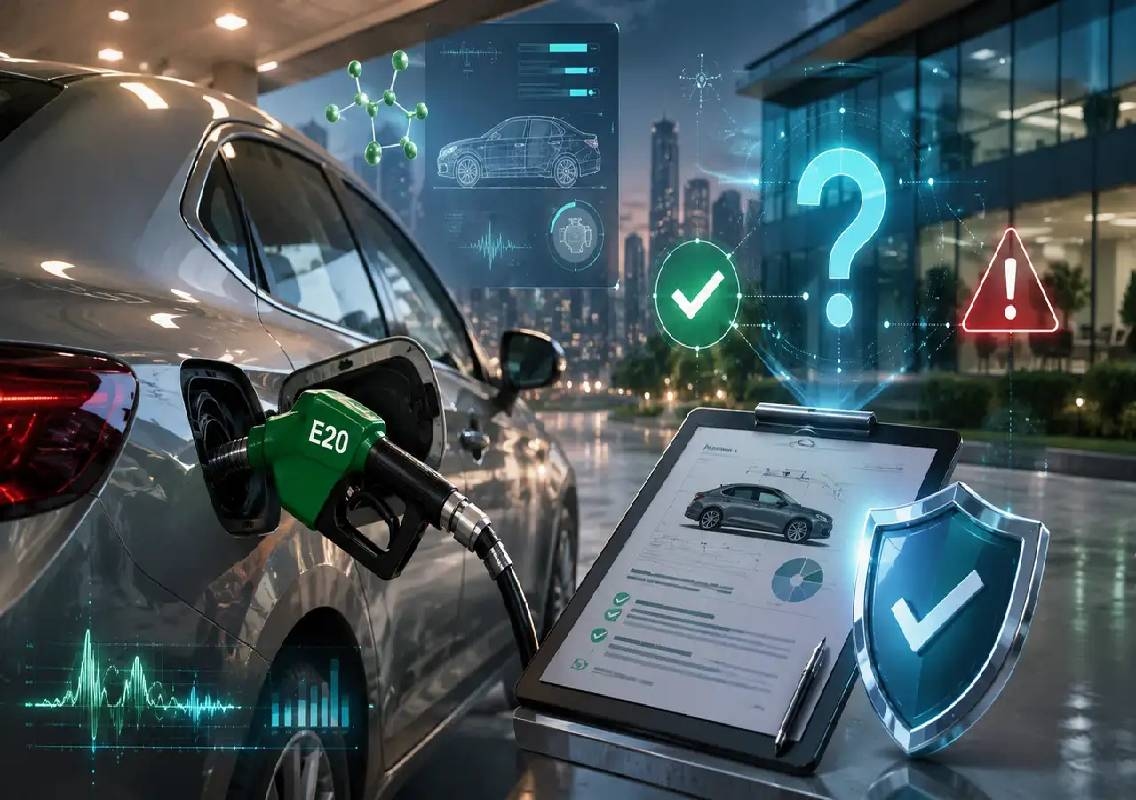


New Delhi: As India accelerates the adoption of E20 petrol under its ethanol blending programme, many vehicle owners have questioned whether using the fuel could result in their motor insurance claims being rejected. Insurance experts and the government have now clarified that simply using government-approved E20 petrol will not invalidate a motor insurance policy or become a reason for claim rejection.
However, experts emphasise that while E20 fuel itself does not affect insurance validity, policyholders must understand what motor insurance covers—and, more importantly, what it does not.
E20 petrol does not invalidate insurance
According to insurance experts, the use of E20 petrol has no impact on the validity of a comprehensive motor insurance policy.
Since E20 is a fuel approved by the Government of India and forms part of the national ethanol blending programme, insurers cannot reject a claim solely because the vehicle was running on ethanol-blended petrol. The Ministry of Petroleum and Natural Gas has also clarified that E20 usage cannot be cited as a ground for denying motor insurance claims.
What motor insurance actually covers
Experts say many vehicle owners mistakenly believe that if E20 fuel causes engine problems, the repair costs would automatically be covered under insurance.
A standard comprehensive motor insurance policy primarily covers accidental external damage, theft and certain natural or man-made calamities. It generally does not cover gradual mechanical wear and tear or deterioration resulting from prolonged vehicle use.
Engine protection has limitations
Even if a vehicle has an engine protection add-on, the coverage is limited.
Engine protection typically covers accidental engine damage caused by incidents such as flooding, water ingress, loss of lubricating oil following an accident or damage due to an external impact. It is not designed to compensate for long-term mechanical issues arising from regular usage or maintenance-related problems.
Follow manufacturer recommendations
Experts advise vehicle owners to use E20 petrol only if their manufacturer recommends or certifies compatibility.
If a vehicle is E20-compatible, using the fuel will not affect insurance coverage. However, owners of older vehicles should continue following the manufacturer’s fuel compatibility guidelines, as any mechanical issues resulting from improper fuel usage could remain a maintenance responsibility rather than an insurable event.
Government backs E20 rollout
The government has reiterated that the ethanol blending programme is based on scientific evaluation and strict quality standards.
Authorities have also stated that there are no documented cases of engine damage directly caused by approved E20 fuel, while encouraging consumers to use compatible vehicles for the best performance.
Why E20 is being promoted
E20 petrol contains 20% ethanol and 80% petrol and forms a key part of India’s strategy to reduce crude oil imports, lower carbon emissions and promote cleaner fuels.
Automobile manufacturers have increasingly introduced E20-compatible engines in newer vehicles, although compatibility may vary in older models.
Conclusion
The government’s clarification should reassure motorists that using approved E20 petrol will not lead to insurance claim rejection. Nevertheless, vehicle owners should continue to use fuel recommended by their manufacturer and understand that motor insurance covers accidental damage—not routine wear, maintenance issues or long-term mechanical deterioration.