







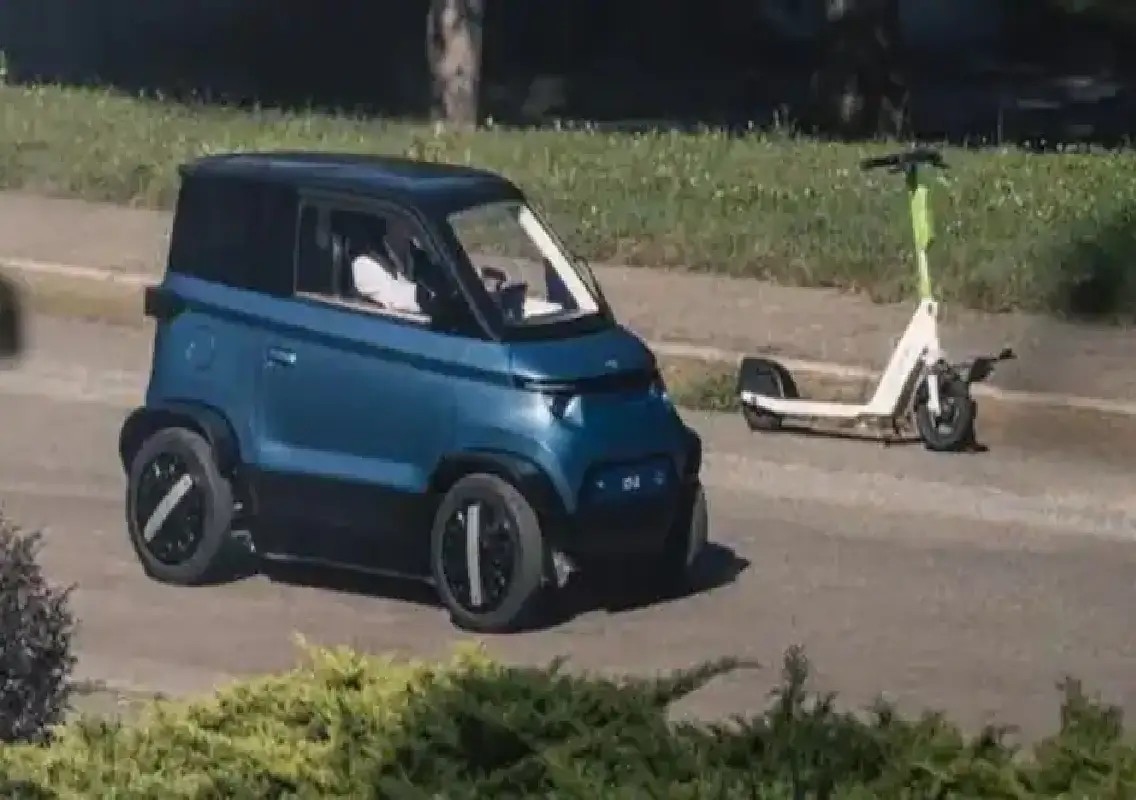


Bengaluru: A compact electric vehicle designed to address traffic congestion and urban mobility challenges is being projected as a future transportation solution for densely populated cities, with developers suggesting that it could potentially serve as an alternative to traditional city commuting options, including e-rickshaws in markets such as India.
During an interaction, CEO Dr. Asaf Formoza of City Transformer shared details about the company’s latest mobility concept and highlighted its potential role in transforming urban transport systems.
The company’s compact electric vehicle has been designed to navigate congested roads while offering features associated with passenger cars, including comfort and safety.
Vehicle designed for congested urban environments
According to Dr. Formoza, one of the most distinctive features of the City Transformer CT-2 is its ability to reduce its width to approximately one metre.
He explained that even smaller city vehicles often struggle in traffic because of their dimensions, whereas the CT-2 has been engineered to adapt its size according to road conditions.
The transformable structure allows the vehicle to move more efficiently through narrow spaces and highly congested urban environments.
Urban congestion continues to remain one of the major transportation challenges in rapidly growing cities across the world, particularly in countries experiencing expanding urban populations and increasing vehicle ownership.
Industry observers have increasingly focused on compact and flexible mobility solutions aimed at improving efficiency and reducing traffic pressures.
India identified as a potential future market
Dr. Formoza stated that India has emerged as one of the markets being considered for future expansion.
According to him, discussions are already underway with Indian stakeholders regarding opportunities for introducing the vehicle into the domestic market.
He also indicated that the company is exploring possibilities for manufacturing the vehicle in India.
The compact dimensions and adaptable design of the CT-2 were cited as factors that may make it suitable for Indian road conditions and densely populated urban areas.
Developers believe that the vehicle could function across multiple categories, including personal mobility, shared transportation systems and urban public transport applications.
The proposal of positioning such vehicles as alternatives to e-rickshaws could also generate discussions regarding future transportation models in crowded cities.
Approved under European regulations
The company also stated that the vehicle has already received approval under European L7E vehicle regulations.
According to Dr. Formoza, the electric vehicle has been issued a German licence plate and is legally permitted for road use in Europe.
Regulatory approval is considered an important step for manufacturers as it enables vehicles to move from development and testing phases towards broader commercial deployment.
Obtaining compliance with established standards often strengthens confidence among potential buyers and investors.
Officials indicated that international regulatory acceptance may also support expansion into additional markets in the future.
Compact design paired with electric performance
One of the key features highlighted by the company is the vehicle’s transformable body structure.
In expanded mode, the CT-2 can reportedly achieve speeds of up to 90 km/h. In its narrower one-metre configuration, the vehicle can continue operating at speeds of up to 40 km/h while occupying road and parking space similar to that of a motorcycle.
Dr. Formoza described the concept as a vehicle capable of combining the characteristics of a car with the parking convenience associated with two-wheelers.
The CT-2 operates using two in-wheel electric motors mounted on the rear wheels and is powered by a 15 kWh battery pack.
The company claims that the vehicle can deliver a driving range of approximately 180 km on a single charge while maintaining a weight of under 600 kg.
Development journey began over a decade ago
According to Dr. Formoza, work on the concept started in 2014 after he experienced challenges involving traffic congestion and parking limitations in Tel Aviv.
He explained that the goal was to combine the practicality and safety of a car with the compactness of a motorcycle.
The company stated that it has already received around 5,000 pre-orders, primarily from Germany, other parts of Europe and Israel.
Officials added that the organisation is presently focusing on raising funds for serial production of the vehicle.
As urban areas continue searching for efficient and sustainable transportation options, compact electric mobility solutions are increasingly drawing attention as possible alternatives for future city travel.