







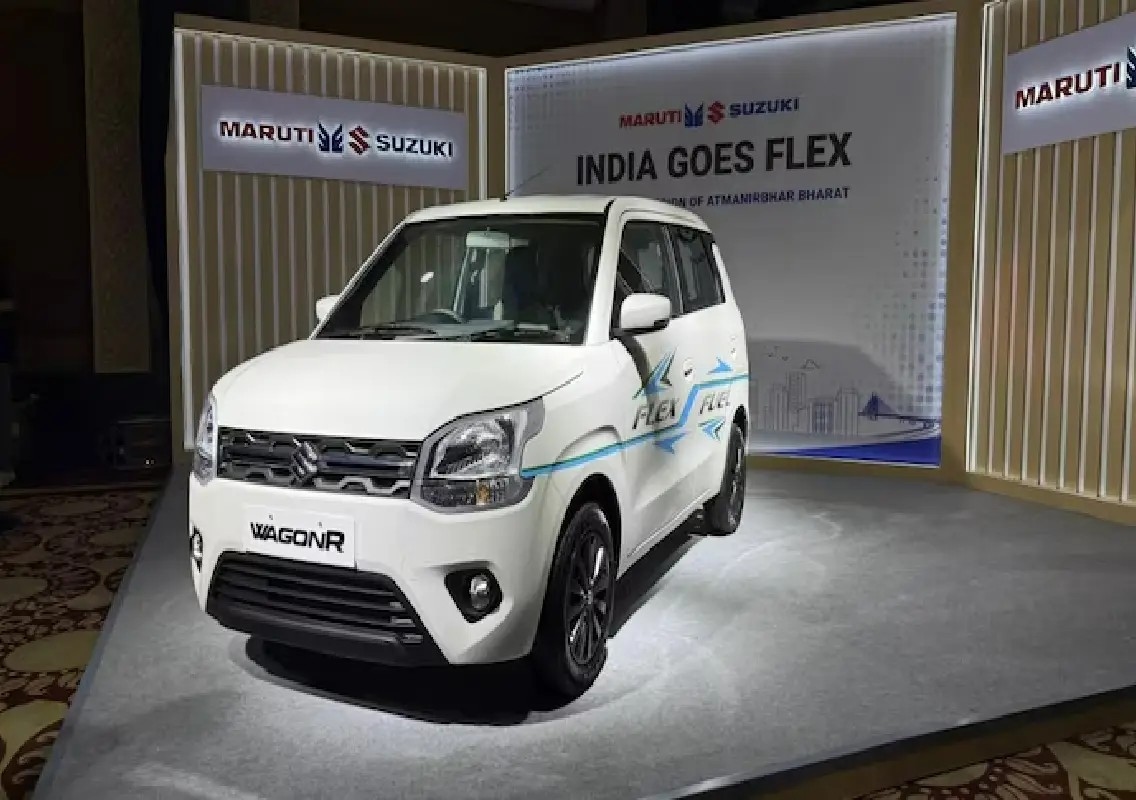


New Delhi: Maruti Suzuki has unveiled the flex-fuel version of the WagonR, making it India’s first passenger vehicle capable of running on E100 ethanol fuel. The launch marks a significant step in the country’s efforts to promote alternative fuels, reduce crude oil imports and support cleaner mobility solutions.
The vehicle was unveiled by Union Road Transport and Highways Minister Nitin Gadkari and Union Petroleum and Natural Gas Minister Hardeep Singh Puri.
The introduction of the WagonR Flex Fuel comes as the Central government accelerates its ethanol blending programme and expands the regulatory framework for higher ethanol-petrol fuel blends across the country.
Push towards ethanol-based mobility
The unveiling aligns with the government’s broader objective of reducing dependence on imported crude oil and promoting domestically produced biofuels.
In May, the Centre notified fuel standards for higher ethanol blends, including E22, E25, E27 and E30, paving the way for increased adoption of ethanol-powered vehicles.
Flex-fuel vehicles are designed to operate on varying mixtures of petrol and ethanol. The newly unveiled WagonR Flex Fuel can run on ethanol-petrol blends ranging from E20 to E85 and is engineered to support E100 compatibility.
Industry experts believe the technology could play a key role in lowering carbon emissions, reducing fuel import bills and strengthening India’s energy security.
Maruti highlights long-term benefits
Speaking at the launch, Maruti Suzuki India Managing Director and CEO Hisashi Takeuchi said the company is pursuing multiple fuel technologies to support India’s transition towards sustainable mobility.
According to him, Maruti Suzuki is investing in battery electric vehicles, hybrid technologies, compressed natural gas (CNG), compressed biogas (CBG) and flex-fuel vehicles.
He noted that while the ethanol ecosystem remains in its early stages, widespread adoption of flex-fuel vehicles could significantly reduce oil imports, lower carbon emissions and improve air quality.
The company also highlighted the potential economic benefits for India’s agricultural sector, as greater ethanol production could create additional demand for agricultural feedstocks and enhance farmer incomes.
E85 fuel network to expand nationwide
Union Minister Hardeep Singh Puri announced that the rollout of E85 fuel dispensing stations will begin in phases.
Initially, between 50 and 100 fuel stations are expected to offer E85 fuel across the Delhi-NCR and Mumbai-Pune-Nagpur corridors.
The network is projected to expand to around 500 outlets by December this year and nearly 5,000 fuel stations across major cities by the end of next year.
The minister also stated that E85 fuel is expected to be priced significantly lower than E20 petrol, potentially making it an attractive option for consumers and commercial operators.
Design remains largely unchanged
Visually, the WagonR Flex Fuel remains almost identical to the existing petrol-powered and E20-compatible versions of the popular hatchback.
The only noticeable exterior change is a small flex-fuel badge positioned at the rear of the vehicle.
The car retains its signature tall-boy design, upright stance and spacious cabin layout that have contributed to its popularity among Indian buyers.
Features such as the wide grille, sweptback headlamps, large glass area and practical tailgate design continue unchanged.
Inside, the hatchback maintains the same dual-tone interior theme and equipment list found in the standard WagonR.
Key features include a 7-inch touchscreen infotainment system, steering-mounted controls, four-speaker audio setup and a spacious 355-litre luggage compartment.
Modified engine supports ethanol blends
Powering the WagonR Flex Fuel is Maruti Suzuki’s 1.2-litre four-cylinder K12N petrol engine.
The engine has been specially modified with upgraded components and calibration to handle higher ethanol concentrations safely and efficiently.
The vehicle can operate on ethanol-petrol blends ranging from E20 to E85, while also supporting E100 compatibility.
However, the company has not yet disclosed detailed performance specifications, including power output, torque figures or fuel-efficiency ratings for the flex-fuel variant.
Industry observers expect ethanol compatibility to require additional engineering enhancements compared to conventional petrol-powered models.
Commercial rollout planned initially
Maruti Suzuki has confirmed that the WagonR Flex Fuel will initially be introduced for commercial applications rather than private buyers.
As a result, the company has not announced pricing details for the vehicle.
Experts anticipate that the flex-fuel version will carry a higher price tag than standard petrol and CNG variants due to the specialised components and engineering required to support higher ethanol blends.
The launch nevertheless represents a major milestone in India’s alternative fuel journey and highlights the growing role of ethanol in the country’s future mobility strategy.
As fuel infrastructure expands and ethanol adoption increases, flex-fuel vehicles could become an important part of India’s efforts to build a cleaner, more sustainable and energy-secure transportation ecosystem.