







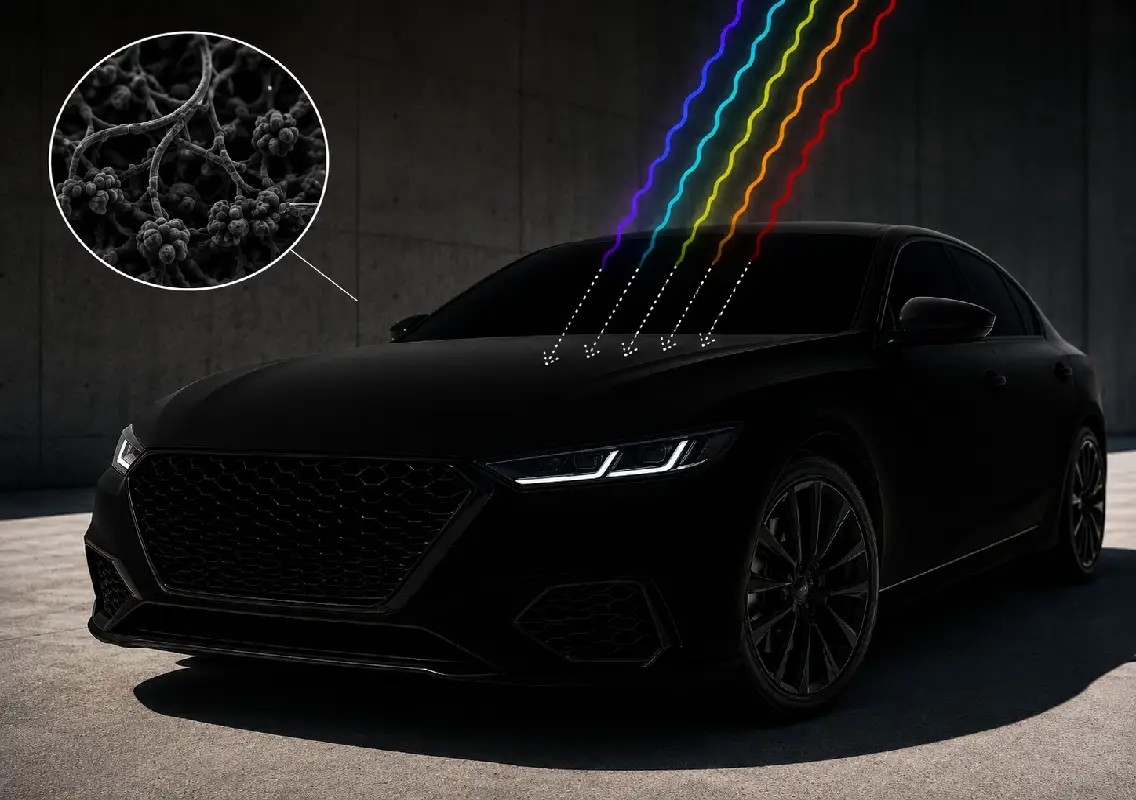


Beijing: Researchers in China have developed a new ultra-black automotive coating capable of absorbing an average of 99.90 per cent of visible light, potentially paving the way for a new generation of strikingly dark luxury vehicles and advanced optical technologies.
The breakthrough addresses a longstanding challenge in materials science — creating an extremely black coating that is not only highly light-absorbing but also durable and practical enough for real-world applications such as automobiles.
Scientists develop practical ultra-black coating
According to the researchers, the newly developed coating combines exceptional light absorption with durability standards expected from automotive paints.
“In this study, we present an easily processable strategy for the construction of ultra-black coatings with an extraordinary visible-light absorption value exceeding 99.90 per cent and remarkable blackness values,” the authors of the study said.
The development could bring a technology previously confined to laboratory experiments and concept vehicles closer to commercial production.
Why making ultra-black paint is difficult
Creating an ultra-black surface involves more than simply making a material darker.
Scientists have long known that carbon nanotubes can trap extraordinary amounts of light. This principle gained widespread attention with the development of ultra-black materials such as Vantablack and was dramatically demonstrated when a concept car coated with a carbon nanotube-based material appeared almost like a flat silhouette.
However, such coatings have generally been expensive, fragile and difficult to manufacture on a large scale. Many also struggle to withstand moisture, heat and physical wear, making them unsuitable for automotive applications.
Conventional black automotive paints rely mainly on carbon black pigments, but these materials have inherent limitations because a portion of incoming light is still reflected from the surface.
Combining carbon black and nanotubes
To overcome these limitations, the researchers combined traditional carbon black pigments with carbon nanotubes.
Carbon nanotubes are tiny cylindrical structures made entirely of carbon atoms and possess exceptional light-absorbing properties. However, they tend to clump together, making them difficult to incorporate into paints.
The research team developed a stable nanoscale composite by blending carbon black particles and carbon nanotubes through a high-energy milling process. The resulting mixture remained stable in water-based formulations and could be applied using conventional spray-coating techniques already used in the automotive industry.
Microscopic structure traps light
The key innovation lies in the microscopic structure of the coating.
Rather than relying solely on the inherent properties of the materials, the coating creates what scientists call “structural absorption”. The carbon particles and nanotubes form a microscopic landscape of peaks, valleys and interconnected structures.
When light enters this structure, it becomes trapped and repeatedly bounces between the nanoscale features. With each reflection, more energy is absorbed until almost no light escapes.
“The enhanced light absorption capability of the ultra-black coating mainly originates from the structural optical trap,” the researchers explained.
As a result, the coating absorbs 99.90 per cent of visible light, causing objects coated with it to appear unusually flat because very little reflected light reaches the human eye.
Coating withstands real-world conditions
One of the most significant aspects of the new material is its durability.
The researchers reported that the coating demonstrated strong resistance to humidity and water exposure, maintaining its performance without significant degradation.
This durability sets it apart from many previous ultra-black materials, which often failed when exposed to real-world environmental conditions.
Potential applications beyond luxury cars
The study was motivated in part by growing demand for premium black finishes in the luxury automobile market, particularly in China, where dark-toned vehicle colours are increasingly associated with elegance and exclusivity.
“Deep black finishes have long been the premium choice and signature colour for luxury cars due to their elegant appearance, powerful visual impact and luxurious undertone,” the researchers noted.
Beyond automobiles, the technology could find applications in optical instruments, cameras, sensors and astronomical equipment, where reducing unwanted reflections is highly desirable.
However, the coating is not yet ready for commercial production. The research team plans to conduct further studies on long-term performance, large-scale manufacturing and advanced coating designs that could potentially absorb even more light.
Conclusion
The development of an ultra-black automotive coating that absorbs nearly all visible light represents a significant advance in materials science. By combining exceptional darkness with practical durability, the new technology could eventually redefine luxury car finishes and open up new possibilities in optics and other high-precision industries.