


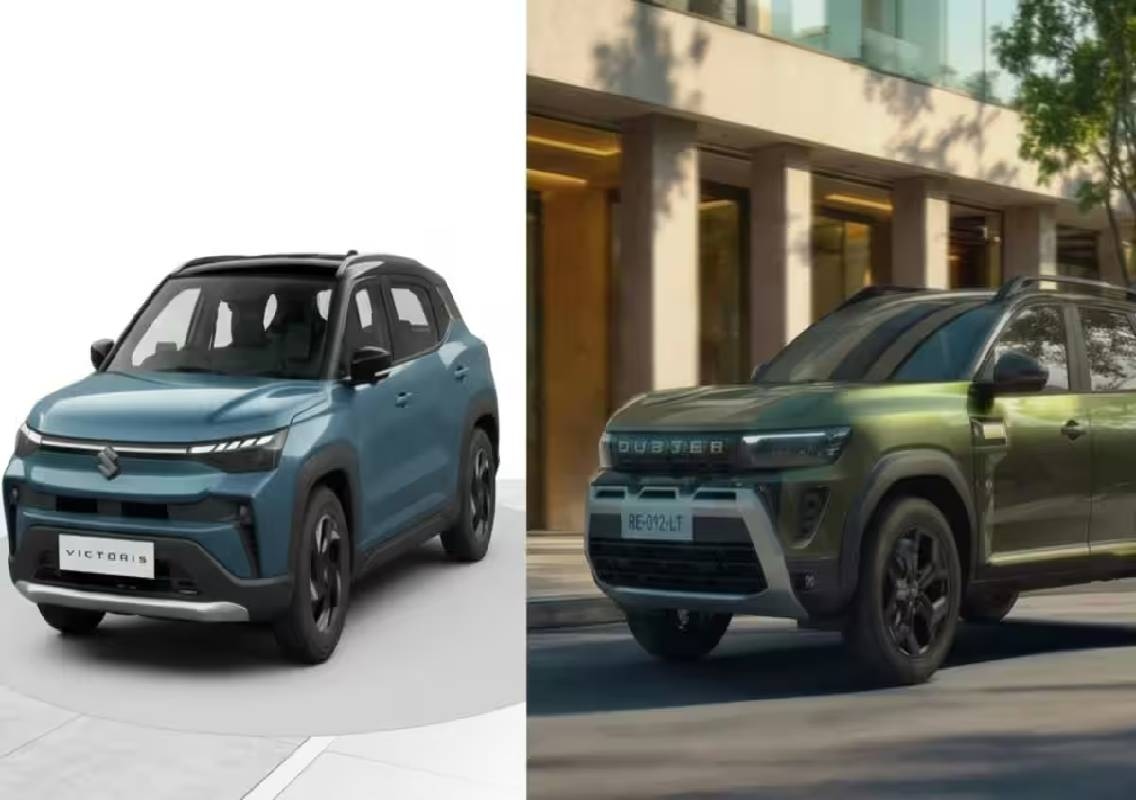


NEW DELHI: The Renault Duster Strong Hybrid and Maruti Suzuki Victoris Strong Hybrid are competing for buyers looking for a fuel-efficient midsize SUV with modern features. With the new Duster hybrid entering the segment, the two models offer different combinations of performance, comfort, technology and pricing.
The top-spec Renault Duster Emotion Strong Hybrid is priced at Rs 19.49 lakh (ex-showroom), while the Maruti Suzuki Victoris ZXi+ (O) Strong Hybrid costs Rs 19,98,900. This gives the Duster an introductory price advantage of Rs 49,900.
While the Duster offers a more powerful hybrid system and slightly higher claimed fuel efficiency, the Victoris brings its own set of convenience, infotainment and safety features.
Renault Duster vs Maruti Victoris hybrid: Price
The Renault Duster Strong Hybrid is available in three variants, with prices starting at Rs 16.99 lakh. The Maruti Victoris Strong Hybrid is priced higher at the top end of its range.
| Model and variant | Ex-showroom price |
|---|---|
| Renault Duster Evolution Strong Hybrid | Rs 16.99 lakh |
| Renault Duster Techno Strong Hybrid | Rs 18.99 lakh |
| Renault Duster Emotion Strong Hybrid | Rs 19.49 lakh |
| Maruti Victoris ZXi+ (O) Strong Hybrid | Rs 19,98,900 |
The prices give the Duster a lower entry point into the strong-hybrid segment. However, buyers should compare the equipment available in each variant before making a decision, as features can differ across powertrain and trim combinations.
Engine, power and hybrid system compared
The Renault Duster uses a 1.8-litre, four-cylinder petrol engine paired with two electric motors and a 1.4kWh battery. Its combined system output is 160bhp, while the petrol engine produces 110bhp and 175Nm of torque.
The Maruti Suzuki Victoris uses a 1.5-litre, three-cylinder petrol engine paired with an electric motor and a 0.76kWh battery. Its combined system output is 116bhp, with the petrol engine developing 92.45bhp and 122Nm.
| Specification | Renault Duster hybrid | Maruti Victoris hybrid |
|---|---|---|
| Petrol engine | 1.8-litre, four-cylinder | 1.5-litre, three-cylinder |
| Petrol engine power | 110bhp | 92.45bhp |
| Petrol engine torque | 175Nm | 122Nm |
| Battery capacity | 1.4kWh | 0.76kWh |
| Combined system power | 160bhp | 116bhp |
| Transmission | Multi-mode automatic | e-CVT |
| Claimed fuel efficiency | 29kmpl | 28.65kmpl |
The Duster has a higher combined power output and a larger battery pack. Renault also claims that the SUV can cover up to 80% of city driving in electric mode under suitable conditions. Both vehicles use self-charging hybrid systems and do not require external charging.
Fuel efficiency: Duster claims a slight lead
Renault claims a fuel efficiency of 29kmpl for the Duster Strong Hybrid, compared with 28.65kmpl for the Victoris Strong Hybrid.
The difference is marginal, meaning fuel efficiency alone may not be the deciding factor for buyers. Actual mileage will depend on traffic, driving style, road conditions and air-conditioning use.
Real-world comparative testing would help establish how closely both SUVs match their claimed efficiency figures in everyday driving.
Dimensions and boot space
The two SUVs have similar lengths, but the Duster is wider and taller and has a longer wheelbase.
| Dimension | Renault Duster | Maruti Victoris |
|---|---|---|
| Length | 4,346mm | 4,360mm |
| Width | 1,815mm | 1,795mm |
| Height | 1,694mm | 1,655mm |
| Wheelbase | 2,657mm | 2,600mm |
| Ground clearance | 212mm | 210mm |
The Victoris is 14mm longer overall, while the Duster has a 57mm longer wheelbase and 20mm greater width. The Duster’s ground clearance is also marginally higher.
Renault quotes 372 litres of boot space up to the parcel shelf and 544 litres up to the roof. The Victoris has a listed boot capacity of 373 litres. These figures should be compared carefully because the measurement methods are not identical.
Features and cabin equipment
Both SUVs offer a 10.1-inch infotainment screen, a 10.25-inch digital driver’s display, ventilated front seats, a panoramic sunroof, wireless phone charging and a powered tailgate.
The Duster’s top-spec hybrid variant features dual-zone automatic climate control, six-way electrically adjustable front seats and a six-speaker Arkamys audio system. It also gets 18-inch alloy wheels.
The Victoris offers an eight-speaker Infinity audio system, an eight-way powered driver’s seat and ambient lighting. Buyers should confirm the availability of features such as navigation, a head-up display and advanced connectivity on the exact hybrid variant they intend to purchase.
Safety features compared
Both models offer six airbags, electronic stability control, tyre-pressure monitoring, hill-start assist, rear parking sensors and an electronic parking brake with auto-hold.
However, buyers should check the exact variant’s equipment list before comparing advanced safety technology. Features available on other versions of an SUV may not be offered on its strong-hybrid variant.
The availability of a 360-degree camera, advanced driver assistance systems (ADAS) and other parking technologies should therefore be verified with the respective manufacturer or dealer.
Which hybrid SUV offers more?
The Renault Duster Emotion Strong Hybrid has a lower introductory ex-showroom price, a higher combined power output and a marginal advantage in claimed fuel efficiency. Its larger dimensions in several areas may also appeal to buyers who prioritise a more substantial SUV footprint.
The Maruti Suzuki Victoris counters with its own comfort and infotainment equipment, including an eight-speaker audio system and ambient lighting.
For buyers, the decision will depend on priorities such as performance, cabin comfort, equipment, ownership support and the exact on-road price. A test drive and a variant-specific feature check are advisable before making the final choice.