







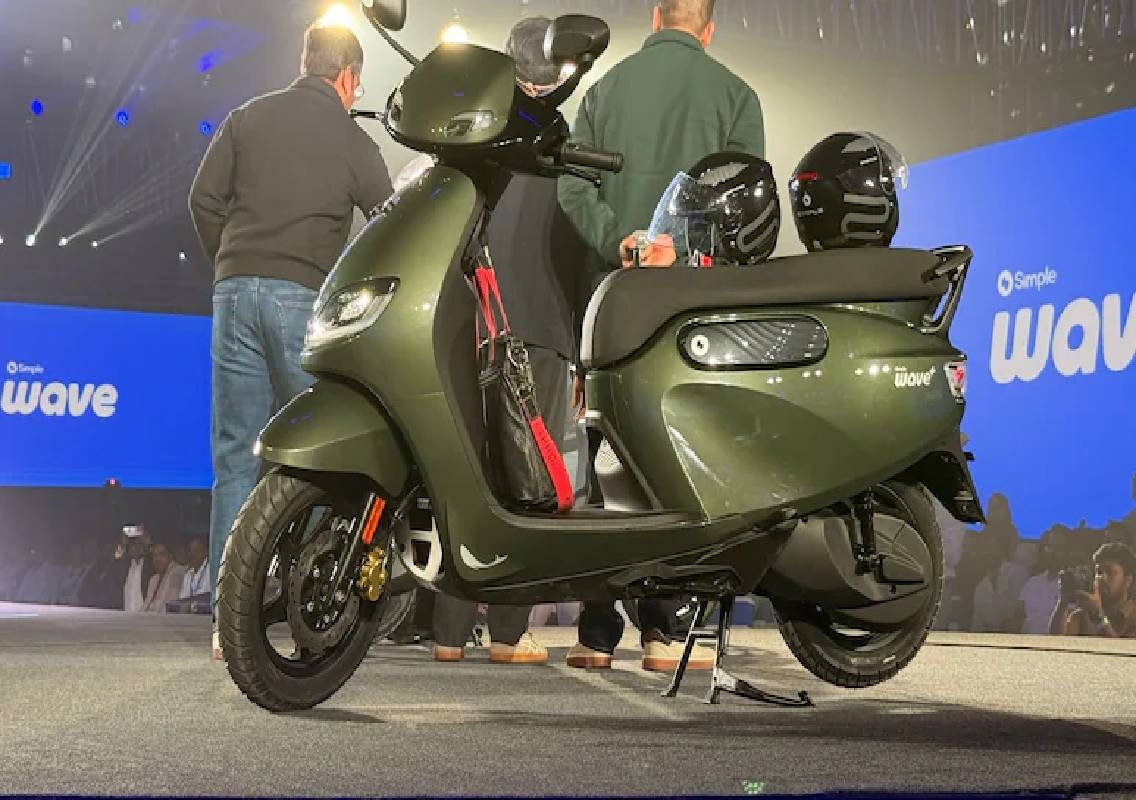


Bengaluru: Simple Energy has launched its new Wave electric scooter in India at an introductory price of Rs 1.10 lakh, expanding its portfolio into the family scooter segment. The Bengaluru-based EV maker is positioning the Wave as a practical alternative to established electric scooters, with a claimed IDC range of up to 243 km.
The Simple Wave is available in multiple versions with different battery capacities and range figures. The top-spec Wave+ gets the largest 5 kWh battery and claims up to 243 km of IDC range, while the standard Wave offers up to 171 km and the Wave S offers up to 132 km, according to Simple Energy.
The new scooter marks a shift in Simple Energy’s product strategy. Unlike the performance-oriented Simple One, the Wave has been developed with family use, practicality, storage and everyday commuting in mind.
Simple Wave price and variants
The Simple Wave range starts at Rs 1,09,999, which is generally rounded to Rs 1.10 lakh. The scooter is offered in different battery and performance configurations, allowing buyers to choose between affordability and longer range.
The Wave S is the entry-level version, with a claimed range of up to 132 km and a top speed of 75 kmph. The standard Wave offers up to 171 km of IDC range and a 90 kmph top speed, while the Wave+ is the range-topping version with a claimed 243 km range and a 90 kmph top speed.
This gives the Wave range a wider spread than Simple Energy’s earlier products and allows the company to target customers looking for an electric scooter for regular family and city use.
Up to 243 km claimed range
The biggest talking point of the Simple Wave is its claimed range. The Wave+ can cover up to 243 km on a single charge under IDC testing conditions, making it one of the longer-range options in the family electric scooter segment.
The range figure will vary in real-world riding depending on factors such as speed, traffic, rider weight, road conditions and use of electrical features. Therefore, the 243 km figure should be viewed as a claimed IDC range rather than an assured everyday riding distance.
The standard Wave has a claimed range of 171 km, while the Wave S has a claimed 132 km range.
Motor and performance
The Simple Wave uses a 6.4 kW motor. The Wave and Wave+ have a claimed top speed of 90 kmph, while the entry-level Wave S is limited to 75 kmph.
Simple Energy has also focused on making the scooter suitable for carrying both a rider and pillion. The Wave uses a tubular steel frame and progressive twin rear shock absorbers, with the suspension setup aimed at everyday comfort.
The company claims a 0-40 kmph acceleration time of 3.3 seconds for the Wave and Wave+, while the Wave S takes 4 seconds.
Large storage space for family use
Practicality is one of the key areas where Simple Energy wants the Wave to stand out.
The company has equipped the scooter with a large amount of storage, with reports citing up to 70 litres of combined storage capacity. Simple Energy’s current product page lists up to 66 litres of boot space, indicating that the exact figure can vary depending on the version or storage configuration.
The spacious design is aimed at customers who use scooters for daily commuting, shopping and carrying household items. This is particularly important in the family scooter segment, where storage and passenger comfort are often as important as performance.
Features and technology
The Simple Wave comes with connected and smart features intended to make everyday riding more convenient. Depending on the variant, buyers can get features such as fast charging and connected technology.
Higher variants also receive GripSense traction control, while combined braking is offered across the range according to current specification listings.
The scooter also gets a relatively long seat, designed to provide additional room for both the rider and pillion. This is consistent with Simple Energy’s positioning of the Wave as a family-focused scooter rather than a purely performance-oriented model.
Simple Wave rivals
The Simple Wave enters an increasingly competitive electric scooter market in India. Its rivals include the TVS iQube, Ather’s family-oriented offerings and other electric scooters aimed at practical urban mobility. NDTV has also positioned the Wave against models such as the Ather Konarc and TVS iQube.
The Wave’s main selling points are its claimed long range, large storage capacity and family-oriented design. However, buyers will also consider factors such as charging infrastructure, after-sales support, real-world range and the availability of service centres before making a purchase.
Deliveries and market expansion
Simple Energy is expanding its presence as it introduces the Wave. Reports said bookings have opened through the company’s network, with the brand looking to increase production capacity as demand grows.
The company is also entering the family scooter segment at a time when India’s electric two-wheeler market is expanding rapidly. According to NDTV, electric scooter sales in India had crossed 13.6 lakh units in 2026, with TVS, Bajaj and Ather among the leading manufacturers.
For Simple Energy, the Wave therefore represents more than another product launch. It is an attempt to move beyond the premium-performance positioning of the Simple One and attract a much broader group of everyday scooter buyers.
Simple Wave: What buyers should know
The Simple Wave’s combination of a starting price of around Rs 1.10 lakh, multiple battery options and a claimed range of up to 243 km gives the scooter a strong specification-led proposition.
However, the 243 km figure applies to the top Wave+ version under IDC conditions, while lower variants have shorter claimed ranges. The actual on-road range will also depend on riding conditions.
With its family-oriented design, large storage capacity, 90 kmph top speed on higher variants and connected features, the Simple Wave is aimed squarely at India’s growing practical electric scooter market.
The launch also gives consumers another option in a segment increasingly defined by range, practicality and technology rather than simply electric powertrains.