







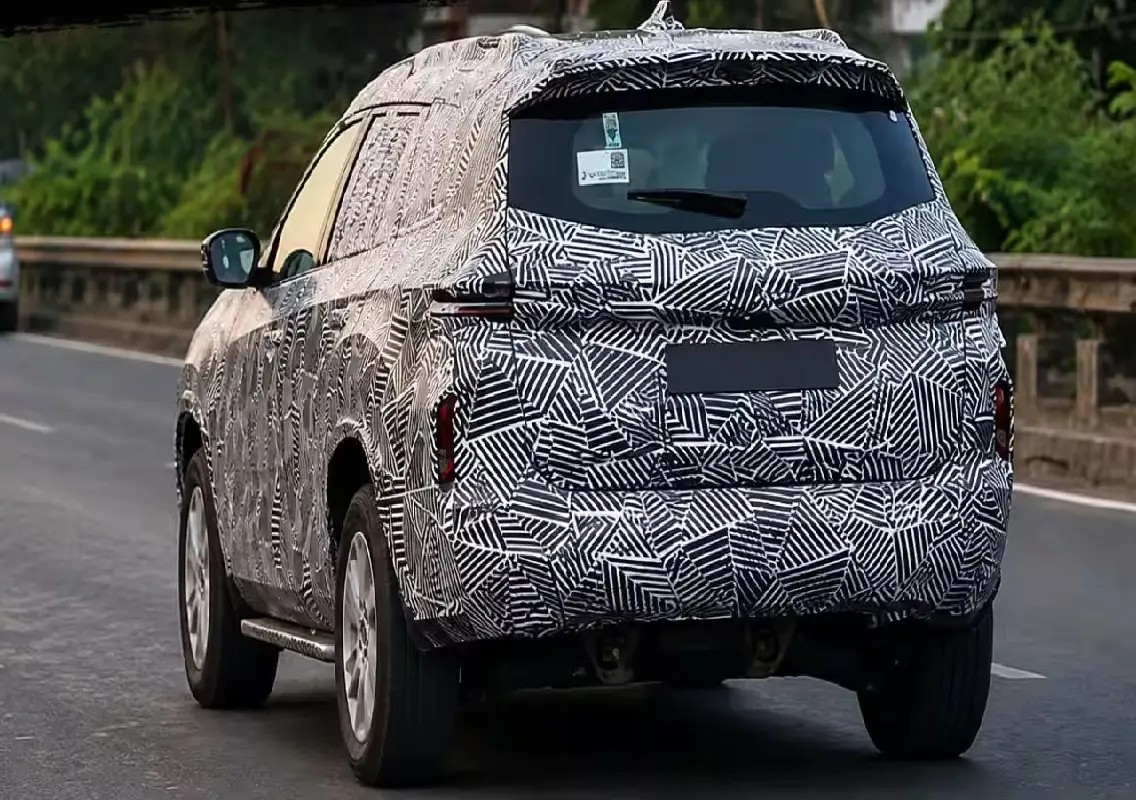


New Delhi: Tata Motors has commenced road testing of the upcoming Safari EV, with the electric version of its flagship SUV being spotted on Indian roads for the first time. Expected to be launched during the festive season later this year, the Safari EV is set to become the most premium electric passenger vehicle in Tata Motors’ portfolio.
The three-row electric SUV is expected to strengthen Tata’s position in the growing electric vehicle segment and compete with upcoming premium electric SUVs in the Indian market.
First spy shots reveal EV-specific changes
The test vehicle retains the familiar silhouette of the internal combustion engine (ICE) version of the Safari, but several details suggest that it is an all-electric model.
One of the most noticeable differences is the absence of a conventional exhaust outlet. The prototype also features an independent multi-link rear suspension setup, similar to that seen on the recently unveiled Harrier EV.
These features indicate that the vehicle under testing shares much of its engineering with Tata Motors’ latest generation of electric SUVs.
Another notable addition is a side step, a feature not currently available on the standard Safari. While extensive camouflage conceals most exterior details, the production model is expected to feature EV-specific styling elements.
Design updates expected
Although Tata Motors has not officially revealed the design of the Safari EV, industry expectations suggest the SUV will receive several visual enhancements to distinguish it from the diesel-powered version.
These may include redesigned front and rear bumpers, new aerodynamic alloy wheels, revised grille elements and dedicated EV badging.
The overall dimensions are likely to remain similar to those of the current Safari, preserving its spacious three-row layout and commanding road presence.
The electric version is expected to retain the SUV’s practicality while incorporating subtle design cues associated with Tata’s electric vehicle range.
Built on Acti.ev+ architecture
The Safari EV is expected to be underpinned by Tata Motors’ Acti.ev+ architecture, the same platform that forms the basis of the Harrier EV.
Rather than being a ground-up electric vehicle, the Safari EV is likely to be an electrified adaptation of an existing platform, allowing Tata Motors to leverage proven architecture while introducing advanced EV technology.
This approach is similar to the strategy adopted for several electric vehicles currently available in the Indian market.
Advanced technology features likely
Inside the cabin, the Safari EV is expected to closely resemble the current Safari while receiving a unique interior theme and EV-specific interface elements.
The SUV is also likely to incorporate Tata’s latest TiDAL (Tata Intelligent Digital Architecture Layer) electronic architecture.
This system is expected to enable a range of connected and intelligent features, including over-the-air software updates, summon mode and advanced driver assistance functions.
Other expected features include auto-park assist, low-speed adaptive cruise control, UPI-enabled in-car payment services and an upgraded 540-degree surround-view camera system.
These additions are aimed at enhancing convenience, connectivity and safety for occupants.
Battery options may mirror Harrier EV
While Tata Motors has not disclosed official specifications, the Safari EV is widely expected to share its battery and powertrain options with the Harrier EV.
The SUV could be offered with 65kWh and 75kWh battery packs, depending on the variant.
Higher variants are expected to feature a dual-motor all-wheel-drive (AWD) setup, providing improved performance and traction.
In the Harrier EV, the rear-wheel-drive configuration produces 238bhp and 315Nm of torque. The AWD version adds a front-mounted motor generating 116bhp, resulting in a combined torque output of 504Nm.
A similar setup is anticipated for the Safari EV.
Range likely to be slightly lower
Given its larger dimensions and additional weight associated with a three-row seating configuration, the Safari EV may offer a slightly lower driving range than the Harrier EV.
For comparison, the Harrier EV claims a range of up to 538km with the 65kWh battery pack. The larger 75kWh battery delivers a claimed range of up to 628km in rear-wheel-drive form and 622km in all-wheel-drive variants.
The Safari EV is expected to offer competitive range figures while balancing performance and practicality.
Tata strengthens premium EV portfolio
The launch of the Safari EV will mark another significant step in Tata Motors’ electric mobility strategy.
As India’s leading electric passenger vehicle manufacturer, Tata has steadily expanded its EV lineup across multiple segments. The addition of a premium three-row electric SUV is expected to broaden its appeal among family buyers seeking larger electric vehicles.
The Safari EV is also likely to play a key role in strengthening Tata’s presence in the premium electric SUV segment, which is witnessing increasing competition.
Conclusion
With road testing now underway, the Tata Safari EV appears to be moving closer to production. Expected to arrive during the festive season, the electric SUV is likely to combine the practicality of the Safari with advanced EV technology, premium features and competitive range. As Tata Motors continues to expand its electric portfolio, the Safari EV could emerge as one of the most significant launches in the premium electric SUV segment this year.