







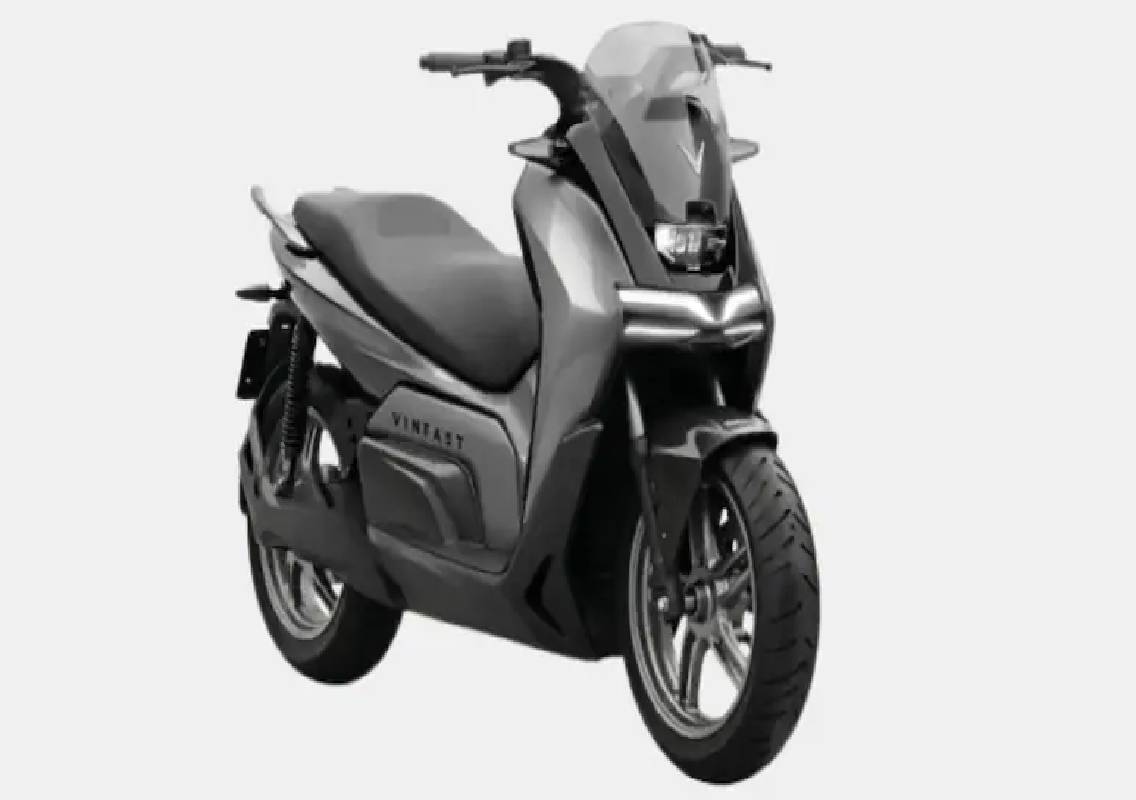


New Delhi: VinFast has filed a design patent in India for its upcoming Rasad electric maxi-scooter, signalling that the Vietnamese electric vehicle maker could be preparing a broader two-wheeler portfolio for the Indian market. The Rasad was unveiled globally earlier in 2026 and is positioned as a performance-oriented electric maxi-scooter.
The Indian patent filing is significant because the Rasad is not the only VinFast electric two-wheeler to have appeared in India’s design registrations in recent months. The company has also patented the Viper scooter and an electric motorcycle believed to be based on the Sulad concept. Together, the filings suggest that VinFast may be looking at multiple segments of India’s rapidly expanding electric two-wheeler market.
However, a patent filing does not confirm an India launch. VinFast has yet to announce an official launch date, India-specific specifications or pricing for the Rasad.
VinFast Rasad gets Indian design patent
The Rasad’s Indian design registration adds another model to VinFast’s growing list of electric two-wheelers protected in the country.
According to patent information reported by Auto Punditz, the filing lists VinFast Trading and Production Joint Stock Company as the applicant. The design carries registration number 500338-001, while the filing is associated with a Vietnamese priority date of January 20, 2026. The Indian registration is dated April 30, 2026.
Design registration primarily protects the appearance and visual identity of a product. It does not necessarily mean that the manufacturer has committed to producing or selling the vehicle in that market.
In VinFast’s case, however, the filing comes at a time when the company is building its presence in India and registering several electric two-wheelers. That makes the Rasad particularly interesting for the Indian market.
A sporty electric maxi-scooter
The Rasad is considerably different from the compact electric scooters that dominate the commuter segment.
The patent images show a large, muscular and angular scooter with a tall windscreen, broad front apron and substantial side panels. It also features a stepped seat and a relatively large overall footprint, giving it the appearance of a maxi-scooter rather than a conventional urban commuter.
The design puts the Rasad closer to performance-oriented scooters such as the Yamaha Aerox and Honda ADV160 in terms of overall concept.
VinFast appears to be targeting riders who want the convenience of a scooter but also prefer stronger performance, a larger road presence and more substantial hardware.
The design also includes a wide handlebar, sizeable footboard and a broad seat, features that could contribute to a more relaxed riding position.
Rasad gets chunky tyres and 14-inch wheels
The Rasad’s design is built around relatively large wheels, with reports indicating 14-inch alloy wheels.
Larger wheels can offer advantages in terms of stability and ride quality, particularly at higher speeds and over uneven surfaces, although the final ride characteristics will depend on the production version’s suspension tuning, tyre specifications and overall weight.
The scooter also gets road-oriented tyres and a sizeable wheelbase-like stance, reinforcing its maxi-scooter character.
This is an important distinction from many electric scooters designed primarily for short urban commutes.
Disc brakes at both ends
VinFast has equipped the Rasad design with disc brakes at both the front and rear.
Suspension duties are handled by a telescopic front fork and twin rear shock absorbers. These components are visible in the patent design and point towards a chassis developed with performance and stability in mind.
The combination of larger wheels, twin rear shocks and disc brakes should give the Rasad a more substantial hardware package than basic city-focused electric scooters.
However, braking performance in the production model will ultimately depend on factors such as brake size, calliper specifications, tyre grip, vehicle weight and the calibration of any electronic safety systems.
Reported 7.1 kW motor
VinFast has not officially disclosed the complete technical specifications of the production Rasad.
However, reports from Vietnamese media indicate that the scooter could use a centrally mounted electric motor producing around 7.1 kW of peak power. A claimed top speed of approximately 100 km/h has also been reported.
If those figures are retained in the final production model, the Rasad would sit towards the performance end of the electric scooter segment.
A centrally mounted motor would also differentiate it from many electric scooters that use hub-mounted motors. The final drivetrain configuration, however, needs to be confirmed by VinFast before it can be treated as production specification.
Battery and range details remain unknown
One of the biggest unanswered questions concerns the Rasad’s battery.
VinFast has not yet announced the battery capacity, certified range or charging specifications for the model.
This means that the reported 7.1 kW output and 100 km/h top speed cannot yet be considered a complete picture of the scooter’s capabilities.
For an electric maxi-scooter, battery capacity will be particularly important because customers are likely to expect greater touring capability than from a conventional city commuter.
The final range will depend not only on battery capacity but also on the motor’s efficiency, vehicle weight, aerodynamics, riding modes, tyre size and test conditions.
Global debut expected in late 2026
The Rasad was unveiled globally in early 2026 as part of VinFast’s wider overhaul of its electric two-wheeler portfolio.
Reports suggest that the model could make its broader commercial debut in the fourth quarter of 2026, although VinFast has not yet confirmed final market-wise availability.
The timing could make the Rasad one of the more interesting additions to VinFast’s international two-wheeler plans later this year.
For India, however, the company has not confirmed whether the Rasad will be among the models introduced locally.
VinFast is patenting multiple electric two-wheelers
The Rasad’s Indian patent becomes more significant when viewed alongside VinFast’s other recent filings.
The company has already registered designs in India for the Viper scooter and an electric motorcycle believed to be based on the Sulad concept. (Autocar)
That potentially gives VinFast a three-pronged electric two-wheeler strategy:
- A mainstream electric scooter
- A premium/performance-oriented electric maxi-scooter
- An electric motorcycle
The registrations alone do not confirm that all three products will reach Indian dealerships. Automakers often protect vehicle designs in markets where they may eventually operate without necessarily launching every registered model.
Still, the number and variety of VinFast filings make the possibility of a broader Indian two-wheeler range more credible.
Rasad could target the premium electric scooter segment
If VinFast eventually brings the Rasad to India, it is unlikely to compete directly with entry-level electric scooters.
Its large maxi-scooter design, reported 7.1 kW motor, larger wheels and dual-disc brake setup point towards a more premium positioning.
The model could appeal to customers who want to move beyond basic commuter scooters and are looking for a combination of electric power, performance and touring-oriented design.
The segment could also become increasingly competitive as more manufacturers introduce electric scooters with stronger performance and larger dimensions.
The Rasad’s success would therefore depend on more than its design.
Price will be a crucial factor
VinFast has not announced an India price for the Rasad.
Pricing could be one of the most important factors in determining whether the scooter can compete effectively in India.
A premium positioning could allow VinFast to differentiate the Rasad from mass-market electric scooters, but the company would still need to offer competitive value through battery capacity, performance, technology, range and after-sales support.
The Indian market is highly price-sensitive, particularly in the two-wheeler category.
A premium electric scooter can attract buyers, but customers are increasingly comparing not only purchase prices but also charging costs, battery warranties, service availability and long-term ownership expenses.
India could become an important market for VinFast
VinFast’s growing number of Indian two-wheeler design filings comes as the company expands its wider EV ambitions in the country.
India offers a large two-wheeler market and has witnessed growing demand for electric scooters across commuter and premium segments.
For VinFast, entering electric two-wheelers could provide an opportunity to build a wider presence beyond electric cars.
The company is already pursuing an India strategy for its passenger EV business, and a two-wheeler portfolio could potentially complement that approach.
The recent patent activity indicates that VinFast is at least protecting a range of products for possible future use in India. (Autopunditz)
Rasad design has a strong road presence
The visual design could be one of the Rasad’s biggest differentiators.
The tall windscreen, broad front section and angular bodywork give the scooter a more imposing appearance than typical urban electric scooters.
The V-shaped lighting treatment at the front is another distinctive element associated with VinFast’s design language. (Autopunditz)
The long stepped seat also suggests that the company has prioritised both rider and pillion accommodation.
If the production version retains these features, the Rasad could stand out in a market where many electric scooters follow relatively compact and conventional designs.
What remains to be confirmed
Despite the growing interest around the Rasad, several important details remain unavailable.
VinFast has yet to confirm:
- Battery capacity
- Certified riding range
- Charging time
- Final motor output
- Final top speed
- India launch date
- India-specific equipment
- India price
The reported 7.1 kW motor and 100 km/h top speed should therefore be treated as reported figures rather than confirmed production specifications. (NDTV)
This distinction is important because a concept or pre-production model can undergo technical changes before entering series production.
Could it rival the Aerox and ADV160?
In terms of format, the Rasad is clearly aimed at the same broad type of rider attracted to maxi-scooters such as the Yamaha Aerox and Honda ADV160.
The comparison is based primarily on body style and intended positioning, rather than confirmed performance or pricing.
The Rasad’s electric powertrain could give it an advantage in terms of instant torque and potentially lower running costs, while established petrol-powered rivals may offer advantages in refuelling convenience and established service networks.
The eventual comparison will depend heavily on the Rasad’s battery range, charging infrastructure, price and after-sales support in India.
Patent does not equal confirmed launch
For prospective buyers, the most important caveat is that the Indian patent should not be interpreted as a launch announcement.
Automakers file design patents to protect intellectual property and future commercial possibilities.
Auto Punditz also notes that a registered design does not automatically mean that the vehicle will be commercially launched in India. (Autopunditz)
In VinFast’s case, however, the filing is noteworthy because it follows other two-wheeler registrations and comes amid the company’s stated interest in the Indian market.
That makes the Rasad a strong candidate for consideration, but not yet a confirmed India-bound product.
Conclusion
The VinFast Rasad electric maxi-scooter has been patented in India, giving the Vietnamese EV maker another potential product for its expanding Indian electric two-wheeler roadmap. The scooter features a muscular maxi-scooter design, chunky tyres, 14-inch wheels, disc brakes at both ends, a telescopic front fork and twin rear shocks.
VinFast has not yet revealed the Rasad’s official production specifications. Reports suggest a centrally mounted electric motor with around 7.1 kW of peak power and a claimed top speed of approximately 100 km/h, but these figures remain unconfirmed by the manufacturer. Battery capacity, range and charging details are also yet to be announced.
The Indian patent is particularly significant because it follows filings for the Viper scooter and Sulad-based electric motorcycle, indicating that VinFast could be considering a wider range of electric two-wheelers for India.
For now, there is no official confirmation of an India launch or price. If VinFast eventually brings the Rasad here, its performance-oriented positioning could put it in competition with premium maxi-scooters while giving Indian buyers another electric alternative.