


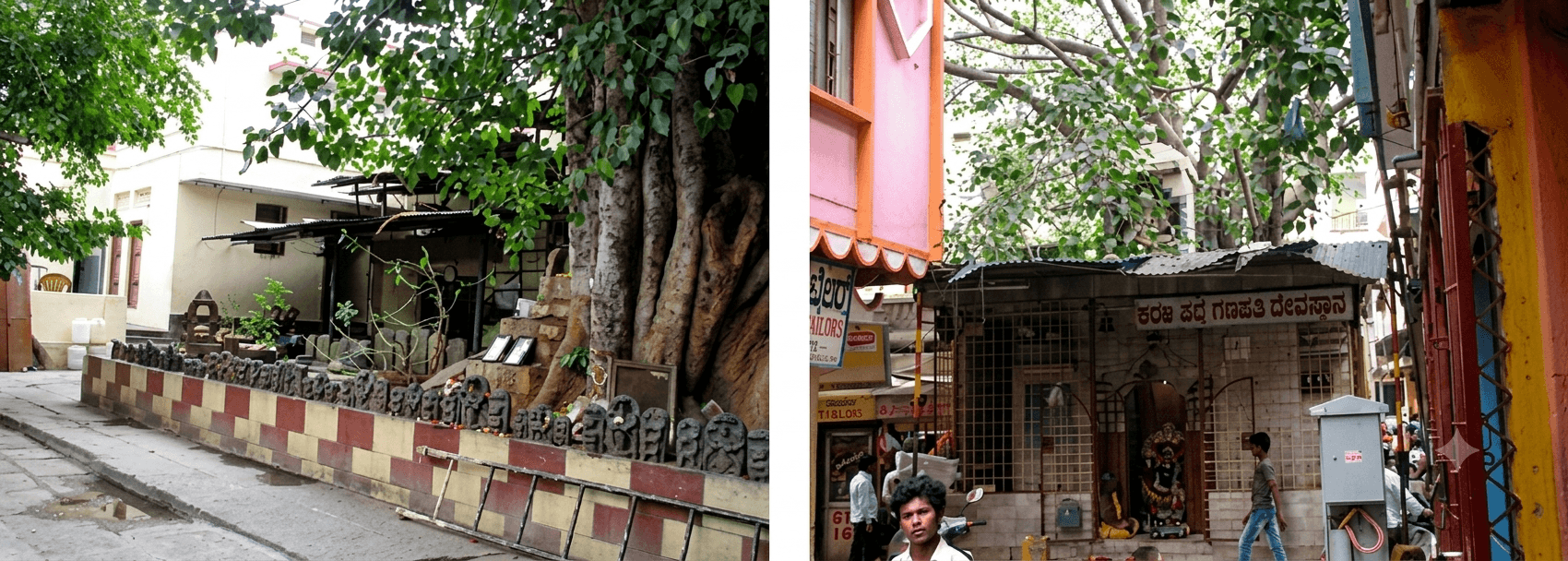


Bengaluru: Amid the city’s expanding elevated corridors, glass-fronted commercial buildings and increasingly screen-focused lifestyles, the traditional Ashwatha Katte continues to offer something that modern urban spaces often lack: an opportunity for people to pause, interact and build a sense of community.
Built around Peepal trees, Ashwatha Kattes are much more than religious or heritage structures. These traditional platforms serve as neighbourhood gathering places where residents exchange local news, friends engage in conversations, children spend time together and small-scale economic activities can develop.
Their importance lies in the everyday interactions they encourage. By bringing people together without requiring them to spend money or enter a commercial establishment, these spaces help create trust, familiarity and social connections among residents. In that sense, Bengaluru’s Ashwatha Kattes can be seen as the city’s original social networks.
A study by urban designer Kiran Keswani and Suresh Bhagavatula, a professor at the Indian Institute of Management Bangalore (IIM-B), explores this role in their book, The City Beneath the Tree, published by Permanently Black.
The researchers studied 20 Ashwatha Kattes and conducted nearly 400 interviews to understand how people use and value these spaces. Their findings point to strong public affection for the traditional gathering places and underline their continuing relevance in a rapidly changing city.
“We started our work on Kattes with the assumption that they were part of the past, but the more we looked at them, the more we realised that they were very relevant to the present day as well,” Keswani said.
Ashwatha Kattes are living urban commons
Often regarded as remnants of an older Bengaluru, Ashwatha Kattes continue to perform an important social function in neighbourhoods across the city.
Bhagavatula argues that these spaces should be understood as living urban commons rather than structures that merely preserve religious or cultural heritage. Their value comes from the activities and relationships they support.
Unlike commercial spaces, where access and participation can be shaped by spending power, Ashwatha Kattes offer residents an informal place to gather. People can sit under the shade of a tree, meet neighbours, discuss local developments and spend time without the pressure of making a purchase.
These everyday encounters help create what urban researchers describe as social capital — the networks, relationships and mutual trust that make communities function.
The platforms also provide opportunities for informal economic activity. Their presence can support small vendors and neighbourhood-level commerce, allowing public interaction and local livelihoods to coexist.
The researchers believe that this combination of social, cultural and economic functions makes Ashwatha Kattes particularly relevant to contemporary urban planning.
Rather than treating them only as heritage structures, they argue that city authorities should recognise their potential as sustainable public spaces that contribute to neighbourhood life.
Rapid development puts traditional spaces at risk
Despite their continuing relevance, many Ashwatha Kattes face pressure from Bengaluru’s rapid urban expansion.
Bhagavatula says some traditional gathering spaces are being displaced by development, while others are undergoing so-called beautification measures that may undermine their original purpose.
Steel fencing and excessive tiling around these platforms can alter how people use the spaces. While such interventions may be intended to improve their appearance or protect the structures, they can also make the surrounding areas less accessible.
The researchers point out that preserving the physical structure of a Katte is not enough. Its surroundings must also remain open and welcoming if it is to continue functioning as a community gathering place.
The social value of these spaces depends on people being able to approach them, sit around them and interact freely. If access is restricted or the surrounding environment becomes less inviting, the everyday encounters that sustain neighbourhood relationships may gradually disappear.
This raises an important question for Bengaluru’s urban planners: should traditional community spaces be preserved only as heritage landmarks, or should they be integrated into the city’s future development?
Keswani and Bhagavatula favour the latter approach. They advocate an urban planning model that gives greater importance to natural elements, trees and shared spaces where residents can meet.
Why Bengaluru needs more places to pause
The researchers believe that the city’s development priorities must extend beyond roads, transport infrastructure and commercial buildings.
As Bengaluru grows, its residents increasingly depend on transport networks and planned commercial spaces for everyday activities. However, the opportunities for informal interaction are often overlooked.
Bhagavatula argues that the future of commerce and urban life should not be limited to malls and large commercial developments. Cities also need accessible places where people can meet, talk and establish relationships.
“The future of commerce does not have to be a mall. Cities of the future need to create opportunities for people to meet, talk and build relationships. As Bengaluru continues to grow, there is a need for more public spaces that foster interaction and protect trees. The future of cities is not just glass and steel, but also the shade of a tree,” said Bhagavatula, an IIM-B professor, entrepreneurship scholar and social networks expert.
His argument highlights the need to consider the social consequences of urban design. Infrastructure may improve connectivity and reduce travel time, but neighbourhoods also need spaces that encourage people to spend time together.
Ashwatha Kattes offer one example of how natural spaces can serve this purpose. Their continued presence can help preserve local identity while providing residents with places for informal gatherings.
Kattes could become natural pause points in urban planning
Keswani believes that traditional gathering spaces can also be linked to broader discussions about urban mobility and public infrastructure.
Bengaluru’s planning debates increasingly focus on Metro connectivity, last-mile transport and walkability. While these are essential to making the city more accessible, the researchers argue that planners must also consider what happens when people reach their destinations.
“Whether we are discussing Metro systems, last-mile connectivity or walkability, one thing is clear: cities do not offer enough opportunities for people to pause. If city planners prioritise mobility, then perhaps one way to advocate for kattes is to position them as natural pause points and social connectors within those networks,” Keswani said.
This approach would place Ashwatha Kattes within a wider network of neighbourhood-level public spaces. Instead of viewing them as isolated heritage structures, planners could consider how they connect residential areas, pedestrian routes and public transport access points.
Such an approach would also recognise the importance of trees and shaded spaces in a city where everyday movement is increasingly shaped by traffic and dense development.
Preserving community life beyond heritage
The findings of The City Beneath the Tree underline that the value of Ashwatha Kattes cannot be measured only by their age, architecture or religious significance. Their importance also lies in the relationships they help create.
As Bengaluru continues to expand, protecting these spaces could offer a way to retain some of the neighbourhood character that makes a city feel connected and welcoming.
The researchers’ work makes a case for treating Ashwatha Kattes as essential parts of the urban landscape. Their preservation would require more than retaining the platforms and trees; it would mean protecting public access and allowing the surrounding spaces to remain active.
In a city where people increasingly move between homes, offices, shopping centres and transport corridors, the humble Katte offers a different model of urban life. It provides a place where residents can meet without appointments, conversations can happen spontaneously and community ties can grow.
Bengaluru’s traditional Ashwatha Kattes may have existed long before digital social networks, but their role remains strikingly relevant. They remind the city that meaningful connections are often built not through screens or commercial spaces, but through simple, shared places where people can stop and spend time together.