







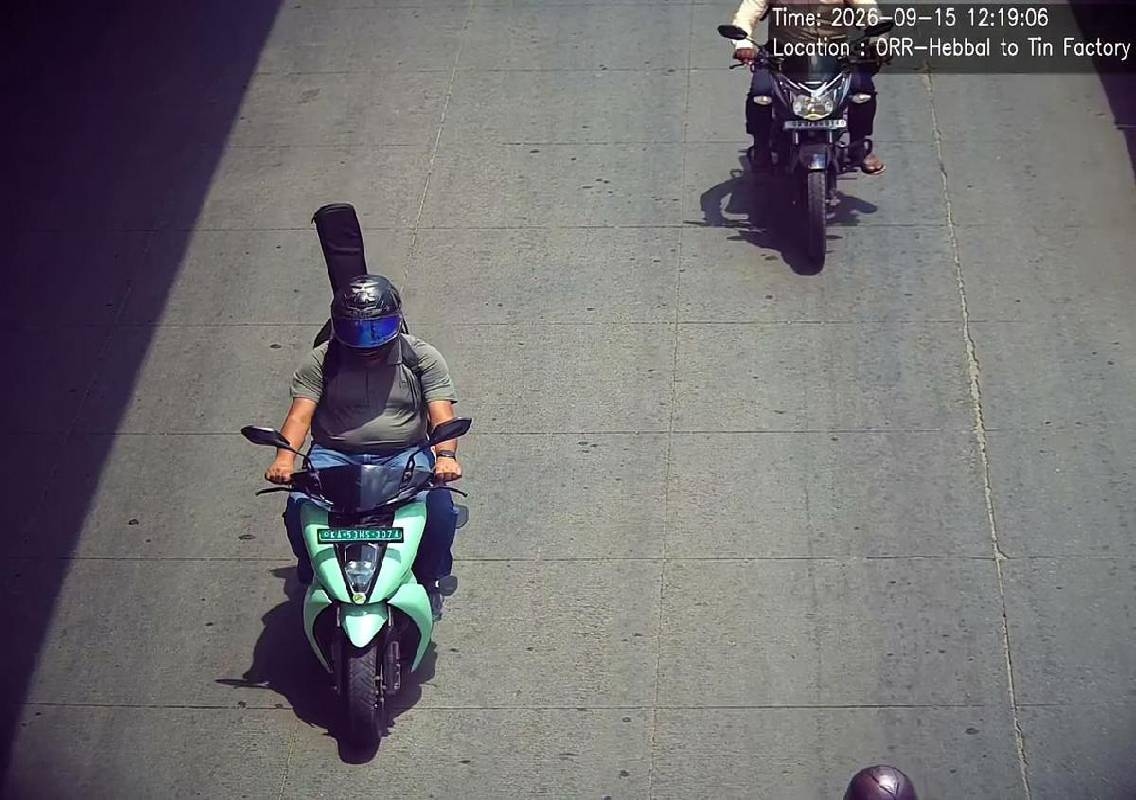


Bengaluru: An AI-powered traffic camera in Bengaluru reportedly mistook a guitar strapped to a scooter rider’s back for a pillion passenger and issued a Rs 500 challan for an alleged helmet violation.
The unusual incident came to light after Souvik Dutta received an automated traffic fine based on an image captured by an AI-enabled traffic enforcement camera. According to reports, Dutta was riding his wife’s scooter with his guitar strapped to his back when the system apparently interpreted the guitar bag as another person travelling on the vehicle.
AI camera detects ‘helmetless’ pillion rider
Dutta was reportedly travelling between Hebbal and Tin Factory when the traffic camera captured an image of his scooter. The system subsequently generated a challan stating that the pillion rider was not wearing protective headgear.
The fine amounted to Rs 500. The challan was sent to Dutta’s wife’s mobile phone as the scooter was registered in her name.
When the couple checked the photographic evidence attached to the challan, they reportedly noticed that the supposed pillion rider was actually the guitar carried by Dutta.
Dutta later shared the incident on social media, questioning the accuracy of AI-based traffic enforcement.
Bengaluru Traffic Police asked to examine error
The reported error was brought to the attention of Bengaluru Traffic Police. Joint Commissioner of Police (Traffic) Karthik Reddy said the matter would be examined and indicated that the violation could be revoked if the error was confirmed.
The incident has brought attention to the challenges involved in automated traffic enforcement, where camera systems use image recognition and other technologies to identify violations.
AI-based enforcement is designed to process large volumes of traffic data and identify offences such as helmet violations, signal jumping and other road-rule breaches. However, an incorrect identification can result in a challan being issued against a motorist who has not committed the recorded violation.
Questions over automated traffic enforcement
Bengaluru Traffic Police introduced AI-based surveillance as part of its efforts to strengthen traffic enforcement. The system is intended to reduce the need for traffic personnel to monitor every violation manually.
However, reports of incorrect challans have raised questions about the importance of human verification in automated enforcement systems.
The guitar incident is not the first reported case in Karnataka involving an apparent error by an AI traffic camera. A similar incident was recently reported in Belagavi district, where an AI camera reportedly generated a Rs 500 helmet-violation notice for a car.
Such cases have prompted discussion about how automated systems distinguish between people, objects and other elements visible in traffic-camera images.
How motorists can dispute incorrect challans
Motorists who believe that an automated traffic challan has been issued incorrectly can raise a dispute through the official traffic-police channels.
According to the latest reports, motorists can use the Bengaluru Traffic Police website or the relevant police mobile applications to submit complaints about incorrect challans. They may be required to provide vehicle details and supporting photographic or documentary evidence.
In Dutta’s case, the photograph attached to the challan itself reportedly helped demonstrate the apparent mismatch between the violation recorded by the system and what was actually visible in the image.
The incident also illustrates why motorists should check the photographic evidence accompanying an automated challan before paying a fine when they believe the violation may have been recorded incorrectly.
AI systems still face identification challenges
Automated traffic enforcement systems rely on cameras and software to identify specific objects and behaviour in road scenes. While such technology can assist authorities in monitoring busy roads, unusual objects or situations can potentially lead to incorrect identification.
In Dutta’s case, the shape and position of the guitar bag reportedly caused the system to interpret it as a second person on the scooter.
The reported incident does not by itself establish that AI-based enforcement systems are broadly unreliable. Instead, it highlights a specific type of identification error and the need for mechanisms through which motorists can challenge incorrect penalties.
For traffic authorities, accurate image processing, appropriate system calibration and effective verification procedures can help reduce the possibility of incorrect challans reaching vehicle owners.
Conclusion
The Bengaluru incident involving a guitar being mistaken for a pillion rider has drawn attention to the limitations that can arise in AI-based traffic enforcement. Bengaluru Traffic Police is examining the reported error, with the Rs 500 violation potentially subject to cancellation if the mistake is confirmed.