




Delhi currently leads the country with an operational metro network of around 374.5 km. Mumbai’s combined network, including Mumbai Metro and Navi Mumbai Metro, is approximately 102 km. With the addition of the Pink Line’s elevated stretch, Bengaluru will move ahead of Mumbai in terms of operational network length.
The expansion marks another milestone for Namma Metro, which began operations in October 2011 with a 6.7-km stretch between Baiyappanahalli and MG Road. Since then, the network has grown through successive phases, connecting several parts of the city.
Pink Line adds six stations
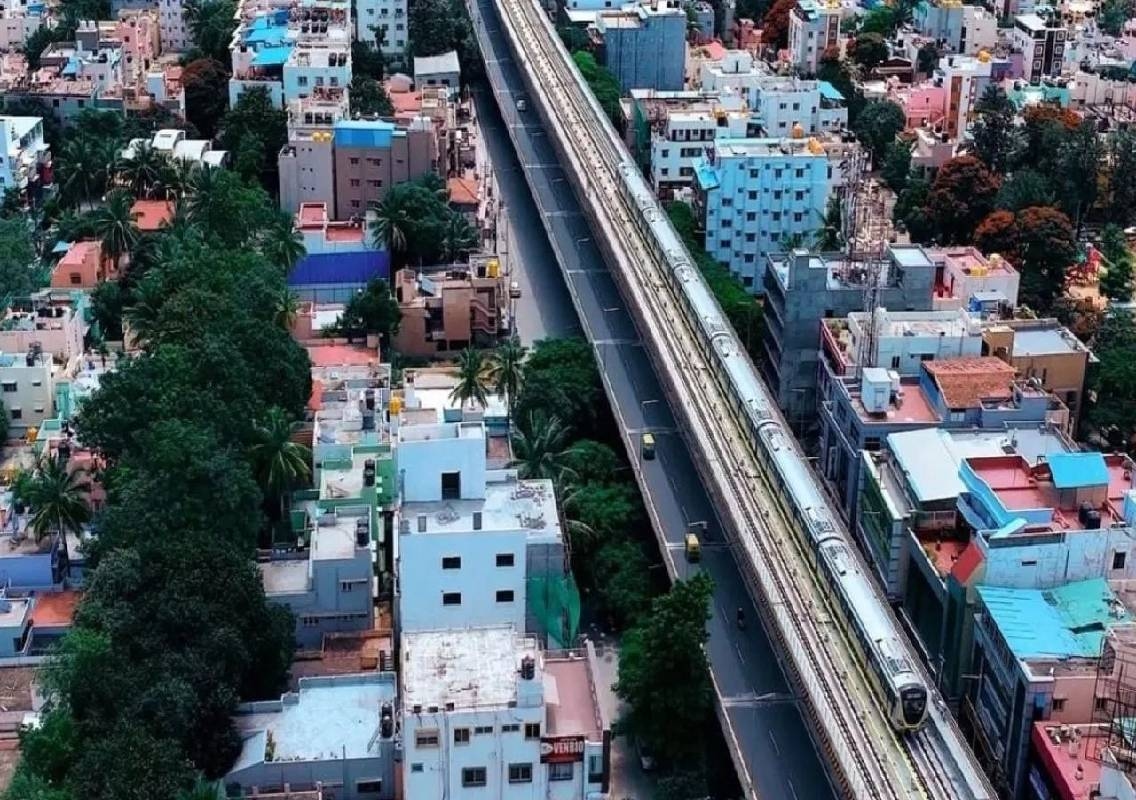
The newly inaugurated section runs for 7.5 km between Kalena Agrahara and SG Palya, formerly known as Tavarekere. It has six stations: Kalena Agrahara, Hulimavu, Bilekahalli-IIMB, NS Palya-JP Nagar 4th Phase, Jayadeva Hospital and SG Palya.
The elevated section has been developed at an estimated cost of ₹3,470 crore. Commercial services are scheduled to begin at 6 am on Saturday, November 14, following its inauguration by Prime Minister Narendra Modi on Friday.
Initially, five trains have been allocated to the corridor, with four expected to operate regularly and one kept on standby. Services are expected to run at intervals of approximately eight minutes.
Pink Line to improve connectivity in south Bengaluru
The elevated corridor runs along Bannerghatta Road and is expected to improve access for commuters travelling through Kalena Agrahara, Hulimavu, Bilekahalli and JP Nagar.
Jayadeva Hospital station will serve as an interchange with the Yellow Line, providing connectivity towards RV Road and Bommasandra, including the Electronic City corridor.
The complete Pink Line will extend for 21.26 km between Kalena Agrahara and Nagawara, with 18 stations comprising six elevated and 12 underground stations. While the elevated section is opening now, the underground portion remains under construction and is expected to become operational in 2027. Once completed, the corridor will provide a north-south connection through several important residential and commercial areas.
BEML trains equipped with advanced technology
The Pink Line will operate six-coach trains manufactured by BEML. The trains are equipped with driverless train technology and are designed to reach speeds of up to 90 kmph. Their stated passenger capacity is 2,008.
Platform screen gates are also planned at all six elevated stations. These barriers are intended to improve passenger safety by separating the platform area from the tracks.
The corridor’s integration with other metro lines is expected to make it easier for commuters to switch between routes and access different parts of Bengaluru. The connection at Jayadeva Hospital will link the Pink Line with the Yellow Line, while the underground section will eventually provide an interchange with the Purple Line at MG Road.
Bengaluru’s metro expansion
Bengaluru’s operational metro network currently comprises the Purple, Green and Yellow lines. The Purple Line connects Whitefield with Challaghatta, while the Green Line runs between Madavara and Silk Institute. The Yellow Line links RV Road with Bommasandra.
The opening of the Pink Line’s elevated section will take the operational network from approximately 96.1 km to 103.6 km. This will place Bengaluru ahead of Mumbai’s combined operational metro network, making it the country’s second-largest metro network after Delhi.
The expansion is expected to provide an additional public transport option for residents in south Bengaluru, particularly those travelling along the Bannerghatta Road corridor. The completion of the underground section will further extend the line’s reach towards central and north Bengaluru.