


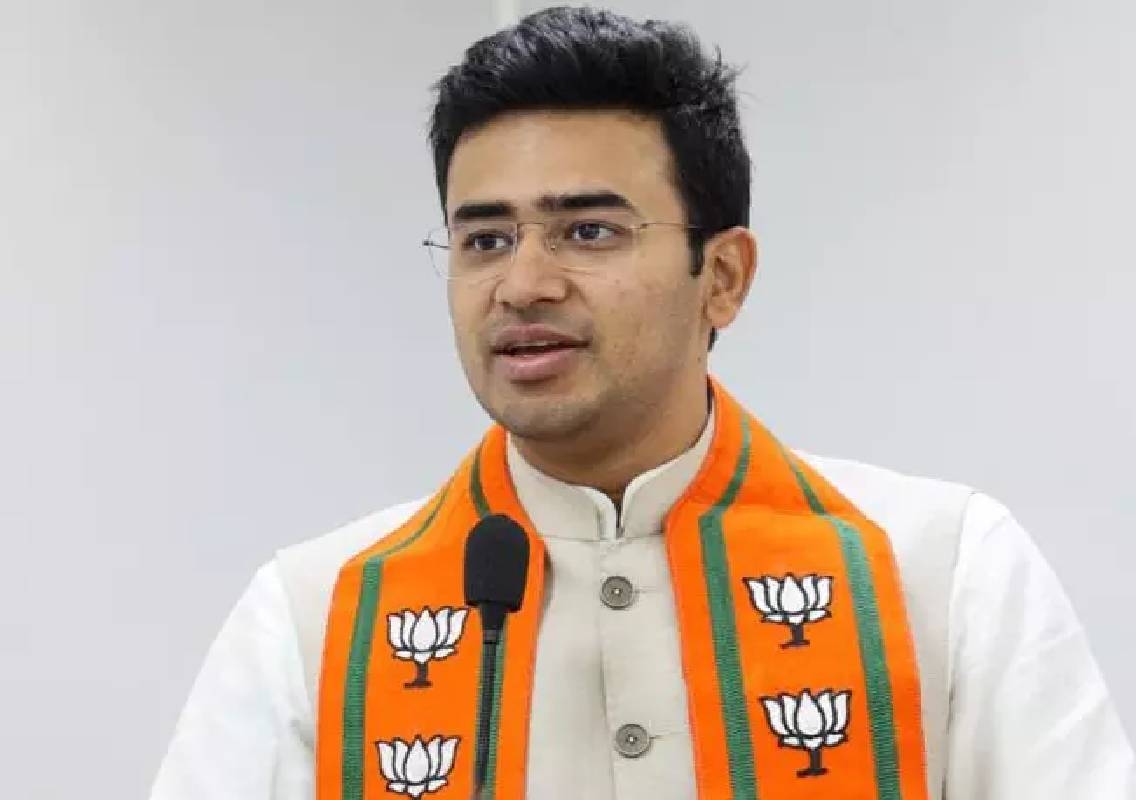


Bengaluru: Bengaluru South MP Tejasvi Surya has disputed the Karnataka government’s claim that the State bears nearly 84% of the cost of Namma Metro, stating that the Centre’s contribution accounts for 53.35% of the total approved project funding. He put Karnataka’s share at 46.65%, arguing that the State’s calculation includes foreign loans secured with the Centre’s sovereign guarantee.
Surya made the remarks at a press conference on Thursday, November 12, ahead of Prime Minister Narendra Modi’s visit to Bengaluru to inaugurate the elevated section of the Namma Metro Pink Line on Friday.
The funding dispute follows Greater Bengaluru Development Minister Krishna Byre Gowda’s statement that Karnataka was bearing ₹65,291 crore, or 83.8% of the combined approved project cost of ₹77,891 crore, while the Centre was contributing ₹12,600 crore, or 16.2%.
Surya challenged this calculation, saying the difference arose from how international borrowings worth ₹28,958 crore had been accounted for in the respective funding statements.
Dispute over ₹28,958 crore in foreign loans
According to Surya, the Karnataka government had included ₹28,958 crore in foreign loans under the State’s contribution, even though the borrowings were arranged through international financial institutions with the Centre’s sovereign guarantee.
He maintained that the loans were extended to Bangalore Metro Rail Corporation Limited (BMRCL), the agency executing the Metro projects, and not directly to the Karnataka government. BMRCL is responsible for servicing the borrowings, he said.
Citing BMRCL’s approved funding plan for Metro Phases 1 to 3, Surya said the total approved funding of approximately ₹77,891 crore comprised ₹41,558 crore from the Centre and ₹36,333 crore from Karnataka.
Based on this calculation, the Union government’s share works out to 53.35%, while the State’s contribution stands at 46.65%.
The Karnataka government, however, maintains that it bears the repayment burden of the foreign loans, along with land acquisition expenses, rehabilitation costs and other project-related expenditure. The two sides are therefore presenting different funding calculations based on how these expenses and borrowings are classified.
BMRCL is a 50:50 joint venture
Surya also pointed out that BMRCL is an equally owned joint venture between the Union and Karnataka governments. Both governments have contributed ₹9,164 crore each towards the corporation’s equity.
He argued that the corporation’s financial responsibilities should be distinguished from the direct budgetary contributions made by the two governments.
The MP accused the State government of confusing BMRCL’s borrowings with Karnataka’s direct contribution and questioned the presentation of the funding figures. He called for greater transparency in explaining the financial arrangements behind the Metro network.
The State government’s assessment, on the other hand, includes foreign loan repayments and other expenses borne by Karnataka while calculating its overall share of the project cost.
Surya raises concerns over project delays and cost escalation
Apart from the funding dispute, Surya criticised delays in the implementation of Bengaluru Metro projects, particularly the proposed Orange Line.
He alleged that repeated changes to the design and alignment had affected the project’s progress. He also questioned the planning and coordination between Metro expansion works and other infrastructure projects in the city.
Regarding the proposed Sarjapur–Hebbal corridor under Phase 3A, Surya said the initial project estimate of ₹28,405 crore had been revised to ₹25,999 crore following a review sought by the Centre. He said the revision could reduce the estimated project cost by ₹2,406 crore.
The MP also referred to findings from a Comptroller and Auditor General (CAG) report, highlighting additional expenditure of ₹6,603 crore linked to delays in land acquisition and shortcomings in cost estimates.
He cited the increase in Phase 2 land acquisition costs from an initial estimate of ₹2,000 crore to ₹7,458 crore by March 2023.
Funding debate intensifies ahead of Pink Line inauguration
The exchange between the State government and the BJP has brought the funding arrangements for Namma Metro back into focus ahead of the Pink Line inauguration.
The Karnataka government has argued that the Centre’s contribution to the overall Metro network has declined over successive phases and has sought a larger financial commitment from the Union government, along with faster approvals for pending projects.
Surya, meanwhile, has called for the State and Centre to work together to speed up Metro expansion and improve integrated transport planning.
The disagreement centres on whether foreign loans secured with the Centre’s sovereign guarantee should be counted as part of the Union government’s contribution or as a financial burden borne by Karnataka. The two governments have presented different calculations, reflecting their differing approaches to accounting for the project’s funding and repayment responsibilities.