







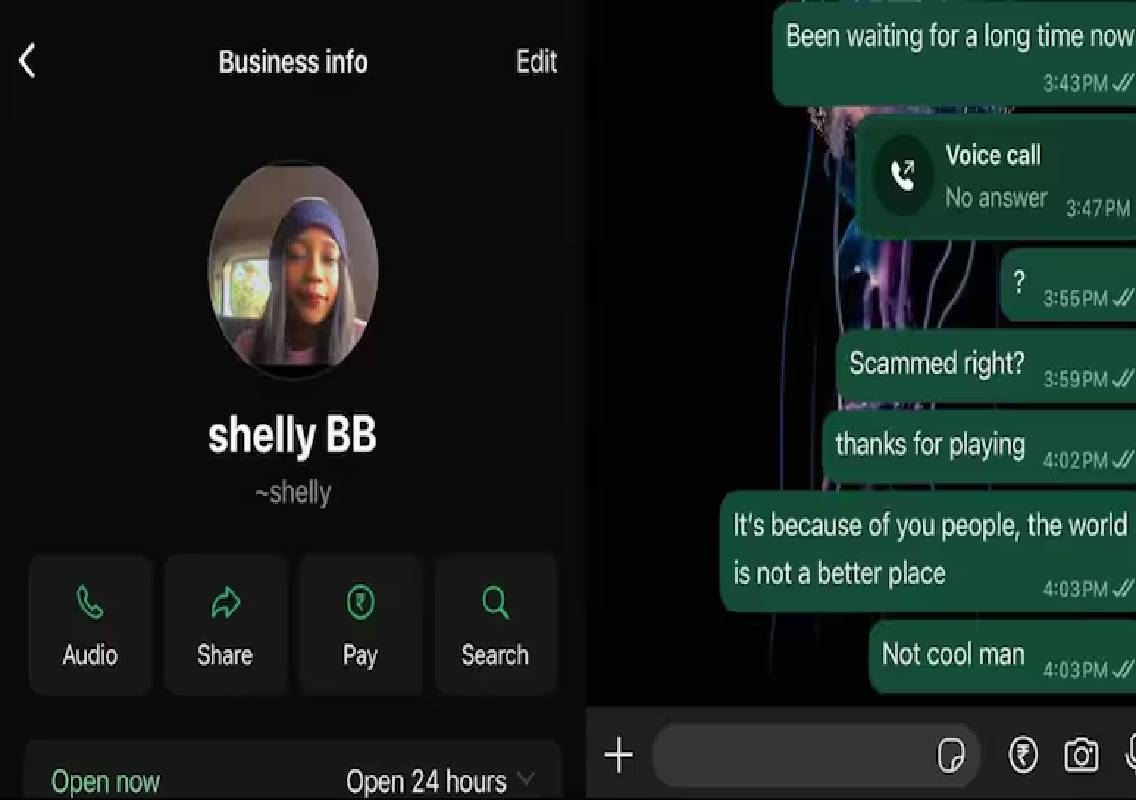


Bengaluru: A Bengaluru man has shared how he allegedly lost money in a dating app scam after a woman he had been speaking to asked him to collect and pay for a package from another man before their planned meeting.
The man described his experience in a social media post titled “Bangalore dating scam alert”, warning others about a suspected scam involving a woman he identified as Shelly and another person named Ron. According to his account, the two appeared to be working together and allegedly used a fake package payment request to obtain money from him.
The amount the man lost has not been disclosed in the report.
Bengaluru man connects with woman on dating app
According to the victim’s account, he matched with a woman named Shelly on a dating app and the two continued speaking for several days.
He said his busy work schedule initially prevented him from meeting her in person. However, after getting some time away from work, he decided to arrange a meeting with her.
The interaction appeared normal to him initially, and he continued communicating with her before the planned meeting.
The situation reportedly changed when Shelly asked him to collect a package from another man named Ron.
Woman allegedly asks him to pay for package
The woman reportedly told the Bengaluru man that he should collect the package from Ron and make the payment online. She allegedly said she would return the amount to him in cash.
The man said the request initially made him uncomfortable. However, according to his account, Shelly gave him an explanation that persuaded him to proceed.
She allegedly told him that her mother had a business and that she had more cash available than money online.
The man subsequently went to the location provided to him, where he met Ron.
Victim becomes suspicious at payment location
When the man reached Ron’s location, Ron reportedly told him that the package was being packed and asked him to make the payment in the meantime.
The Bengaluru man said he became suspicious at this stage and initially asked Ron to complete the process before he made the payment.
However, he eventually transferred the money.
Throughout the interaction, he said he remained in contact with Shelly, who was reportedly at a different location.
The continued communication with her apparently gave him confidence that the package request was connected to the woman he had planned to meet.
Second request raises more suspicion
After making the payment, the woman allegedly made another request.
According to the victim, Shelly asked him to buy cigarettes because she had forgotten to order them.
He complied with the request and returned after completing the errand.
However, the situation had changed by then.
The man said that both Shelly and Ron had stopped responding to his messages and that he could no longer contact either of them.
He subsequently concluded that the two were likely coordinating with each other.
Both suspects allegedly block victim
The Bengaluru man said that both individuals became unreachable after the payment was made.
According to his account, the woman and Ron had been communicating with each other while he was being persuaded to make the payment.
He alleged that the entire interaction had been carefully planned to deceive him and take his money.
NDTV reported the incident based on the man’s social media post and did not independently establish the identities of the two people or the allegations made in the post.
No police complaint or official investigation details were provided in the report.
Social media users react to the incident
The man’s post attracted attention online, with several users expressing sympathy and warning others to be cautious when meeting people through dating platforms.
Some users said that sharing such experiences could help other people recognise similar scams before losing money.
One commenter claimed to have interacted with a person matching the description on Bumble and said they had avoided further contact after becoming busy. However, such comments are individual accounts and do not independently establish a connection to the reported incident.
Other users encouraged the victim to report the incident to cybercrime authorities.
Dating scams increasingly use multiple steps
The reported incident highlights how dating scams can involve more than simply asking a victim for money.
In this case, according to the man’s account, the alleged scam involved establishing a relationship through a dating app, arranging a meeting and then introducing a third person and a seemingly unrelated package transaction.
The request for an online payment was reportedly presented as a temporary arrangement, with the woman allegedly promising to reimburse the victim in cash.
Such requests can make a payment appear less suspicious because the victim may believe they are simply helping someone they are about to meet.
The use of another person in the transaction can also make it more difficult for a victim to immediately recognise the larger pattern.
Warning signs to watch for
The incident serves as a reminder to exercise caution when someone met online asks for money or requests that a payment be made to an unfamiliar person.
Requests involving packages, urgent purchases, online transfers or reimbursements in cash should be treated carefully, particularly when the person making the request has not been met in person.
People should also be cautious if someone they have met online introduces a third party and asks them to transfer money directly to that person.
A request that seems unusual should be independently verified rather than relying solely on assurances from an online contact.
Avoid sending money to unfamiliar people
One of the simplest precautions when using dating apps is to avoid transferring money to people whose identity has not been independently verified.
Even when a person appears genuine and communication has continued for several days, familiarity through online conversations does not necessarily establish trust.
Users should also avoid sharing sensitive financial information, banking details, passwords or one-time passwords with people they meet through dating platforms.
If a financial request appears suspicious, ending the transaction and verifying the information through an independent channel can help prevent losses.
What victims can do after a suspected scam
The social media discussion around the Bengaluru incident also included advice to report suspected cybercrime.
One commenter suggested contacting the national cybercrime helpline 1930 and providing details such as phone numbers and transaction information.
A person who believes they have been financially defrauded should preserve relevant evidence, including payment records, bank transaction details, screenshots, chat messages, phone numbers and dating-app profiles.
Promptly informing the bank or payment service may also be important after an unauthorised or fraudulent transaction.
Online dating requires financial caution
Dating apps allow people to meet and communicate with others, but the anonymity of online interactions can also be exploited by scammers.
Fraudsters may create convincing identities, establish communication over several days and then introduce a financial request once the victim has developed a level of trust.
The Bengaluru man’s account illustrates how a relatively small request connected to a planned meeting can potentially turn into a financial loss.
The incident also demonstrates why unusual requests should not be ignored simply because they come from someone with whom a user has been communicating regularly.
Victim’s account highlights need for vigilance
The man said he initially felt that something was unusual about the request but eventually proceeded with the payment.
His experience shows how scammers can potentially exploit hesitation, urgency and emotional trust to persuade a person to continue with a transaction despite warning signs.
The fact that the alleged suspects became unreachable after the payment was made further increased his suspicion that the interaction had been coordinated.
However, the allegations remain based on the victim’s social media account unless and until they are confirmed through an official investigation.
Conclusion:
A Bengaluru man has shared his account of allegedly losing money in a dating app scam involving a woman and another person who reportedly asked him to pay online for a package. After the payment, both allegedly became unreachable. The incident serves as a reminder to verify identities, avoid unfamiliar financial requests and report suspected cyber fraud promptly.