







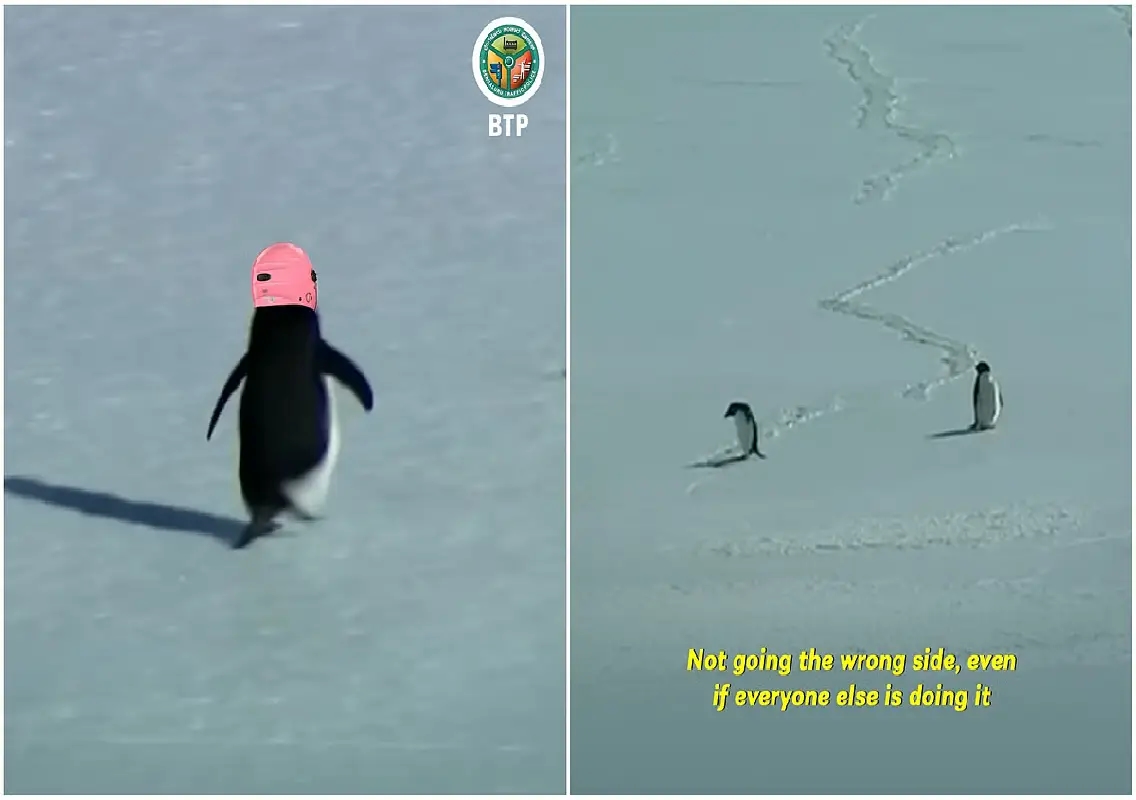


Bengaluru: In a creative blend of internet culture and public awareness, the Bengaluru Traffic Police have struck gold on social media by adopting the viral “Nihilist Penguin” trend to promote road safety. The light-hearted yet meaningful campaign, urging commuters to wear helmets and follow traffic rules, has resonated widely online and drawn praise for its relatable messaging.
The post, shared on the official X (formerly Twitter) handle of the Bengaluru Traffic Police, featured a series of images inspired by the globally popular “Nihilist Penguin” meme. The visuals showed a penguin seemingly wearing a helmet, walking alone with quiet determination — a clever metaphor for choosing safety over haste, even when others do not.
A viral trend meets road safety messaging
The post carried a thoughtful caption that tied the penguin’s solitary journey to responsible behaviour on Bengaluru’s often chaotic roads.
“This penguin walked miles and made headlines — not for speed, not for shortcuts, but for taking safe, steady steps forward. On Bengaluru roads too — don’t rush, don’t risk. Every ride matters. Helmet on. Always,” the caption read.
Each image in the series reinforced a specific traffic rule. The text over the visuals included messages such as:
- “Wearing a helmet always — even if it is for a short ride”
- “Not going the wrong side, even if everyone else is doing it”
- “Patience over pressure. Safety over speed”
The post quickly gained traction, with users appreciating the police department’s ability to communicate a serious message through humour and popular culture.
Internet reacts with praise and engagement
Social media users lauded the Bengaluru Traffic Police for their innovative approach. Many commented that the post was both emotionally resonant and effective in conveying the importance of road safety. Several users noted that such campaigns are more likely to stay in people’s minds compared to conventional warnings or penalty-focused messaging.
The post was widely shared, liked and commented on, adding to the department’s growing reputation for using digital platforms creatively to engage with citizens, particularly younger audiences.
What is the ‘Nihilist Penguin’ trend?
The “Nihilist Penguin” trend has been circulating widely across social media platforms in recent weeks. It is based on a short clip showing a lone penguin walking away from its colony toward distant snowy mountains, seemingly embarking on a solitary journey.
The video struck a chord with viewers, who interpreted it in multiple ways — from existential crisis and individualism to loneliness and quiet defiance. Many described the penguin’s walk as “almost human-like,” projecting emotions and philosophical meaning onto the simple act.
Though the trend has resurfaced strongly in 2026, the original footage is not recent. The clip comes from Encounters at the End of the World, a documentary directed by renowned filmmaker Werner Herzog. The documentary was released in 2007, nearly a decade before the clip gained viral status on social media.
From existential symbolism to brand campaigns
As the penguin clip went viral, brands, public institutions and prominent personalities began adapting it for their own messages. Apart from the Bengaluru Traffic Police, organisations such as the Delhi Police, food delivery platforms Swiggy and Zomato, ride-hailing service Rapido, and even United States President Donald Trump were among those who referenced the trend in various contexts.
Each adaptation added a unique interpretation, reflecting how subjective and flexible the symbolism of the penguin has become in the digital age.
A softer approach to a serious issue
Road safety remains a major concern in Bengaluru, which records thousands of traffic accidents every year. According to official data, failure to wear helmets and rash driving are among the leading causes of fatal two-wheeler accidents in the city.
By tapping into a popular trend, the Bengaluru Traffic Police have managed to reframe safety rules not as strict impositions, but as conscious, thoughtful choices — much like the penguin’s calm, steady walk away from the crowd.
Conclusion
The viral “Nihilist Penguin” post demonstrates how public institutions can effectively use humour, emotion and cultural relevance to communicate critical messages. As Bengaluru continues to grapple with traffic congestion and road safety challenges, such creative campaigns may play a key role in encouraging citizens to slow down, follow rules and prioritise safety — even when it means walking alone against the tide.