







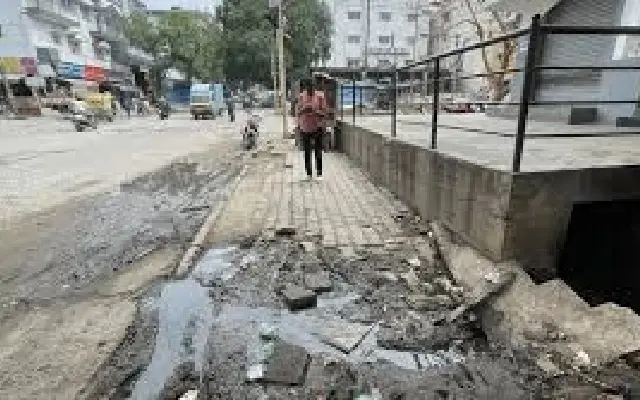


In India’s startup hub, footpaths are scarcer than unicorns. Despite Bengaluru‘s extensive 14,000km road network, pedestrian infrastructure is alarmingly insufficient. Out of 1,671km of arterial and sub-arterial roads, walkways exist along a mere 2.9km — roughly 17cm per 100 metres, about the length of a pencil.
TenderSure roads, designed with pedestrians in mind, cover just 13.4km. Elsewhere, the BBMP admits it lacks data. On the ground, paths are often broken, encroached, or absent. Zonal disparity is stark: East zone offers 1.2km of footpaths for 318km of roads; South zone, only 227m for 231km.
Local voices echo frustration. Jayanagar residents, like Malathi Sathish and Anish Reddy, lament disappearing walkways and new roads without pedestrian access. In KR Pura, there’s just 29.4m of footpath along 83km of road. Even upscale areas like Lavelle Road show neglect.
Planned infrastructure doesn’t promise better: of 272.4km of upcoming roads, only 594m are earmarked for footpaths. BBMP blames inadequate funds and missing data.
Globally, cities like Copenhagen, Tokyo, and Singapore lead with inclusive pedestrian policies. In contrast, Bengaluru’s footpath crisis affects the vulnerable — elderly, children, the poor. Over 15,000 pedestrian deaths were reported in India in 2021; Bengaluru recorded 292 fatalities in 2023 alone.
Experts urge policy shifts, citing safety, health, and sustainability. Citizens stress that walkable cities begin with safe, accessible sidewalks — not flyovers or fancy expressways. As resident Dhivya Kiran says, “A truly progressive city is one where even its weakest can walk freely.”
Read also: