







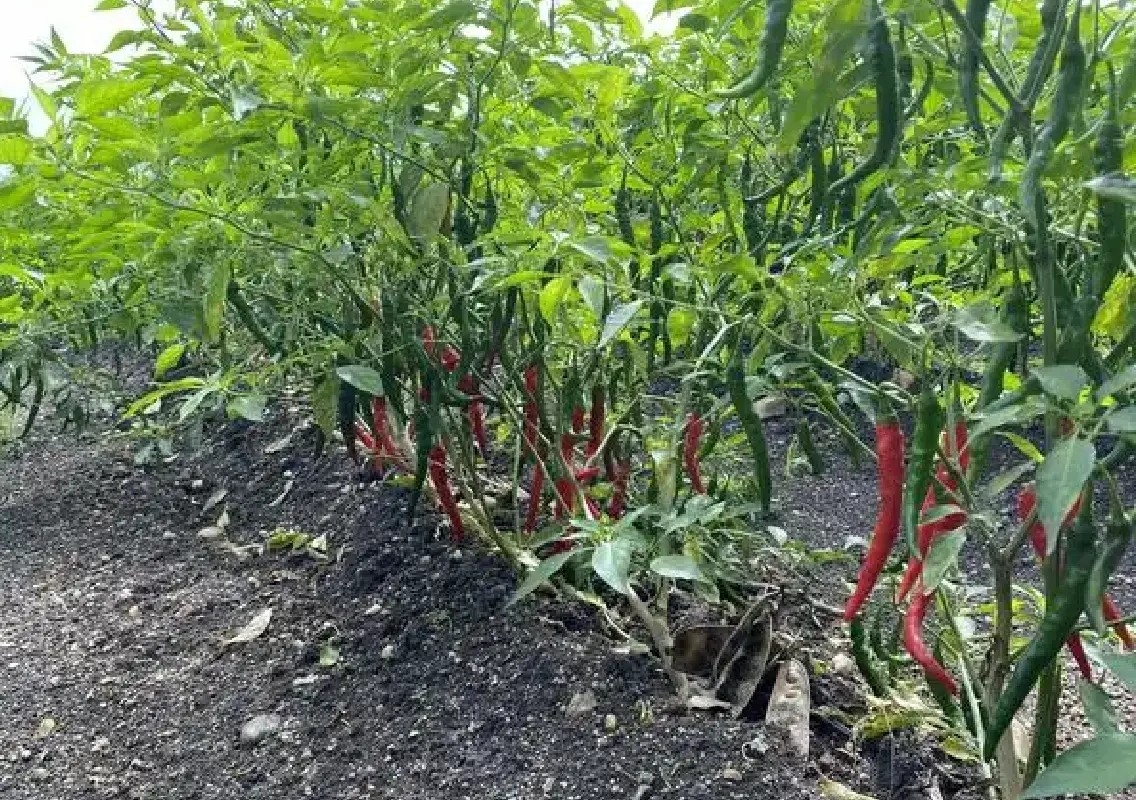


Bengaluru: Tiny black thrips have emerged as one of the biggest threats to Karnataka’s chilli farmers, damaging crops across major cultivation belts and significantly increasing production costs. While scientists say the pest is now better controlled than before, farmers continue to demand stronger government support to tackle the invasive insect.
The pest, Thrips parvispinus, has spread across north and Kalyana Karnataka, with Raichur recording the highest infestation levels.
Bengaluru identified as the origin of spread
Scientists first detected black thrips on papaya leaves in Bengaluru in 2015. By 2021, surveys conducted by the ICAR–Indian Institute of Horticultural Research (IIHR), Bengaluru, found that the pest had rapidly spread to chilli-growing regions, particularly Raichur.
According to IIHR, Thrips parvispinus accounted for 94–96% of the thrips population in Raichur during the survey, replacing other common species and becoming the dominant pest affecting chilli crops.
A 2024 survey published in the International Journal of Entomology Research found that Raichur recorded an average of 14.7 black thrips per plant, indicating severe infestation and crop damage.
Centre outlines support measures
The issue was recently raised in Parliament by Raichur MP G. Kumar Naik, who sought details on crop losses, compensation and measures to protect chilli growers.
Responding on behalf of the Centre, Union Minister of State for Agriculture Ramnath Thakur acknowledged that black thrips had become the predominant pest affecting chilli cultivation in Raichur.
The Centre said chilli cultivation has been brought under the Pradhan Mantri Fasal Bima Yojana (PMFBY) and the Restructured Weather-Based Crop Insurance Scheme, while Karnataka has increased the scale of finance for chilli cultivation by nearly 24%, from ₹55,884 to ₹69,189 per acre for the 2026–27 season.
However, the government admitted it does not maintain district-wise data on crop losses or farmer indebtedness linked to the pest.
Scientists recommend timely planting
IIHR entomologists said sustained scientific intervention has significantly reduced infestation levels.
Entomologist V. Sridhar said that while farmers were reporting 100–120 thrips per plant in 2021, the number has now fallen to fewer than 15 per plant in many fields.
He advised farmers to transplant chilli seedlings in July or August, allowing the crop to reach the fruiting stage before the pest population peaks during November and December.
Despite these improvements, farmer representatives continue to call for stronger scientific support, timely extension services and coordinated institutional action to protect Karnataka’s chilli growers.