







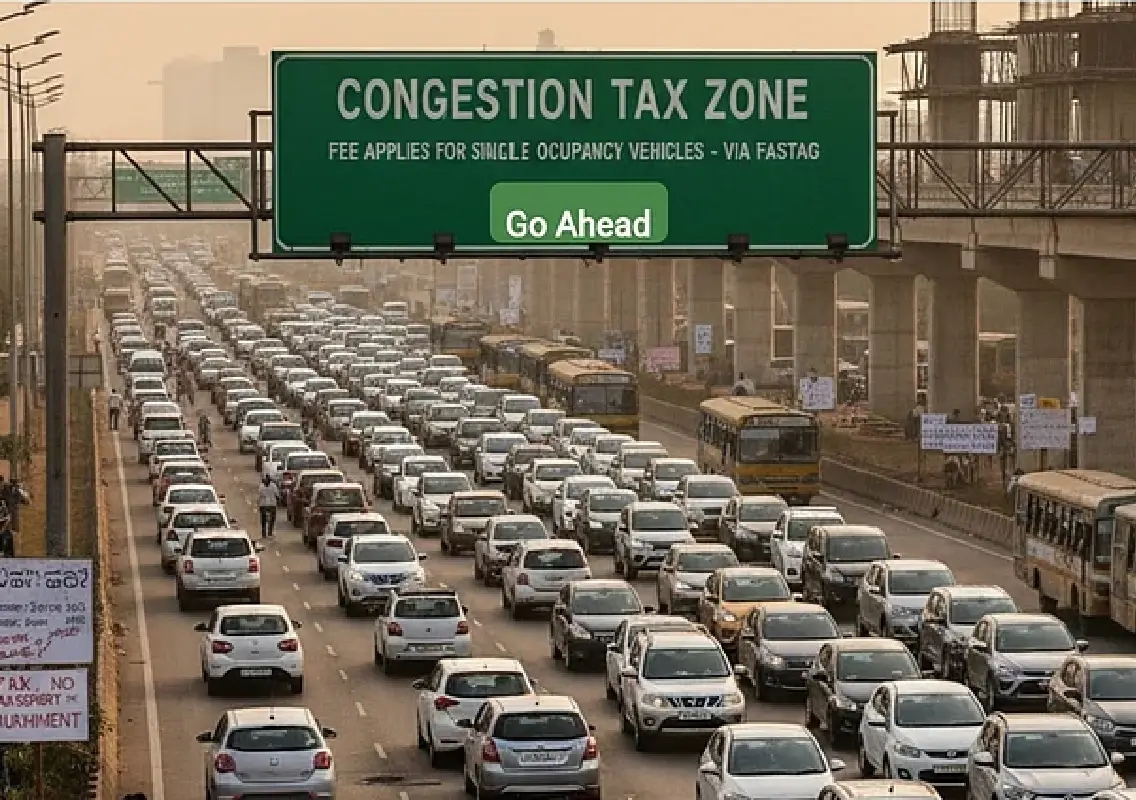


A congestion tax may soon become a reality for motorists in the city after the Karnataka State Finance Commission recommended introducing a “London-model” congestion charge to tackle rising traffic and raise revenue for urban development.
The recommendation was made in the Fifth State Finance Commission’s report for the period 2026–2030, which was recently tabled in the Karnataka Legislative Assembly.
According to the report, the proposed congestion tax aims not only to discourage excessive use of private vehicles but also to generate predictable revenue that could be reinvested in public transport and road infrastructure improvements.
Tax model inspired by global cities
The commission suggested implementing a system similar to the congestion charge introduced in London, where motorists are charged a fee to drive in heavily congested areas during peak hours.
Officials said such a system could potentially be implemented on major traffic corridors such as the Outer Ring Road using FASTag technology.
“The charge would help reduce congestion and pollution while creating a steady revenue stream that can be invested back into the city’s transport infrastructure,” the commission stated in its report.
Government yet to take final decision
However, the proposal is currently only a recommendation. The state government led by Siddaramaiah will decide whether to accept the commission’s suggestions.
Officials from the Chief Minister’s Office indicated that the report has only been tabled and a final decision on implementing the recommendations will be taken later.
Traffic crisis driving policy debate
The proposal comes as Bengaluru continues to struggle with severe traffic congestion. The city has more than 1.2 crore registered vehicles, with nearly 1,500 new vehicles being added every day.
Globally, cities such as Singapore have used congestion pricing successfully to reduce traffic volumes.
However, urban experts point out that congestion in Bengaluru is caused by multiple factors including inadequate road infrastructure, poor traffic management, delayed mass transit projects and limited investment in public transport.
Since the proposal was first discussed last year, public opinion has remained divided, with some residents supporting the idea while others question whether it would effectively solve the city’s traffic challenges.