







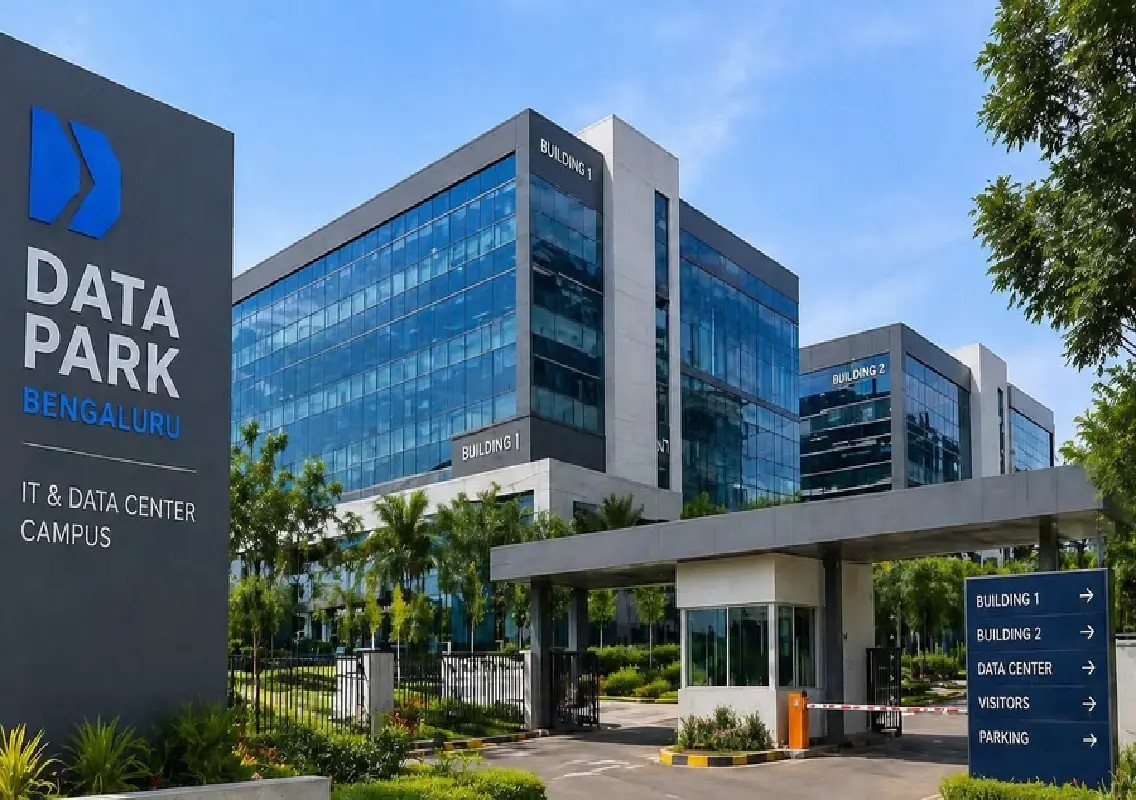


Bengaluru: The Karnataka government has announced plans to establish three “sustainable” data centre parks in Bengaluru, Mysuru, and Mangaluru, with a combined capacity of 1,000 megawatts (MW), in a move aimed at supporting the state’s growing digital infrastructure while addressing environmental concerns.
Large-scale data parks planned
The proposal was finalised during a preliminary meeting attended by Energy Minister KJ George, Industries Minister MB Patil, and IT Minister Priyank Kharge, along with senior officials.
A major data park with a capacity of 500 MW will be developed near Hoskote in Bengaluru. The government has also identified 350 acres of land at Baikampady Industrial Area in Mangaluru, under the Karnataka Industrial Areas Development Board (KIADB), for the second park. Suitable land for the third facility will be identified in Mysuru.
Focus on sustainability
The announcement comes after the government initiated a review of its data centre policy in March, amid concerns over the environmental impact of such facilities, particularly their high consumption of electricity and water.
To address these concerns, the proposed parks will incorporate sustainability measures. Solar power generated at Pavagada is expected to be supplied directly to the Bengaluru data park, reducing dependence on conventional energy sources.
Water requirements will also be managed through recycling. The Bangalore Water Supply and Sewerage Board (BWSSB) has indicated that it can supply up to 60 million litres per day (MLD) of secondary treated water. Industries setting up operations in the parks will further treat this water to meet their specific needs.
Growing demand for data infrastructure
Karnataka currently hosts 32 data centres, and the demand is expected to grow significantly with the expansion of technologies such as artificial intelligence, machine learning, and cloud computing.
Officials noted that a combined capacity of 1,000 MW—equivalent to one gigawatt—represents the total electrical load required to run servers, cooling systems, and network infrastructure across the three parks.
Investment and infrastructure challenges
The government has assured that both power and water will be provided to investors setting up data centres in these parks. Ministers have directed officials to begin preparatory work and organise meetings with potential investors in the coming weeks.
However, challenges remain, particularly in ensuring uninterrupted power supply for such energy-intensive facilities. According to officials, one megawatt of data centre capacity can require an investment of around Rs 70 crore and significant land and water resources.
Environmental concerns highlighted
Speaking earlier in the Assembly, Priyank Kharge had described data centres as a “necessary evil”, acknowledging their importance in driving digital innovation while also highlighting their environmental footprint.
He pointed out that data centres consume large volumes of water and electricity, with estimates suggesting that a single megawatt facility may require around 25 million litres of water annually.
Next steps
In the next phase, the government plans to constitute a committee of ministers, including Deputy Chief Minister DK Shivakumar, to oversee implementation and address resource-related challenges.
Industries Minister MB Patil stated that the data parks would be established at the earliest, signalling the government’s intent to position Karnataka as a leading hub for next-generation digital infrastructure.
Conclusion
The proposed data parks reflect Karnataka’s ambition to balance technological growth with environmental responsibility. While the initiative promises to boost investment and innovation, its long-term success will depend on how effectively sustainability measures are implemented alongside rapid infrastructure expansion.