







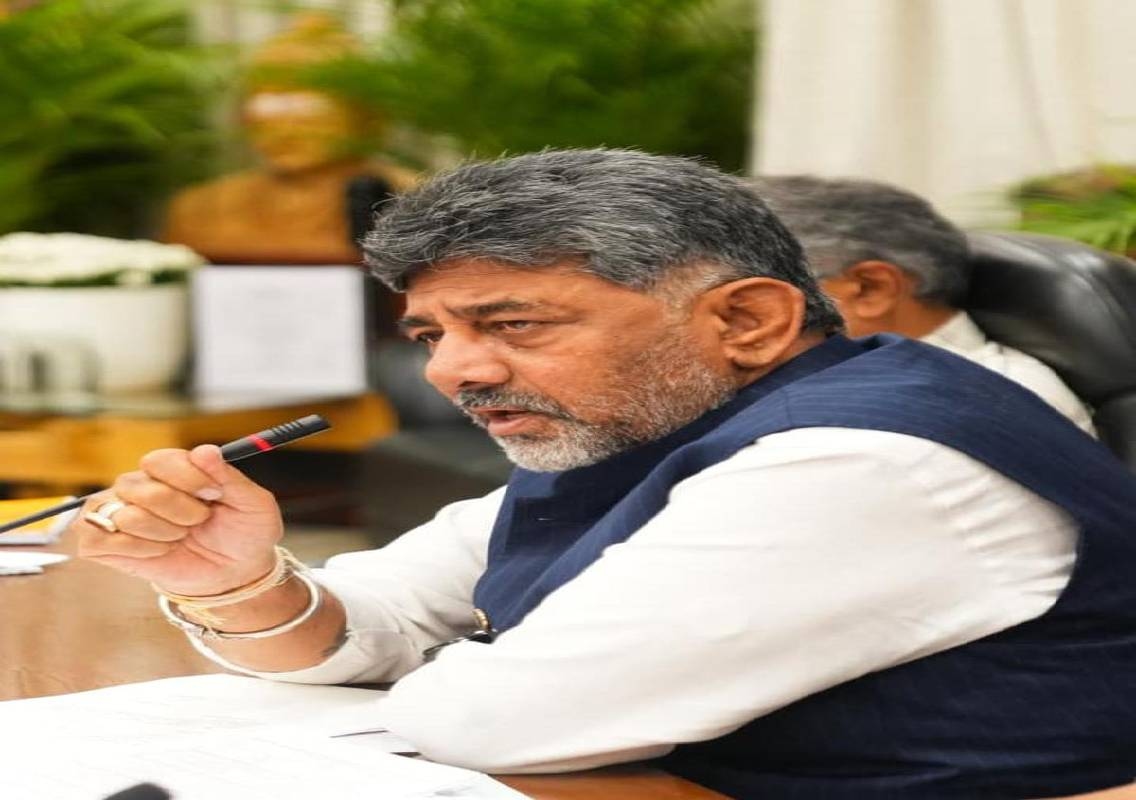


Bengaluru: Karnataka Chief Minister D.K. Shivakumar has directed officials to identify five cities outside Bengaluru for industrial development, in a move aimed at spreading investment, creating jobs and strengthening economic activity across different parts of the State.
The directive was issued during a progress review meeting of the Commerce and Industries Department at the Chief Minister’s home office in Bengaluru on Friday. The proposed initiative is part of the State Government’s broader “Beyond Bengaluru” strategy, which seeks to reduce the concentration of industrial and technology activity in the capital and encourage companies to establish operations in other cities.
Officials have been asked to identify cities that have suitable infrastructure, including airport connectivity, and the potential to attract major investments. The Government plans to offer special incentives to companies that establish operations in the selected locations, particularly in emerging and high-growth sectors.
The move comes as Karnataka seeks to strengthen its position as an investment destination while ensuring that industrial development reaches regions beyond Bengaluru.
Five cities to be identified outside Bengaluru
The Chief Minister has asked officials to shortlist five cities across Karnataka that can be developed as new industrial centres.
The Government has not yet announced which five cities will be selected. Officials are expected to assess factors such as connectivity, availability of infrastructure, industrial land, skilled manpower and investment potential before making their recommendations.
Airport connectivity has been identified as an important consideration. The Government believes cities with good air links and supporting infrastructure will be better positioned to attract large domestic and international companies.
The selected locations are expected to receive focused attention as part of Karnataka’s effort to create a more geographically distributed industrial ecosystem.
Focus on emerging industries
The proposed industrial hubs are expected to target sectors with significant future growth potential.
These include semiconductors, aerospace and defence, clean mobility and cell manufacturing, along with other emerging industries.
These sectors are considered important to Karnataka’s long-term industrial strategy because they can attract large investments while creating skilled employment opportunities.
Semiconductor manufacturing, for instance, requires substantial infrastructure and specialised talent, while aerospace and defence can generate a wide network of suppliers and ancillary industries.
Similarly, clean mobility and battery or cell manufacturing are expected to become increasingly important as India expands its electric vehicle ecosystem.
By identifying locations outside Bengaluru for such investments, the Government hopes to encourage industrial clusters to develop in different regions of Karnataka.
Special incentives planned for investors
The State Government plans to use special incentives to attract companies to the selected cities.
The incentives are intended to make locations outside Bengaluru more competitive for investors and encourage companies to consider alternatives to the State capital.
The Government’s approach recognises that infrastructure alone may not be sufficient to persuade companies to establish operations in emerging industrial centres.
Financial and policy incentives could therefore play an important role in attracting investments, particularly during the initial stages of development.
The proposed strategy could also encourage companies already operating in Bengaluru to consider expanding into other Karnataka cities.
Job creation among key objectives
Employment generation is another major objective of the initiative.
Bengaluru has attracted a large share of Karnataka’s technology, services and high-value industries over the years, creating significant employment opportunities in and around the city.
However, concentrating economic activity in one metropolitan region can also create pressure on housing, transport, infrastructure and public services.
Developing industrial centres elsewhere could help distribute employment opportunities across the State.
The Government expects the proposed industrial expansion to create jobs in the selected cities while also supporting businesses and services around new industrial clusters.
Beyond Bengaluru strategy gets fresh push
Karnataka has been promoting the Beyond Bengaluru concept for several years, with the objective of encouraging investment and technology development in cities other than the capital.
The latest directive gives the strategy a renewed industrial focus.
Rather than limiting the initiative to technology and startups, the Government is now looking at a broader range of industries, including manufacturing and emerging technologies.
The selection of five cities could therefore become an important step in creating multiple economic centres across Karnataka.
Airport connectivity to influence selection
One of the clearest criteria mentioned by the Government is airport connectivity.
Easy access to airports can be particularly important for industries that depend on international business travel, high-value cargo movement and connections with global supply chains.
It can also make cities more attractive to senior executives and skilled professionals who need to travel frequently.
Officials will therefore have to balance industrial potential with existing transport infrastructure when deciding which cities should be recommended.
Faster approvals for industries
Alongside identifying new industrial locations, Shivakumar has directed departments to improve the process of granting approvals to businesses.
The State’s single-window system currently integrates 22 departments and 119 services, according to the review meeting. The Chief Minister stressed that applications should be processed within the stipulated timeframe.
A faster approval process is expected to reduce delays for companies looking to establish operations in Karnataka.
For investors, the speed and predictability of government approvals can be as important as financial incentives.
The Government therefore appears to be pursuing two parallel objectives: creating attractive industrial locations and making it easier for companies to start operations.
Karnataka wants to improve investor ranking
During the meeting, Shivakumar said Karnataka currently stood ninth in NITI Aayog’s investor-friendly index and directed officials to work towards improving the State’s ranking.
Improving the investment environment is expected to be important as Karnataka competes with other States for large industrial projects.
The Government also discussed measures adopted by Andhra Pradesh, Uttar Pradesh, Tamil Nadu and Madhya Pradesh to attract investments.
Studying the policies of competing States could help Karnataka identify areas where its own investment framework can be strengthened.
Competition between States intensifies
Indian States are increasingly competing to attract manufacturing, technology and infrastructure investments.
Large projects in sectors such as semiconductors, electric mobility and aerospace can bring substantial capital expenditure as well as long-term employment.
Karnataka already has a strong industrial and technology base, but the Government wants to ensure that new investments continue to flow into the State.
Developing multiple industrial centres could help Karnataka compete more effectively by offering companies alternatives based on land availability, connectivity, workforce and local infrastructure.
Bengaluru faces growing infrastructure pressure
The push to develop industrial centres outside Bengaluru also comes against the backdrop of the capital’s rapid growth.
Bengaluru remains Karnataka’s dominant technology and business hub, but its expansion has placed increasing pressure on roads, public transport, housing and other urban infrastructure.
A larger distribution of industrial activity could eventually reduce some of the pressure caused by excessive concentration around the capital.
However, building viable industrial hubs outside Bengaluru will require substantial investment in roads, power, water supply, housing, logistics and education.
Infrastructure will determine success
Identifying five cities is only the first step.
For the initiative to succeed, the selected cities will need infrastructure capable of supporting large industrial projects.
Companies looking to establish manufacturing facilities require reliable electricity, water, roads, logistics networks and telecommunications.
They also need access to skilled workers and supporting businesses.
The Government will therefore need to coordinate industrial development with urban planning and infrastructure expansion.
Opportunity for Karnataka’s regional cities
The proposed initiative could provide a significant opportunity for Karnataka’s regional cities.
Cities across the State already have different industrial strengths, educational institutions and existing business ecosystems.
Some have established manufacturing clusters, while others have advantages in areas such as aerospace, automobiles, agriculture, textiles, logistics and information technology.
A targeted industrial strategy could build on these existing strengths rather than attempting to create identical industrial hubs everywhere.
Manufacturing remains a major focus
The initiative also comes as Karnataka seeks to strengthen its manufacturing sector.
The State has traditionally been known globally for information technology and services, particularly because of Bengaluru.
However, manufacturing can provide employment opportunities across a broader range of skill levels and can support large networks of small and medium enterprises.
New industrial centres could therefore help Karnataka create a more diversified economy.
Semiconductor sector offers major potential
The semiconductor industry is one of the sectors specifically identified for attention.
India is seeking to build domestic semiconductor manufacturing and electronics supply chains, creating opportunities for States that can offer suitable land, infrastructure and skilled manpower.
Karnataka already has a strong technology and engineering ecosystem, which could give the State an advantage in attracting companies linked to the semiconductor industry.
The challenge will be to ensure that suitable infrastructure is available outside Bengaluru as well.
Aerospace and defence opportunities
Aerospace and defence are also expected to play a role in the proposed industrial expansion.
Karnataka has an established aerospace ecosystem, supported by engineering talent and major research and manufacturing institutions.
Expanding aerospace and defence-related industries into additional cities could create new supplier networks and employment opportunities.
Such clusters can also generate opportunities for smaller companies involved in precision engineering, components, maintenance and specialised manufacturing.
Clean mobility and cell manufacturing
The Government’s focus on clean mobility and cell manufacturing reflects the changing automotive industry.
Electric vehicles are increasing demand for batteries, battery cells, charging infrastructure and related components.
Karnataka can potentially use its existing automotive and technology ecosystem to attract investments in these areas.
Locating such facilities outside Bengaluru could also provide access to larger industrial land parcels and potentially lower operating costs.
Global technology centres also planned
The State is also considering establishing global technology centres in five different locations, according to reports on the Government’s wider industrial strategy.
Such centres could help extend Karnataka’s technology ecosystem beyond Bengaluru.
The development of technology centres alongside industrial clusters could create stronger links between research, manufacturing and services.
It could also encourage skilled professionals to build careers outside the capital.
Single-window system under scrutiny
The Chief Minister’s emphasis on the single-window approval system highlights another challenge facing industrial expansion.
Companies typically need clearances from multiple departments before starting operations.
Delays in approvals can increase project costs and affect investment decisions.
With 22 departments and 119 services currently integrated into Karnataka’s system, the Government wants departments to ensure applications are processed within prescribed timelines.
Learning from other States
Officials have also examined investment-attraction measures adopted by other States.
Andhra Pradesh, Uttar Pradesh, Tamil Nadu and Madhya Pradesh were among the States discussed during the meeting.
The comparison is significant because each of these States has been competing aggressively for manufacturing and infrastructure projects.
Karnataka’s challenge will be to retain its existing advantages while addressing concerns such as approval timelines, industrial land availability and regional infrastructure.
Potential impact on smaller businesses
The creation of new industrial hubs could benefit small and medium enterprises as well.
Large manufacturing projects typically require suppliers for components, logistics, maintenance, food services, transport and other business needs.
Once an industrial cluster develops, these supporting businesses can generate additional employment and investment.
The Government’s regional industrial strategy could therefore have an impact beyond the companies that directly receive investment incentives.
Need for balanced regional development
The initiative could also support more balanced economic development across Karnataka.
Large cities tend to attract more investment because they already have better infrastructure and larger talent pools.
However, this can create regional disparities.
Directing industrial investment towards selected cities outside Bengaluru could help bridge some of these gaps.
The success of the strategy will depend on whether the selected locations receive sustained policy and infrastructure support.
Challenges ahead
There are several challenges that Karnataka will have to address.
The first is identifying cities that genuinely have the potential to attract major industries.
The second is developing the infrastructure required by those industries.
The third is ensuring that incentives are competitive without creating unnecessary financial burdens for the State.
Finally, the Government will have to ensure that the new industrial hubs receive consistent support over several years rather than only during the initial investment phase.
What happens next
Officials will now begin the process of identifying the five cities.
The Government is expected to assess their airport connectivity, infrastructure and industrial potential before finalising the locations.
Once the cities are identified, the next stage would involve designing incentives and developing the infrastructure required to attract investors.
The Government will also need to coordinate with the relevant departments to ensure that approvals are processed quickly.
A shift from one-city growth
Karnataka’s latest move represents an attempt to move away from a model where Bengaluru remains the primary destination for new industries.
The capital will continue to be a major economic centre, but the Government is seeking to create additional locations capable of supporting high-value industries.
If successful, the strategy could produce a network of industrial and technology hubs across the State rather than a single dominant centre.
Conclusion
Bengaluru: Karnataka Chief Minister D.K. Shivakumar has directed officials to identify five cities outside Bengaluru for industrial development, with the Government planning incentives to attract investments and create more employment opportunities.
The proposed cities will be selected based on factors including airport connectivity and supporting infrastructure. Emerging sectors such as semiconductors, aerospace and defence, clean mobility and cell manufacturing are expected to be among the areas targeted for investment.
The Government is also working to improve the single-window approval system, which currently integrates 22 departments and 119 services. Shivakumar has instructed officials to process industrial applications within stipulated timelines and improve Karnataka’s investor-friendly ranking.
The initiative could give regional cities a stronger role in Karnataka’s industrial economy while helping reduce the concentration of jobs and investment in Bengaluru. However, its success will depend on the quality of infrastructure, incentives, connectivity and long-term government support provided to the selected cities.