







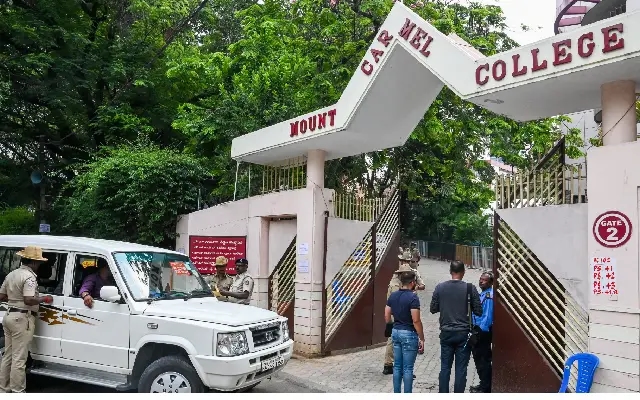


Bengaluru: A campaign opposing the student dress code at Mount Carmel College has sparked a wider debate on whether such rules amount to moral policing and curtailment of freedom of expression.
The campaign was shared on the Instagram page of Collective Bangalore and described the rules as “new”. However, the college principal has previously stated that the regulations have long been in place.
Rules and restrictions
The dress code prohibits flip-flops, cargo pants, coloured hair, and round or V-neck T-shirts, while requiring male students to keep their hair groomed. Students also claim the institution has introduced restrictions on campus movement and cancelled student elections.
Several students have spoken about their experiences. A first-year female student said she and her peers are often reprimanded for wearing printed T-shirts. On one occasion, she was sent home for wearing pants with pockets, and on another, for pairing a sleeveless blouse with a shirt.
A first-year male student said such rules create “unwanted fear among girls” and make them feel unsafe. “I have long hair but am constantly told to cut it. The rules feel arbitrary,” he added.
A broader divide on dress codes
Faculty and administrators across institutions remain divided. Joshua Samuel, principal of Baldwin Methodist College, said his institution has followed a dress code for over a decade without major resistance. Students of professional courses wear uniforms, while others are expected to dress “well”. He said the objective was to promote equality and decency, not to police fashion.
Y C Kamala, associate professor at Government First Grade College, Malleswaram, called dress codes a “necessity”. She argued that boundaries help students focus on learning during college hours, while acknowledging that decency is subjective.
Former University Visvesvaraya College of Engineering principal Venugopal K R also supported dress codes, especially uniforms, saying they reduce class disparities. “In private colleges, fashionable and expensive clothes often reflect social status. Moderate attire ensures focus and discipline,” he said.
Voices of opposition
Others, however, are firmly opposed. S Japhet, former vice-chancellor of Bengaluru Central University, said dress codes, especially in women’s colleges, are problematic. “Dress is a form of self-expression. Restricting it in the name of decency is moral policing,” he argued. Japhet maintained that such decisions should be made democratically, in consultation with students, parents and alumni, rather than imposed unilaterally.
A journalism professor said codes of conduct should prioritise justice and safety rather than attire, warning that vague rules often become tools for micromanagement. “Over-policing breeds mistrust,” she observed.
Echoing this view, Rolla Das, assistant professor at a private university, noted that dress codes, initially intended to ensure uniformity and professionalism, have now become instruments of surveillance and control.
Conclusion
The debate highlights a deep divide between administrators and students on the role of dress codes in higher education. While some argue they promote equality and focus, critics warn that they risk stifling individuality and fostering a culture of control.