







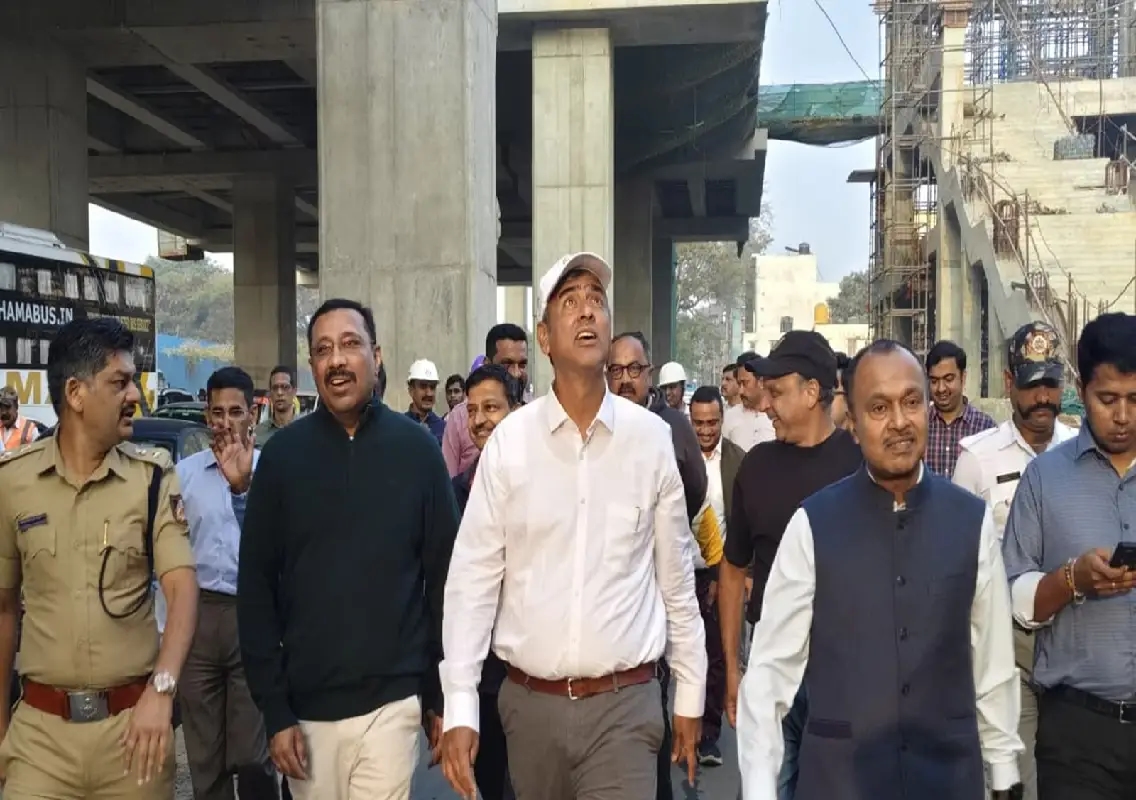


Bengaluru: Greater Bengaluru Authority (GBA) Chief Commissioner Maheshwar Rao has directed officials to prepare a detailed blueprint for constructing an additional flyover near Iblur Junction on the Outer Ring Road (ORR) to address chronic traffic congestion in the corridor. The direction was issued during a joint inspection conducted with senior officials from multiple infrastructure and civic agencies.
The inspection team included representatives from the GBA, Bengaluru Smart Infrastructure Limited (B-SMILE), Bangalore Metro Rail Corporation Limited (BMRCL), and the East and South City Corporations. Officials reviewed on-ground conditions and ongoing works along the busy stretch, which carries some of the highest traffic volumes in the city.
Focus on Silk Board to KR Puram corridor
Bengaluru officials said the ORR stretch from Silk Board Junction to KR Puram is proposed to be developed in a comprehensive and integrated manner, combining flyovers, service roads, footpaths, Metro-linked works and pedestrian infrastructure.
During the visit, Rao instructed departments to adopt modern construction technologies so that the proposed flyover near Iblur Junction can be built within a short timeframe and with minimal disruption to traffic. He asked officials to submit a detailed project plan covering estimated cost, construction model, traffic diversion strategy and completion timeline.
Infrastructure experts involved in preliminary assessments indicated that an approximately 800-metre-long flyover may be required at Iblur Junction to streamline vehicle movement and reduce bottlenecks.
Coordination with Metro and civic agencies
Bengaluru authorities emphasised that the flyover and related works must be closely coordinated with ongoing Metro construction activity along the corridor. Rao called for joint planning with BMRCL and the South City Corporation to ensure holistic development of key junctions, especially Silk Board and surrounding intersections.
He noted that Metro pile cap works are currently underway at major points and directed officials to speed up execution while ensuring that vehicular movement is not severely affected. Traffic management during construction must be planned in advance, he said.
Officials were also asked to integrate flood-prevention measures, high-performance road construction (HRPC) techniques and junction redesign elements wherever required, instead of executing isolated works.
DPR to avoid duplication of work
Bengaluru project authorities said a broader traffic decongestion plan is being prepared for the ORR, covering carriageway upgrades, service roads, pedestrian paths and junction improvements. As Metro-related median and footpath works are already in progress at several locations, Rao directed BMRCL and B-SMILE to jointly finalise the Detailed Project Report (DPR).
The aim is to avoid duplication of work and repeated digging or redesign of the same stretches by different agencies. He stressed that all Metro-related surface works must strictly follow the approved comprehensive corridor development plan.
Officials said such coordination is critical to prevent cost overruns and repeated inconvenience to commuters.
Road width and surface issues flagged
Bengaluru inspection teams observed that roads beneath several Metro stations along the ORR are currently uneven and narrowed due to ongoing pile cap construction. In some places, barricading and material storage have reduced usable carriageway width, increasing congestion risk during peak hours.
Rao directed officials to conduct a station-by-station inspection along the corridor and immediately rectify surface defects, unsafe barricading and uneven stretches. Temporary restorations and proper surfacing must be completed wherever civil works have disturbed the road, he said.
He warned that unattended interim conditions could worsen congestion and increase accident risk.
Footpath and pedestrian infrastructure gaps
Bengaluru field officers also noted poor maintenance and incomplete work along a nearly 2-km footpath stretch near Iblur Metro Station towards Silk Board Junction. The Chief Commissioner instructed agencies to develop and complete the footpaths without delay to improve pedestrian safety and accessibility.
He said pedestrian infrastructure must be treated as an essential component, not an afterthought, in ORR development. All Metro-linked footpath works should be executed in coordination with B-SMILE and civic bodies.
In addition, officials from the City Corporation and Traffic Police have been directed to jointly inspect the ORR and prepare a list of locations where pedestrian skywalks are required. The report must include design concepts and estimated funding needs.
Kodibisanahalli stretch to be widened
Bengaluru authorities also reviewed congestion issues near Kodibisanahalli Metro Station, close to the Marathahalli Police Station. A narrow stormwater drain and constrained road edge were found to be affecting smooth vehicular flow at this point.
Rao instructed officials to widen the usable road space in this stretch and construct proper footpaths alongside, while addressing the stormwater drain constraint through engineering solutions.
He reiterated that junction improvements, pedestrian access, drainage and carriageway width must be addressed together rather than in isolation.
Integrated approach to ORR upgrades
Bengaluru planners said the proposed Iblur flyover and related ORR works are part of a larger integrated mobility approach combining Metro expansion, grade separators, pedestrian facilities and smart traffic engineering.
Once the blueprint and DPR are finalised, the project will move to cost approval and execution model selection. Officials indicated that phased implementation with strict inter-agency coordination will be key to delivering congestion relief on one of the city’s most critical corridors.