







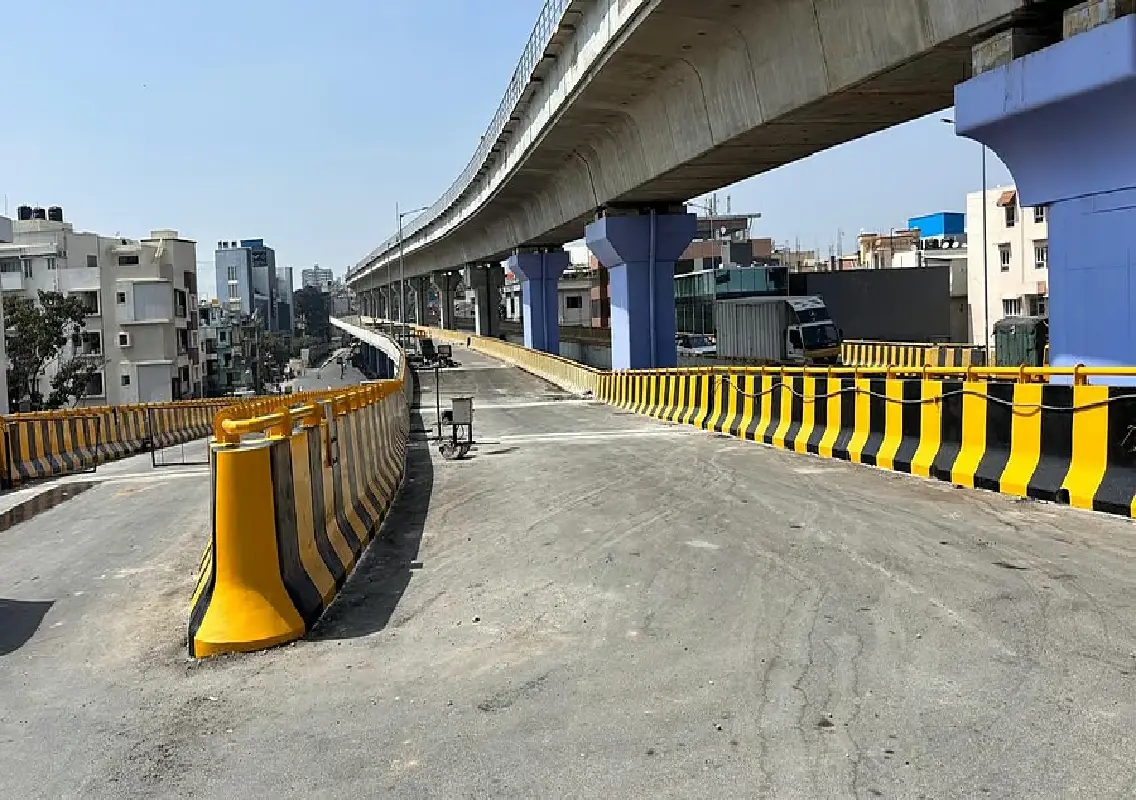


Bengaluru: The city’s first double-decker flyover at the congested Silk Board Junction is nearing completion, raising hopes of significant relief for thousands of daily commuters. The ₹449-crore infrastructure project, designed to ease chronic traffic congestion at one of Bengaluru’s busiest intersections, is expected to be fully operational by the end of February, according to officials.
Project nearing the finish line
Major portions of the double-decker flyover were opened to traffic in phases during 2024. However, one crucial stretch remained incomplete due to delays in installing a 42-metre-long steel bridge over the existing roadway. Officials said this technically complex task slowed progress but is now in its final stages.
Workers are currently completing concrete slab casting on the remaining section. Bengaluru Metro Rail Corporation Limited (BMRCL), which is overseeing the project, has indicated that all civil works are likely to be wrapped up by the end of February, subject to final inspections and approvals.
Strategic link between key corridors
The flyover connects HSR Layout with BTM Layout and is intended to allow vehicles to bypass the heavily congested Silk Board signal. Once fully operational, it is expected to streamline traffic movement between major residential and commercial hubs, including Hosur Road, BTM Layout, HSR Layout and Bellandur.
The structure has been planned as a double-decker to optimise limited urban space and improve traffic flow without acquiring large stretches of land. Urban planners believe this design could serve as a model for future infrastructure projects in traffic-prone parts of the city.
Commuters pin hopes on faster travel
Regular commuters have expressed cautious optimism about the flyover’s opening. Many say even a marginal reduction in waiting time at Silk Board Junction would make a significant difference to their daily commute.
“I travel from Banashankari, and Silk Board is the worst part of my journey. Even a 10-minute reduction in wait time would be a reward. Silk Board is a nightmare every evening,” said Lavanya K, an officegoer. She added that once the HSR-bound ramp opens, vehicles heading towards HSR Layout and Hosur Road are expected to move faster instead of being funnelled into the same traffic signal.
Another commuter, Vijay Das, echoed similar sentiments. “Avoiding the signal from Silk Board to BTM Layout will be a huge relief. Right now, traffic piles up from all directions, and it takes forever to cross the junction,” he said.
Several commuters pointed out that while the Banashankari-side flyover is already operational and has eased traffic to an extent, the missing HSR connection has been a major bottleneck. “That link is critical. Without it, the benefit of the flyover is only partial,” a daily commuter remarked.
Delays and engineering challenges
Officials involved in the project acknowledged that the installation of the 42-metre steel girder posed engineering and logistical challenges. The work had to be carried out over live traffic and existing infrastructure, requiring careful planning and multiple safety clearances.
Despite the delays, BMRCL officials maintained that the project is now firmly back on track. “The work is in its final stages. Once the contractor completes the remaining tasks, the structure will be inspected by traffic police before it is opened to the public,” a senior BMRCL official said.
Traffic police clearance awaited
The final step before opening the flyover is a mandatory inspection and clearance by the traffic police. This process includes verifying structural safety, signage, lane markings and traffic integration plans to ensure smooth flow once vehicles are allowed.
Deputy Commissioner of Police (Traffic, South) Gopal M Byakod confirmed that the flyover is expected to be fully operational by the end of February. He said the new infrastructure would help ease congestion not just at the Silk Board Junction but also along connecting corridors leading to BTM Layout, HSR Layout and Bellandur.
Anticipated impact on congestion
Traffic experts believe that once operational, the double-decker flyover could significantly reduce congestion during peak hours by allowing through-traffic to bypass the signal entirely. This is expected to reduce queue lengths, travel time and fuel wastage at one of the city’s most notorious choke points.
However, some experts caution that infrastructure alone may not be a permanent solution unless complemented by traffic management measures and public transport improvements. With vehicle numbers continuing to rise in Bengaluru, sustained monitoring and adaptive traffic planning will be essential to maintain smoother flow.
Conclusion
As the finishing touches are applied to the Silk Board double-decker flyover, expectations among commuters are high. If opened as scheduled by the end of February, the project could mark a turning point for traffic movement at the junction long regarded as one of Bengaluru’s worst bottlenecks. While long-term congestion management will require multiple interventions, the flyover is widely seen as a much-needed step towards easing daily travel woes in the area.