


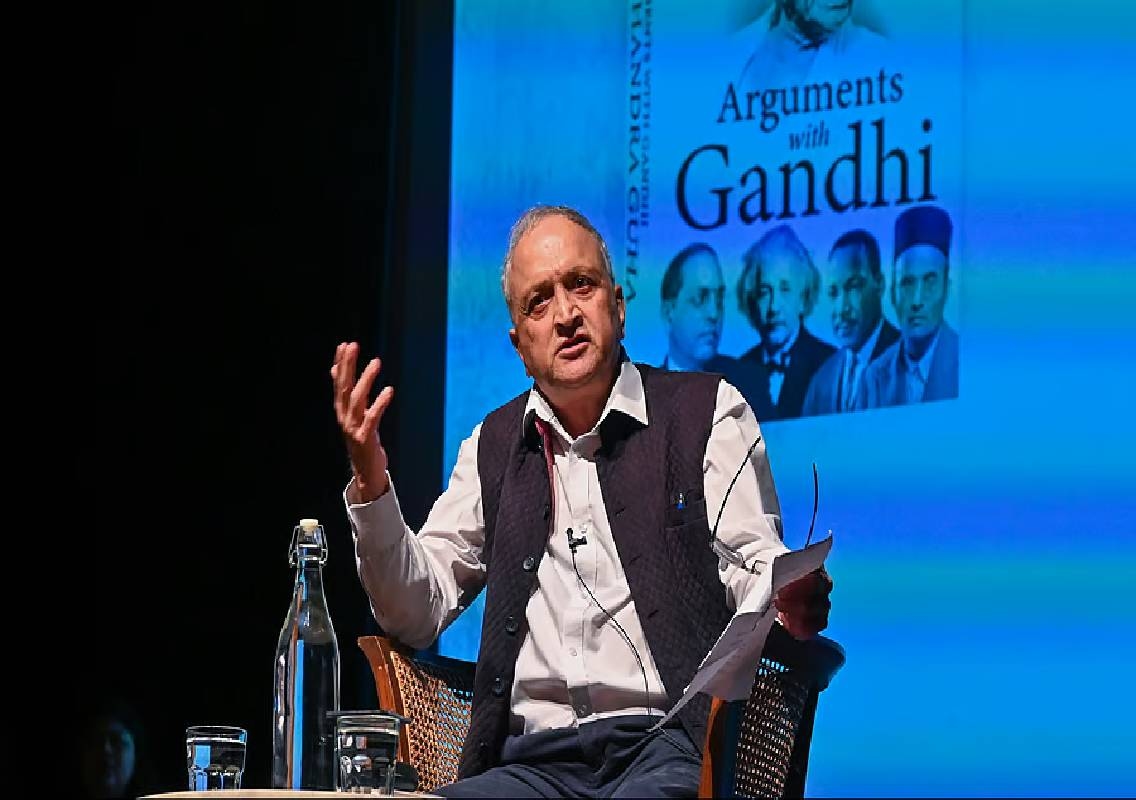


Bengaluru: Historian and author Ramachandra Guha launched his latest book, Arguments with Gandhi, at the Bangalore International Centre (BIC) in Domlur on October 2, coinciding with Gandhi Jayanti. The event examined Mahatma Gandhi’s ideas through the disagreements, debates and intellectual exchanges that shaped his public life and continued after his death.
The book, published by Fourth Estate India, was formally released on October 2, 2026. It runs to 432 pages and is priced at Rs 999.
Guha’s latest work approaches Gandhi differently from his earlier two-volume biography. Rather than following Gandhi’s life through a conventional chronological account, the book uses major arguments around caste, religion, violence, nationalism, economics and social change to examine the continuing relevance and limitations of Gandhi’s ideas.
Book traces nearly three decades of work
Speaking at the Bengaluru event, Guha said the origins of Arguments with Gandhi went back to 1996, when he was invited to teach at the University of California, Berkeley.
While preparing a course, Guha studied Gandhi alongside the writings of B.R. Ambedkar and D.R. Nagaraj. He subsequently proposed a university course titled Arguments with Gandhi, which brought together students from different cultural and social backgrounds.
The classroom experience encouraged him to examine how Gandhi’s ideas were understood outside India and how people from different traditions responded to his positions.
Guha later spent years researching and writing his two-volume biography of Gandhi — Gandhi Before India and Gandhi: The Years That Changed the World. He said that the extensive research undertaken for those books eventually helped him approach Gandhi’s ideas in greater depth for the new work.
Gandhi examined through major disagreements
A central feature of Arguments with Gandhi is its focus on Gandhi’s disagreements with other influential thinkers and political figures.
The book examines Gandhi’s differences with Ambedkar on caste, untouchability and political representation for Dalits. It also looks at debates involving religious nationalism and Gandhi’s understanding of an inclusive Indian nationalism.
Other discussions include Gandhi’s disagreements with Bhagat Singh and revolutionary groups over violence and non-violence. His exchanges with Jawaharlal Nehru on industrialisation, economic development and self-reliance also form part of the book’s broader examination of competing approaches to India’s future.
The book also places Gandhi in conversation with figures from outside India, including Albert Einstein and Martin Luther King Jr., while examining how his ideas travelled across national and ideological boundaries.
Four broad themes shape the new book
The work brings together debates around four broad themes — non-violence, justice, religion and progress.
Guha has described the book as an examination not only of arguments Gandhi had during his lifetime but also of the arguments that later generations continued to make about his legacy.
The discussion of non-violence includes Gandhi’s disagreements with revolutionaries who believed armed resistance could play a central role in the freedom movement.
The question of justice brings in debates around caste and social equality, particularly Gandhi’s relationship with Ambedkar. The book also examines Gandhi’s ideas about women and the criticisms directed at some aspects of his views.
Religion forms another important strand, including Gandhi’s approach to religious equality and interfaith relations. The theme of progress extends into questions about industrialisation, economic development, consumption and the environmental consequences of modern growth.
Gandhi’s legacy viewed through continuing debates
The Bengaluru discussion also highlighted the fact that Gandhi remains a subject of disagreement across ideological traditions.
Guha’s work considers criticisms from Marxists, Ambedkarite thinkers, religious nationalists and others who have challenged different aspects of Gandhi’s political and social thought.
At the same time, the book examines arguments made in support of Gandhi’s ideas, particularly his emphasis on non-violence, religious pluralism and resistance to excessive consumption.
Rather than presenting Gandhi through a single interpretation, the book places different arguments alongside one another. This allows readers to examine how Gandhi’s ideas interacted with the political and social debates of his time and how those debates have continued into the present.
Bengaluru event held on Gandhi Jayanti
The book launch was accompanied by a discussion titled “Gandhi’s Long Shadow: Debates about Nonviolence, Justice, Faith, and Progress” at the Bangalore International Centre.
The event was scheduled for October 2 from 6.30 pm to 8 pm, with Guha as the speaker. BIC described the programme as an exploration of Gandhi’s disagreements with Marxists, religious fundamentalists, economic modernisers and anti-caste radicals.
Holding the event on Gandhi Jayanti added a contemporary dimension to the launch, allowing the author to discuss Gandhi’s legacy on the anniversary of his birth.
The programme also connected historical debates with present-day questions concerning discrimination, political freedom, poverty, economic development and environmental sustainability.
Guha’s continuing engagement with Gandhi
The new book extends Guha’s long engagement with Gandhi as a historian and biographer.
His earlier works on Gandhi examined the leader’s life in detail, including his years before returning to India and the period in which he became one of the central figures of the freedom movement.
Guha has previously spoken about how his interest in Gandhi developed through encounters with his influence in different historical and social movements. His research has drawn upon Gandhi’s writings, correspondence, official records and accounts of people who interacted with him.
Arguments with Gandhi represents another stage in that research, shifting the emphasis from biography to intellectual and ideological debate.
Book connects history with contemporary questions
The book’s themes extend beyond the historical arguments of the freedom movement.
Questions surrounding caste discrimination, religious equality, political violence, economic development and environmental sustainability remain subjects of public debate in India and elsewhere.
Guha’s approach places these contemporary questions alongside the historical disagreements that surrounded Gandhi. The result is an attempt to examine not only what Gandhi argued during his lifetime but also why those arguments continue to be discussed and challenged.
The book also explores Gandhi’s influence beyond India, including the ways in which his ideas about non-violence and civil resistance influenced movements elsewhere in the world.
Conclusion
Ramachandra Guha launched Arguments with Gandhi at the Bangalore International Centre on October 2, bringing nearly three decades of engagement with Gandhi’s ideas into a book centred on debate rather than conventional biography. The 432-page work examines Gandhi through disagreements involving caste, religion, violence, nationalism, economics and progress, while also exploring the international reach of his ideas.