







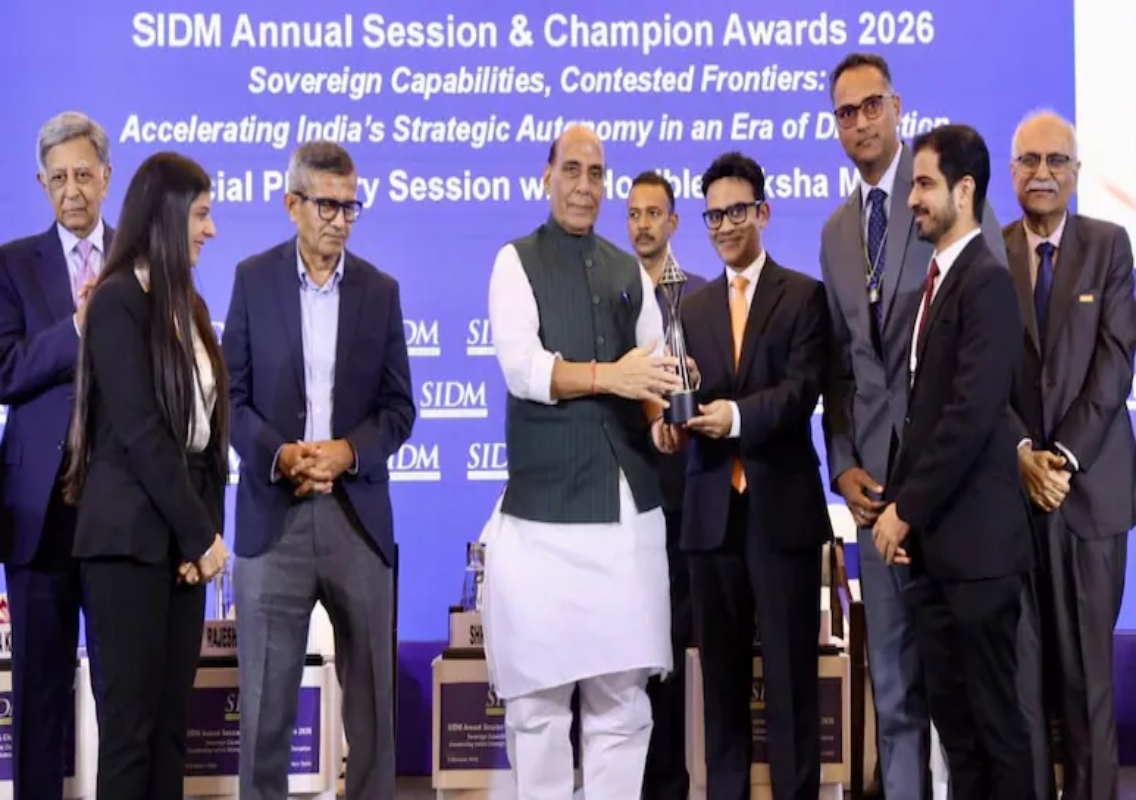


New Delhi: Adani Defence & Aerospace has won the Society of Indian Defence Manufacturers (SIDM) Champion Award 2026 for Export Performance in Defence and Aerospace, recognising its contribution to India’s growing defence manufacturing and export capabilities.
The award was presented by Defence Minister Rajnath Singh at SIDM’s eighth annual session in New Delhi on October 9, 2026. Defence Secretary Rajesh Kumar Singh and Director General (Acquisition) A. Anbarasu were present at the event.
The recognition comes as India seeks to expand its role in the global defence market by increasing domestic manufacturing, encouraging private-sector participation and reducing dependence on imported military equipment.
Adani Defence & Aerospace manufactures small-calibre ammunition for defence and law enforcement customers in international markets. Its ammunition manufacturing complex in Kanpur, Uttar Pradesh, has an annual production capacity of 300 million rounds and produces ammunition conforming to North Atlantic Treaty Organization (NATO) standards.
The company said the award recognises its efforts to build domestic manufacturing capabilities and supply products to customers in overseas markets.
Recognition for defence export performance
The SIDM Champion Awards recognise achievements across India’s defence manufacturing sector, including technology development, product innovation, design, import substitution, manufacturing excellence and exports.
A total of 15 awards were presented during the annual session. The awards highlight the growing role of Indian companies in developing and manufacturing products for the armed forces, security agencies and international customers.
For Adani Defence & Aerospace, the 2026 award specifically recognises export performance. The achievement comes as domestic manufacturers seek to establish stronger positions in international markets while meeting quality, reliability and production requirements.
Defence exports are an important part of India’s strategy to strengthen its defence industrial base. Export orders can help manufacturers expand production, improve economies of scale and invest in technology, while creating opportunities for suppliers and other businesses in the manufacturing ecosystem.
However, the award announcement did not disclose the value of Adani Defence’s exports or provide a company-specific export growth figure. The recognition should therefore be viewed as an industry award for performance rather than a measure of the company’s total overseas sales.
Kanpur facility supports large-scale ammunition manufacturing
The company’s Kanpur Ammunition Complex is central to its small-calibre ammunition manufacturing operations.
With an annual production capacity of 300 million rounds, the facility is designed to support domestic requirements as well as supplies to international defence and law enforcement customers.
The plant produces ammunition that meets NATO standards, an important benchmark for manufacturers seeking to serve customers in markets where internationally recognised technical and quality specifications apply.
The facility also supports the government’s Aatmanirbhar Bharat initiative, which aims to strengthen domestic industrial capabilities and reduce reliance on imports in strategic sectors.
Indigenous manufacturing is particularly significant in defence, where dependable supply chains, product quality and production capacity are essential. Domestic facilities can help build local expertise and improve the ability of Indian companies to serve military and security requirements.
For exporters, the ability to manufacture consistently at scale is equally important. International orders require manufacturers to meet contractual delivery schedules and technical requirements while maintaining quality standards.
Automation and digital systems strengthen production
The Kanpur complex uses automated manufacturing processes, artificial intelligence-enabled quality inspection, real-time data analytics and digital monitoring across its production operations.
These systems are intended to improve process control and support consistent manufacturing quality. Digital monitoring can also help manufacturers identify production issues, track performance and maintain records across different stages of the manufacturing process.
According to the company, its digital shopfloor eliminates manual handling of hazardous materials. The facility also uses digital security systems and maintains 100% digital traceability across the manufacturing value chain.
Traceability allows production information to be tracked through different stages, supporting quality management and accountability. In defence manufacturing, where product reliability and compliance are critical, such systems can help manufacturers maintain detailed records and investigate issues when required.
The complex also houses a ballistics testing range equipped with an Electronic Pressure, Velocity and Action Time (EPVAT) system. The testing range has received accreditation from the National Accreditation Board for Testing and Calibration Laboratories (NABL), India’s national accreditation body for testing and calibration laboratories.
The combination of automated manufacturing, digital quality inspection and accredited testing infrastructure supports the facility’s production and quality-control capabilities.
Previous SIDM recognition in 2025
The latest award follows an earlier SIDM Champion Award presented to Adani Defence & Aerospace’s Kanpur Ammunition Complex in 2025 for design, manufacturing and testing excellence.
The consecutive recognitions highlight the company’s efforts to develop its ammunition manufacturing operations and strengthen its production processes.
The 2025 award focused on manufacturing and testing capabilities, while the 2026 award recognises export performance. Together, the awards reflect different aspects of the company’s role in the defence manufacturing sector.
Adani Defence & Aerospace has also been expanding its presence across other defence-related areas, including unmanned aerial systems, counter-drone technologies and missile-related programmes. Its broader defence business forms part of the company’s strategy to participate in India’s domestic defence production ecosystem.
The export award, however, is specifically associated with defence and aerospace export performance and should not be taken as confirmation of particular new overseas contracts.
Rajnath Singh calls for greater private-sector participation
Addressing the SIDM annual session, Defence Minister Rajnath Singh called for greater participation by private companies in defence production, higher investment in research and development, and expanded manufacturing capacity.
He emphasised the importance of developing technologies and equipment needed by India’s armed forces, as well as strengthening the country’s ability to design, manufacture and control critical defence technologies.
Greater private-sector participation is a key part of India’s effort to develop a broader defence industrial base. Private manufacturers can contribute investment, specialised engineering, production expertise and innovation alongside public-sector enterprises and government research organisations.
Research and development will remain important as defence technology evolves. Manufacturers need to improve existing products, develop new capabilities and meet changing operational requirements. Increased production capacity can also help companies fulfil domestic orders while exploring export opportunities.
The government’s approach aims to combine domestic capability development with a stronger international presence for Indian defence products.
India’s defence exports reach a record high
The award comes against the backdrop of record defence exports by India.
The country’s defence exports reached Rs 38,424 crore in the financial year 2025-26, registering growth of 62.66% compared with the previous financial year, according to figures cited by the Ministry of Defence.
The government has set a target of achieving annual defence exports worth Rs 50,000 crore by 2029.
Reaching that target will require sustained growth across the defence manufacturing ecosystem, including large manufacturers, smaller suppliers, technology companies and businesses involved in components and specialised equipment.
Export growth also depends on international demand, competitive pricing, quality assurance, after-sales support and the ability to meet delivery commitments. Companies must navigate different market requirements and regulatory conditions when supplying defence-related products overseas.
Adani Defence & Aerospace’s award places its export activity within this wider national push, although the company-specific contribution to the national export total was not disclosed in the announcement.
Outlook for India’s defence manufacturing sector
The SIDM Champion Award highlights the growing emphasis on export performance alongside domestic production and manufacturing excellence.
For Adani Defence & Aerospace, the recognition comes as its Kanpur facility combines large-scale ammunition production with automation, digital inspection and accredited testing infrastructure.
For India, the broader challenge is to sustain the momentum in defence exports and build manufacturing capabilities that can compete in international markets. Expanding research and development, improving production quality and increasing the participation of private companies will be important to achieving that objective.
As India pursues its Rs 50,000-crore annual defence export target by 2029, awards such as the SIDM Champion Award provide recognition for individual manufacturers. The longer-term measure of success will be the industry’s ability to secure sustained export orders, develop advanced technologies and strengthen India’s position in the global defence supply chain.