







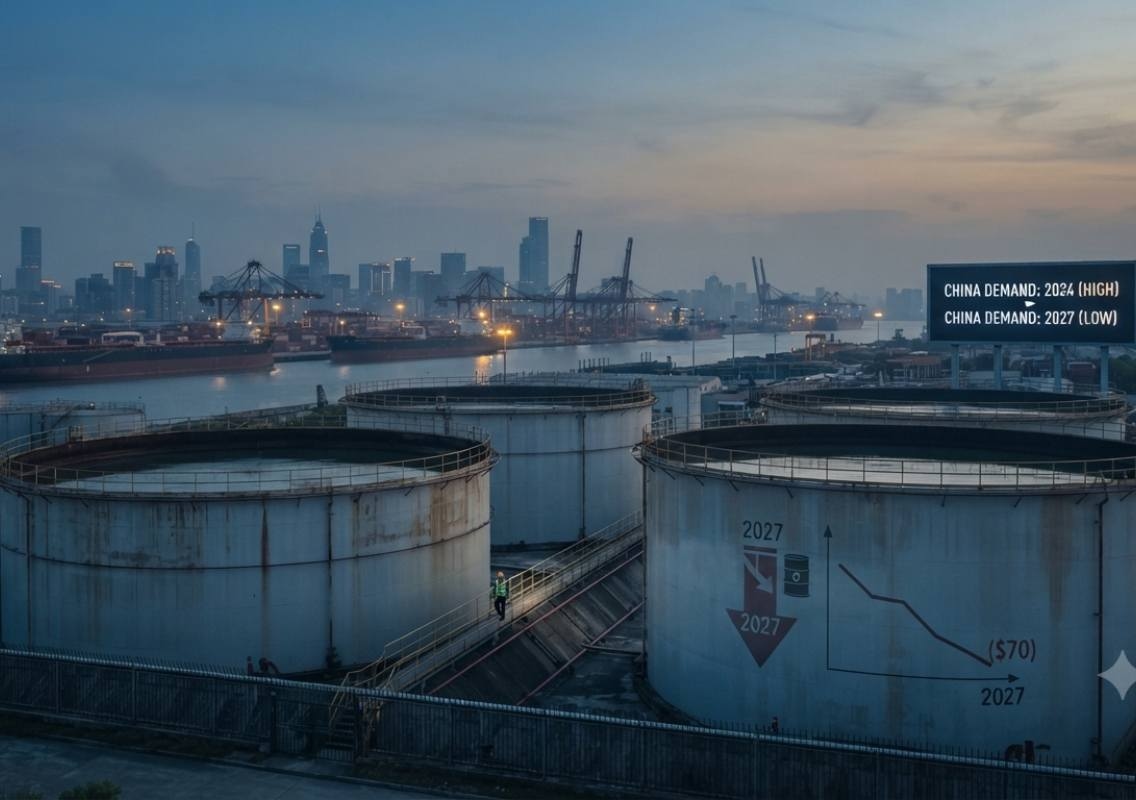


Iran: Global crude oil prices could fall to around $70 per barrel by the end of 2027, driven by increasing supplies from countries outside the OPEC+ alliance and declining oil demand in China, according to a JM Financial report citing an expert session with Iman Nasseri, Senior Vice President for Middle East and Asia at FGE Nexant.
The report said crude prices are likely to remain elevated and volatile in the near term before gradually easing as global supply-demand dynamics improve. However, refining margins are expected to remain stronger for a longer period amid continuing constraints on diesel flows and disruptions in fuel supply chains.
Global oil market could move into surplus
According to the report, the global oil market is expected to move towards a surplus as non-OPEC+ producers increase output while China’s oil demand declines.
The combination of rising supplies and weaker consumption could ease pressure on crude prices over the coming months and into 2027, potentially bringing prices closer to the $70-per-barrel level by the end of the year.
The report said, “Global oil demand-supply balance is expected to move into surplus aided by non-OPEC+ supply growth and decline in China’s oil demand.”
China’s changing oil consumption patterns are expected to play an important role in shaping the global market outlook. The country’s purchases of crude oil are likely to remain gradual even after prices fall below $70 per barrel, limiting the possibility of a significant inventory-restocking push that could otherwise support prices.
The United States, meanwhile, is also unlikely to replenish its Strategic Petroleum Reserve in a way that significantly boosts global crude demand, according to the report.
US-Iran deal unlikely in the near term
The outlook for crude prices is also linked to geopolitical developments in the Middle East, particularly the possibility of an agreement between the United States and Iran.
The report suggested that a US-Iran deal remains unlikely in the near term, although the possibility of a resolution could emerge by mid-2027 as economic pressure on Iran intensifies.
Nasseri reportedly said that an agreement would be difficult without a change in regime in either country. He also pointed to the continued influence of Iran’s Islamic Revolutionary Guard Corps (IRGC), which retains strong control despite the country’s economic pressures.
The uncertainty surrounding negotiations is expected to keep crude oil prices volatile in the short term, even as underlying supply-demand fundamentals begin to improve.
Oil flows through Hormuz and Red Sea recover
Oil shipments through key maritime routes in the Middle East have also shown signs of recovery.
According to the report, crude supplies moving through the Strait of Hormuz and the Red Sea have recovered nearly 90% of their pre-war levels. The recovery has been supported by vessels willing to operate despite elevated risks, exemptions for Iraqi and select Chinese cargoes, and transit payments by Gulf countries to facilitate safe passage.
However, the recovery in crude shipments has not fully resolved disruptions in the broader fuel supply chain, particularly for diesel.
Refining margins expected to remain elevated
Despite the anticipated easing of crude prices, refining margins and product cracks are expected to remain relatively strong in the near term.
Diesel flow constraints and disruptions in fuel supply are likely to support margins for refiners before conditions gradually normalise towards the end of calendar year 2027.
The report said, “Refining margins and product cracks are expected to remain stronger in near-term and gradually normalise by end-CY27.”
Global refinery operations have also remained below earlier levels. In October, global refinery runs were around 5 million barrels per day lower than the February reading, indicating reduced operations across the Middle East, Russia and China.
The lower refinery activity has contributed to supply constraints in petroleum products, particularly diesel, helping keep refining margins elevated despite the possibility of a broader crude oil surplus.
As supply growth from non-OPEC+ producers continues and China’s oil demand weakens, the global crude market could gradually shift towards a more balanced environment. However, geopolitical risks, shipping disruptions and refinery constraints are expected to continue influencing oil and fuel prices in the near term.