







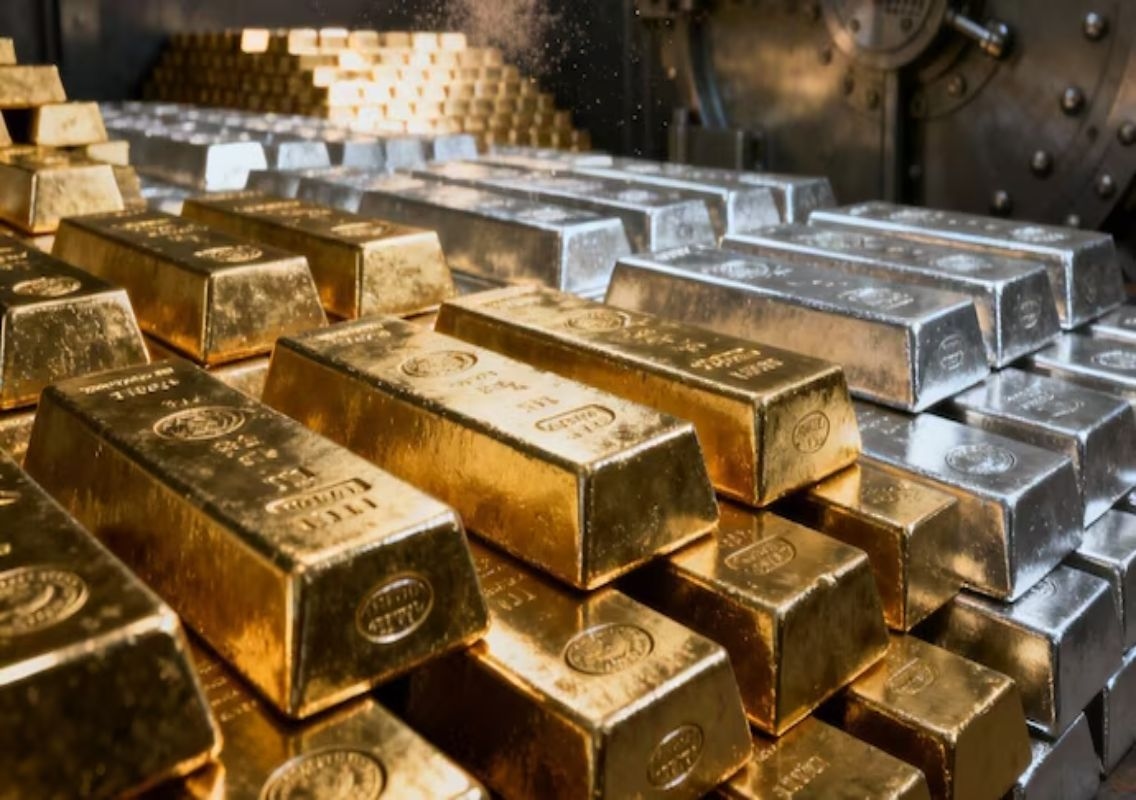


New Delhi: Gold and silver prices declined sharply in India on Wednesday, tracking weakness in global bullion markets as a stronger US dollar, rising oil prices and renewed fears of interest rate hikes weighed on investor sentiment.
Gold prices fell by Rs 2,677 or 1.76% to Rs 1,49,766 per 10 grams, while silver dropped by Rs 4,347 or 1.82% to Rs 2,34,181 per kilogram, according to the latest market data.
Global cues drag bullion lower
The domestic fall mirrors a decline in international markets, where gold slipped to its lowest level in nearly 11 weeks. Spot gold traded around $4,181 per ounce after falling about 1.9%, while US gold futures for August delivery declined to $4,204.70 per ounce.
Silver and other precious metals also remained under pressure, reflecting a broad-based sell-off across the bullion segment.
Strong dollar and rate fears weigh heavily
The primary driver behind the decline is shifting expectations around US monetary policy. A stronger US dollar has made gold more expensive for buyers using other currencies, thereby reducing global demand.
At the same time, rising oil prices have heightened inflation concerns, leading investors to anticipate that the US Federal Reserve may keep interest rates elevated for a longer period.
Higher interest rates typically hurt gold prices, as the metal does not generate any fixed income, making interest-bearing assets like bonds more attractive in comparison.
Rising yields add to pressure
Market experts point to increasing bond yields as another factor impacting bullion.
Ilya Spivak, head of global macro at Tastylive, noted that the decline in gold is largely driven by changing expectations around Federal Reserve policy, along with rising yields and a stronger dollar.
Traders are now pricing in more than a 70% probability of a US rate hike by December, according to the CME FedWatch Tool, further dampening sentiment in the bullion market.
Geopolitical tensions increase volatility
Adding to the uncertainty are renewed tensions between the United States and Iran, which have unsettled global financial markets.
The escalation followed US strikes against Iran after allegations that Tehran had targeted a US Apache helicopter in the Strait of Hormuz. Iran reportedly responded by targeting US military positions across the region.
Such geopolitical developments have increased volatility, prompting investors to reassess inflation risks and the outlook for interest rates.
Broad-based selling across bullion
Analysts say the bullion market has witnessed widespread liquidation as investors react to stronger-than-expected US economic data and hawkish signals from central banks.
Reports of robust US labour market data, stronger home sales and indications of a possible rate hike by the Bank of Japan have further pressured gold and silver prices.
Gold extended its losses below the $4,180 per ounce level, while silver fell over 2% to around $64 per ounce. Platinum and palladium also recorded declines.
What lies ahead for gold?
Analysts are closely watching the $4,100 per ounce level as a key support for gold.
A sustained break below this level could signal a deeper correction, potentially pushing prices towards $3,500 per ounce in the coming months.
Investors are now focusing on upcoming US inflation data, particularly the Consumer Price Index (CPI), which could influence future monetary policy decisions and determine the direction of bullion markets.
Mixed outlook for base metals
While precious metals faced selling pressure, base metals showed mixed trends.
Copper remained relatively stable, supported by long-term demand expectations linked to artificial intelligence infrastructure and China’s proposed large-scale investment in data centres.
However, near-term gains may remain limited due to expectations of tighter monetary policy and ongoing volatility in global markets.
Conclusion
The sharp fall in gold and silver prices highlights the sensitivity of bullion markets to global economic indicators, currency movements and geopolitical developments.
With interest rate expectations and inflation data in focus, precious metals may continue to experience volatility in the near term.
(Disclaimer: The views, opinions, recommendations, and suggestions expressed by experts/brokerages in this article are their own and do not reflect the views of the News Karnataka Group. It is advisable to consult a qualified broker or financial advisor before making any actual investment or trading choices.)