







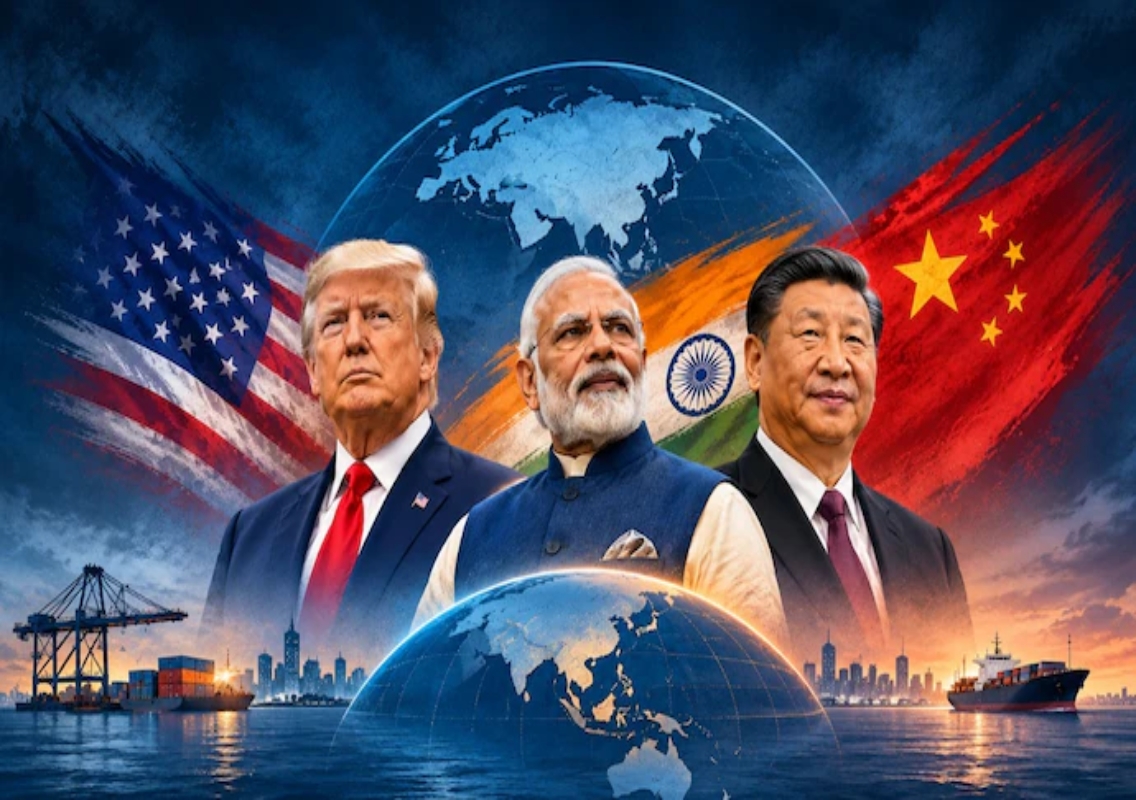


NEW DELHI: India has retained its position as Asia’s third-most powerful country in the 2026 Asia Power Index, while strengthening its influence through cultural reach, defence engagement and diplomatic standing. The report also points to a significant shift in the regional balance of power: the gap between the United States and China has narrowed to its smallest level since the index was launched in 2018.
Released by Australia’s Lowy Institute on November 22, the 2026 index gave India an overall score of 40.5 points, an improvement of 0.5 points from the previous edition. India remained ahead of Japan, which scored 38.6 points, and consolidated its position in the index’s major-power category.
The United States retained the top position with 78.9 points, followed by China with 73.6 points. The 5.3-point difference between the two countries is the narrowest recorded since the index began in 2018. India, meanwhile, has reduced its power gap with China to its lowest level in the index’s history, although China’s overall power remains substantially higher.
The findings suggest that India is becoming more influential across the region despite a slight decline in its economic capability. They also highlight areas where New Delhi needs to strengthen its regional partnerships to convert its economic, military and demographic resources into greater influence.
India improves its cultural and defence influence
India’s strongest gains in the 2026 index came in cultural influence and defence networks. Its Cultural Influence score increased by 2.3 points to 43.8, keeping the country in fourth place globally in this measure.
The cultural influence assessment considers a country’s ability to shape perceptions beyond its borders through cultural projection, information flows and people-to-people exchanges. India’s improvement reflects its growing reach in these areas and its ability to build connections across the region.
India also made progress in Defence Networks, where its score increased by 2.1 points to 18.6. The country climbed two positions to ninth in this category.
The Lowy Institute attributed the improvement to stronger regional defence engagement and India’s BrahMos missile sales to Southeast Asian countries. Defence partnerships and military cooperation can help countries build influence beyond their own military capabilities.
However, India’s ninth-place position also indicates that its defence partnerships have not yet developed to the same level as those of several other regional powers, including Australia, Japan, South Korea and Singapore.
The report highlights the difference between possessing military strength and building a network of strategic relationships through which that strength can contribute to regional influence.
India ranks third in future resources
India continued to perform strongly in the Future Resources category, securing third place with a score of 56.2 points. Its score improved by 1.2 points in 2026.
This measure assesses the economic and military resources that countries are expected to possess in the coming decades. It considers projected economic capabilities, future defence resources and the working-age population.
India’s demographic profile and long-term economic potential remain important advantages in this assessment. A large working-age population and the possibility of sustained economic expansion give the country considerable scope to strengthen its position in Asia.
However, the report also indicates that future resources alone cannot guarantee greater regional influence. Countries must build economic relationships, diplomatic partnerships and defence cooperation to translate their potential into practical power.
Economic capability records a marginal decline
Despite improvements in several areas, India’s Economic Capability score declined by 0.7 points to 26.4. The country nevertheless retained third place in the category, behind the United States and China.
The report linked the decline partly to the weakening rupee, changes in the International Monetary Fund’s measurement of economies and a fall of nearly $20 billion in India’s outbound investment.
India’s economic relationships score stood at 19.9, placing it seventh in the overall index. This indicates that the country still has scope to expand its trade, investment and other economic connections across Asia.
The index also placed India fourth in Military Capability, with a score of 48.5. Its score improved by 0.5 points compared with the previous year.
Military Capability considers conventional military strength, including defence spending, armed forces, weapons systems and the ability to deploy and sustain military forces.
India ranked fourth in Resilience, scoring 55.4 points. The measure evaluates a country’s ability to withstand external threats and disruptions, including challenges relating to resource security, internal stability and geopolitical and geoeconomic security. India’s score in this category declined marginally by 0.1 points.
India still has a gap between resources and influence
One of the important findings in the report concerns India’s ability to convert its resources into actual regional influence.
The Lowy Institute’s Power Yield measure gave India a score of -3.3. The indicator compares the resources available to a country, such as economic capability, military strength, resilience and future resources, with the influence it exercises through diplomacy, economic relationships, defence networks and cultural reach.
A negative score suggests that India is exercising less influence than might be expected from its available resources.
However, the report noted that India’s Power Yield gap narrowed for the first time since 2023. Its score improved from -4.0 to -3.3, indicating progress in translating national resources into regional influence.
Strengthening economic partnerships and defence cooperation will remain important if India is to improve this measure further.
Modi ranked second in regional leadership assessment
India’s diplomatic standing also received attention in the 2026 report. Expert assessments of Prime Minister Narendra Modi’s regional leadership improved, lifting him to the position of the second-most effective regional leader in Asia, behind Chinese President Xi Jinping.
Diplomatic influence remains one of India’s important strengths in the index. The assessment considers how effectively countries engage with regional partners and shape political and diplomatic developments.
The improvement in Modi’s leadership assessment adds to India’s broader gains in regional influence, even as the country faced domestic challenges and a decline in its relative economic capability.
US-China power gap reaches its narrowest level
The 2026 index also highlights the increasingly competitive balance between Washington and Beijing.
The United States scored 78.9 points, while China recorded 73.6 points, leaving a gap of just 5.3 points. The difference is the smallest since the index was introduced in 2018.
According to the Lowy Institute, the narrowing gap reflects more of Washington’s strategic missteps than major advances by Beijing. The report pointed to the US administration’s focus on the Middle East and the impact of the unresolved conflict with Iran on American military resources and diplomatic influence.
The conflict, which began in February 2026, has affected US military capabilities by depleting stocks of long-range missiles. It has also influenced perceptions of Washington’s engagement with Asia.
The report said respondents to its survey viewed the United States as increasingly distracted and disengaged from the region.
China, meanwhile, continues to strengthen its military capabilities and deepen partnerships across Asia. The narrowing gap does not mean that the two countries have reached equal levels of power, but it shows that the United States’ lead has weakened.
What the 2026 index means for India
India’s overall score of 40.5 places it firmly among Asia’s major powers and keeps it ahead of Japan and other regional countries. It also recorded one of the strongest improvements among the region’s leading powers.
However, the report makes clear that India’s position cannot be assessed only through economic growth, military strength or population size. Its ability to build lasting economic relationships, expand defence partnerships and maintain diplomatic influence will be important in determining how much regional power it can exercise.
India’s gains in cultural influence, defence networks and future resources provide a stronger foundation. At the same time, the decline in economic capability and its relatively weak position in defence networks show where further progress is needed.
The 2026 Asia Power Index therefore presents a mixed but broadly positive picture for India: the country is strengthening its regional influence, while the competition between the United States and China is becoming more closely contested.