







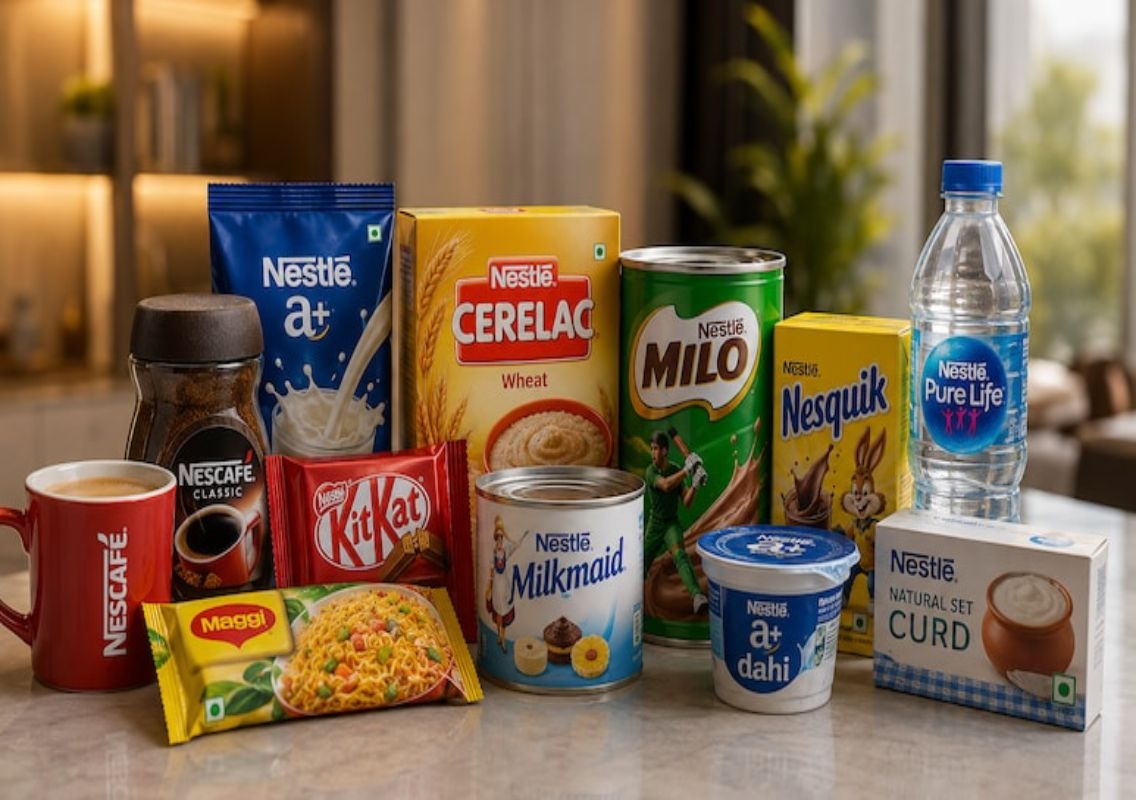


New Delhi: Nestle has backed India’s move towards stricter food labelling and greater transparency, with global CEO Philipp Navratil saying consumers should have clear information about the ingredients and nutritional content of the products they buy. His comments come as the Food Safety and Standards Authority of India (FSSAI) intensifies scrutiny of food companies over misleading claims, advertisements and labelling practices.
Navratil said Nestle supports proactive transparency and already declares ingredients, including calories, on its products in India even where such disclosure is not specifically mandated. He said consumers should be encouraged to be curious about what they eat and that transparency should be an important part of how food quality is perceived.
The comments are significant as India considers stronger front-of-pack labelling requirements that could make nutritional information easier for consumers to understand.
Nestle supports front-of-pack labelling
Navratil said Nestle would welcome front-of-pack labelling norms in India, arguing that clear nutritional information could help consumers make better choices for themselves and their families.
He said Nestle has been working to improve the nutritional profile of its products by reducing sugar, fat and sodium levels. According to him, better labelling could contribute to healthier choices while giving consumers more information about what they are buying.
Front-of-pack labels are designed to make important nutritional information visible without requiring consumers to study the detailed nutrition table on the back of a package.
Such a system could be particularly relevant for packaged foods and beverages that contain significant amounts of sugar, salt or fat.
FSSAI intensifies scrutiny of food claims
Nestle’s comments come against the backdrop of increased regulatory action by FSSAI.
The food regulator has issued more than 150 notices to leading food and beverage companies over misleading advertisements, unverifiable health claims and labelling violations, according to the report. FSSAI has also been scrutinising claims using terms such as “100 per cent”, “natural” and “healthy” where companies may not have sufficient evidence to support them.
The regulator has also sought scientific evidence for claims including “heart-friendly” and “no added sugar”.
Following regulatory intervention, several food and beverage companies have revised product labels, withdrawn certain claims and modified advertising campaigns to comply with the requirements.
The tighter scrutiny reflects a broader push towards making food marketing more transparent and preventing consumers from being influenced by claims that may create a misleading impression about a product.
CEO calls for balanced and scientific rules
While supporting stronger labelling requirements, Navratil said the regulations should be introduced in an appropriate and balanced manner.
He said India should draw on global best practices and ensure that the framework is based on scientific principles.
One issue he highlighted was the way nutritional information should be presented. According to Navratil, comparisons should consider appropriate portion sizes rather than relying solely on the weight of a product.
He argued that consumers generally eat portions rather than individual grams and that some ingredients may be used only in small quantities. Without appropriate portion guidance, he said, comparisons between products may not always provide useful information.
This suggests that Nestle is broadly supportive of stronger disclosure requirements while seeking a system that it believes accurately reflects how consumers actually consume food.
Nestle willing to work with government
Navratil also said Nestle would collaborate with government agencies if asked to contribute to the development of food regulations.
He said companies can provide their perspective while the government ultimately decides the regulatory framework.
Nestle is also willing to share experiences from other countries, particularly on policies such as sugar taxation and nutritional regulation.
Different countries have adopted varying approaches to tackling high sugar consumption and improving food transparency. India could potentially draw lessons from these international experiences while developing rules suited to its own consumers and food market.
The company’s willingness to participate in discussions could provide policymakers with industry-level information on how proposed regulations may affect product formulation, packaging and consumer communication.
Focus on reducing sugar, fat and sodium
Nestle’s support for clearer labelling comes alongside its efforts to modify the nutritional profile of its products.
Navratil said the company has been working to reduce sugar, fat and sodium levels.
The emphasis on these nutrients is particularly relevant to the growing debate around packaged food consumption and healthier diets.
Clearer labelling can help consumers compare products, while reformulation can potentially reduce the amount of certain nutrients in the products themselves.
However, the effectiveness of such measures depends on whether consumers understand the information presented to them and whether healthier choices remain affordable and accessible.
India becomes Nestle’s strongest market
Beyond the regulatory debate, Navratil highlighted India’s growing importance to Nestle.
He said India emerged as the company’s highest-performing market in the first half of calendar year 2026 and has the potential to become one of the Swiss packaged food major’s top five markets.
The comments underline the importance of India to Nestle’s global growth strategy.
The company has operated in India for 114 years, according to Navratil, and he said it would not compromise on product quality or move too quickly simply to achieve growth targets.
He emphasised the importance of keeping consumers at the centre of the company’s approach and taking them along as the business evolves.
Consumers increasingly seek healthier food
Navratil also said consumer preferences are changing, with people increasingly looking for healthier food options.
This shift is creating pressure on packaged food companies to provide clearer nutritional information and improve product formulations.
For manufacturers, changing consumer expectations can influence decisions about ingredients, portion sizes, product development and marketing.
For regulators, the challenge is to ensure that consumers receive reliable information without creating rules that are unnecessarily complicated or difficult for businesses to implement.
Nestle’s comments indicate that transparency and healthier product development are likely to remain important themes for the food industry in India.
Why stricter labelling matters
Food labels play an important role in helping consumers understand what they are purchasing.
Traditional nutrition panels can contain detailed information but may require consumers to spend time interpreting serving sizes, quantities and nutritional values.
Front-of-pack labelling could make key information more immediately visible.
Supporters argue that such labels can help consumers make faster comparisons between products, particularly when shopping for packaged foods.
At the same time, the design of the system matters. Labels need to be scientifically sound and presented in a way that does not create confusion or give an inaccurate impression about a product.
That is why the debate over portion sizes, thresholds and the format of front-of-pack disclosures is likely to remain important as India develops its regulatory framework.
A changing food industry
The latest developments show how India’s packaged food industry is entering a period of greater regulatory and consumer scrutiny.
Companies are facing closer examination of the claims they make, while consumers are increasingly interested in ingredients and nutritional content.
For major companies such as Nestle, greater transparency could also become an important part of maintaining consumer trust.
At the same time, stricter regulations could require businesses to review packaging, advertising and product formulations.
The industry’s ability to adapt will be important as India moves towards a more information-focused food market.
Conclusion
Nestle has backed stricter food labelling norms in India, with global CEO Philipp Navratil saying consumers should have greater transparency about the ingredients and nutritional content of the food they consume. The company supports front-of-pack labelling and says it is already disclosing ingredients, including calories, on its products in India.
The support comes as FSSAI intensifies its scrutiny of misleading advertisements, health claims and labelling violations. The regulator has issued more than 150 notices to leading food and beverage companies and has questioned claims such as “100 per cent”, “natural”, “healthy”, “heart-friendly” and “no added sugar”.
However, Nestle has called for any new framework to be balanced, scientifically designed and based on appropriate portion guidance. The company has also offered to share its international experience with the government if requested.
For India, the debate could lead to clearer information on packaged food products and potentially help consumers make more informed choices. For the food industry, it could also mean greater scrutiny of product claims, nutritional composition and marketing practices.