


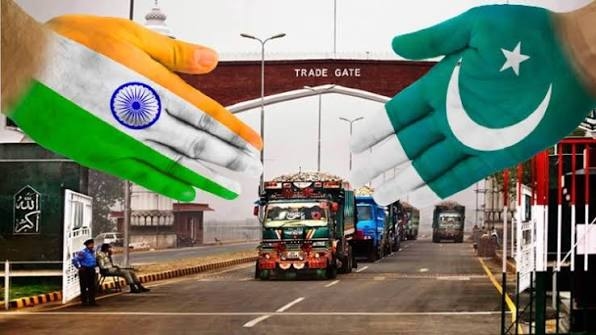


New Delhi: Pakistan’s reported imports from India rose by nearly 69 per cent in the first quarter of the 2026–27 financial year, raising questions about how goods linked to Indian suppliers continue to reach the Pakistani market despite restrictions on bilateral trade.
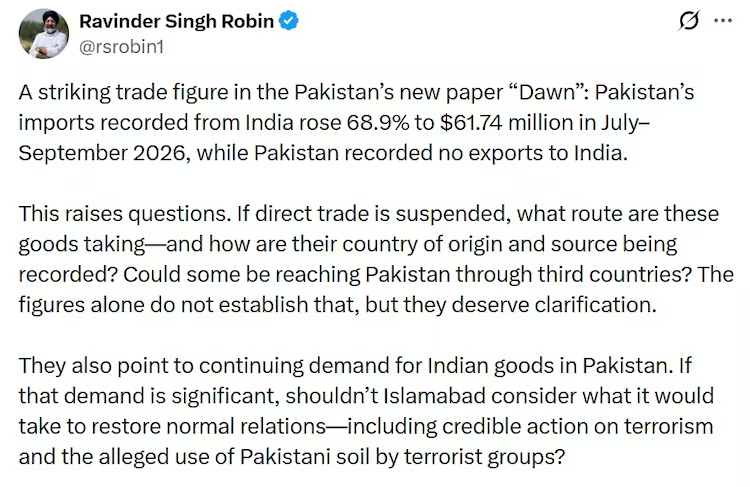
According to data compiled by the State Bank of Pakistan and reported by Dawn, Pakistan imported goods worth US$61.74 million (approximately Rs 587 crore) from India between July and September 2026, compared with US$36.55 million (around Rs 348 crore) during the corresponding period a year earlier. Pakistan recorded no exports to India during the quarter, the report said.
The figures present a trade puzzle because direct trade between the two countries has remained suspended following the Pahalgam terror attack in April 2025. India subsequently prohibited the direct or indirect import or transit of goods originating in or exported from Pakistan, while Pakistan announced its own trade restrictions against India.
Experts cited in the reporting suggest that goods may be moving through third-country trading hubs, including the United Arab Emirates, Singapore and Sri Lanka. However, the available figures do not establish the precise routes used or confirm that every shipment recorded as an import from India was transported directly across the border.
Pakistan’s imports from India jump 69%
The latest figures indicate that Pakistan’s recorded imports from India increased substantially during the first three months of FY27.
Imports rose from US$36.55 million in July–September 2025 to US$61.74 million in the same period in 2026. That represents an increase of approximately 68.9 per cent.
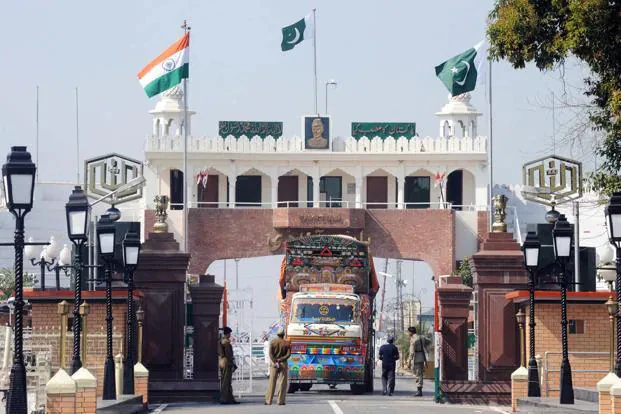
The increase is notable because formal trade between the neighbouring countries has been severely restricted. India closed the Wagah–Attari land border for trade following the Pahalgam attack, in which 26 people were killed. The attack led to a series of retaliatory diplomatic and economic measures.
The latest figures, however, do not by themselves establish whether the goods crossed directly from India, were shipped through intermediaries or were recorded under particular customs classifications. The State Bank of Pakistan data cited in the report provides the import value, but does not explain the routes taken by the consignments.
The distinction matters because trade statistics can record transactions involving goods and suppliers in different countries, while the physical movement of products and their declared country of origin may follow separate routes.
Why are Indian goods still in demand in Pakistan?
Pharmaceutical products are among the important categories of goods traded between the two countries.
Before the restrictions were introduced, Indian pharmaceutical products and raw materials were significant sources of supply for Pakistan. A Reuters report cited in the source material put India’s pharmaceutical exports to Pakistan at US$208 million up to March 2025.
Other products associated with bilateral trade include plastics, petroleum-related products, dyes, organic chemicals, rubber, coffee, tea, vegetables, spices, dairy products and cereals.
For Pakistani businesses, Indian suppliers have historically offered access to a range of products and industrial inputs. Pharmaceutical ingredients are particularly significant because they are used in the manufacture of medicines, although the latest aggregate import figures do not identify how much of the reported increase came from this category.
The continued demand for these products has prompted questions about whether trade is taking place through intermediaries or whether the figures reflect other arrangements in the international supply chain.
Geopolitical expert Ravinder Singh Robin has questioned how the goods are reaching Pakistan and how their country of origin and source are being recorded when direct trade is suspended.
Robin has also argued that the continuing demand for Indian products raises broader questions about the future of trade relations between the two countries. His comments represent an assessment of the figures rather than confirmation of the route used by specific shipments.
How could goods reach Pakistan through third countries?
One possible explanation offered by trade experts is the use of third-country trading hubs.
Under this arrangement, goods supplied by Indian manufacturers may first be shipped to another country before being re-exported to Pakistan. The United Arab Emirates, Singapore and Colombo have been identified in the reporting as possible transit or redistribution centres.
Such hubs play a role in international commerce because they provide warehousing, shipping, distribution and re-export facilities for goods moving between markets.
Ajay Srivastava, founder of the Global Trade Research Initiative (GTRI), has described the alleged practice as a “grey-zone strategy”. He has argued that goods can be sent to trading hubs, stored in bonded warehouses and subsequently re-exported under documentation associated with the intermediary country.
In a typical re-export arrangement, a product may be transported to a third country before being shipped onwards to its final destination. However, re-exporting a product does not automatically change its legal country of origin. That depends on the applicable rules of origin and whether the product undergoes qualifying processing or transformation.
Simply changing labels or shipping documents to conceal a product’s origin could amount to misdeclaration and may violate applicable trade restrictions.
GTRI has estimated that unofficial Indian exports reaching Pakistan could amount to US$10 billion annually. This is an estimate attributed to the think tank, not an officially verified figure for the current financial year. The estimate also should not be confused with Pakistan’s reported imports from India in the latest quarter.
The available data does not confirm that all, or even most, of the US$61.74 million in reported imports travelled through the specific hubs identified by experts.
What do the trade bans prohibit?
India announced a prohibition on May 2, 2025, covering the direct or indirect import or transit of goods originating in or exported from Pakistan. The Directorate General of Foreign Trade said the restriction was imposed in the interest of national security and public policy. It also stated that any exception would require prior government approval.
The prohibition means that routing a Pakistani-origin product through another country does not, by itself, make its import into India permissible.
India’s Directorate of Revenue Intelligence subsequently announced enforcement action against consignments of Pakistani-origin goods routed through third countries, including Dubai. In June 2025, it reported seizing 39 containers carrying 1,115 metric tonnes of goods valued at approximately Rs 9 crore. The consignments included dry dates that had allegedly been declared as originating in the UAE.
Pakistan also suspended trade with India, including trade through third countries, in May 2025. The restrictions on both sides have sharply limited formal bilateral commerce.
The two countries’ restrictions are separate legal measures. The existence of third-country trade routes does not automatically establish that a particular shipment has breached either country’s rules; that would depend on the product’s origin, documentation, route and applicable regulations.
India–Pakistan trade has declined since 2019
Trade ties between India and Pakistan had already deteriorated before the 2025 restrictions.
India withdrew Pakistan’s Most-Favoured Nation status in 2019 following the Pulwama terror attack, in which 40 Indian security personnel were killed. Subsequent restrictions and political tensions further affected commercial relations.
According to figures cited in the source material, bilateral trade fell from US$2.41 billion in 2018 to US$1.2 billion in 2024. Pakistani exports to India also declined sharply over that period.
Before the latest restrictions, India exported pharmaceuticals, chemicals, plastics, agricultural products and other goods to Pakistan. Pakistani exports to India included products such as glassware, copper, sulphur, fruits and nuts.
The restrictions introduced in 2025 marked a further contraction in formal trade. The latest import figures are therefore significant because they show a rise in Pakistan’s recorded imports associated with India even as official trade channels remain restricted.
What the latest figures establish — and what they do not
The increase in reported imports raises legitimate questions about supply chains, customs declarations and the operation of third-country trade routes. But the figures alone cannot answer how the goods reached Pakistan.
To establish the route, investigators and trade analysts would need shipment-level information, including customs declarations, invoices, bills of lading, country-of-origin certificates and details of any processing undertaken in intermediary countries.
Such records could help determine whether the goods were shipped directly, re-exported through another market or classified in a way that requires further explanation.
The latest data also does not, on its own, prove that the goods were deliberately rerouted to evade restrictions. That remains one possible explanation offered by experts and would need to be assessed against individual shipment records.
For now, Pakistan’s reported imports from India have risen despite the breakdown in formal trade relations, while its recorded exports to India remained at zero during the quarter. The figures underline the continuing demand for goods associated with Indian suppliers, but the exact routes and legal status of the shipments remain questions that aggregate trade data cannot resolv