


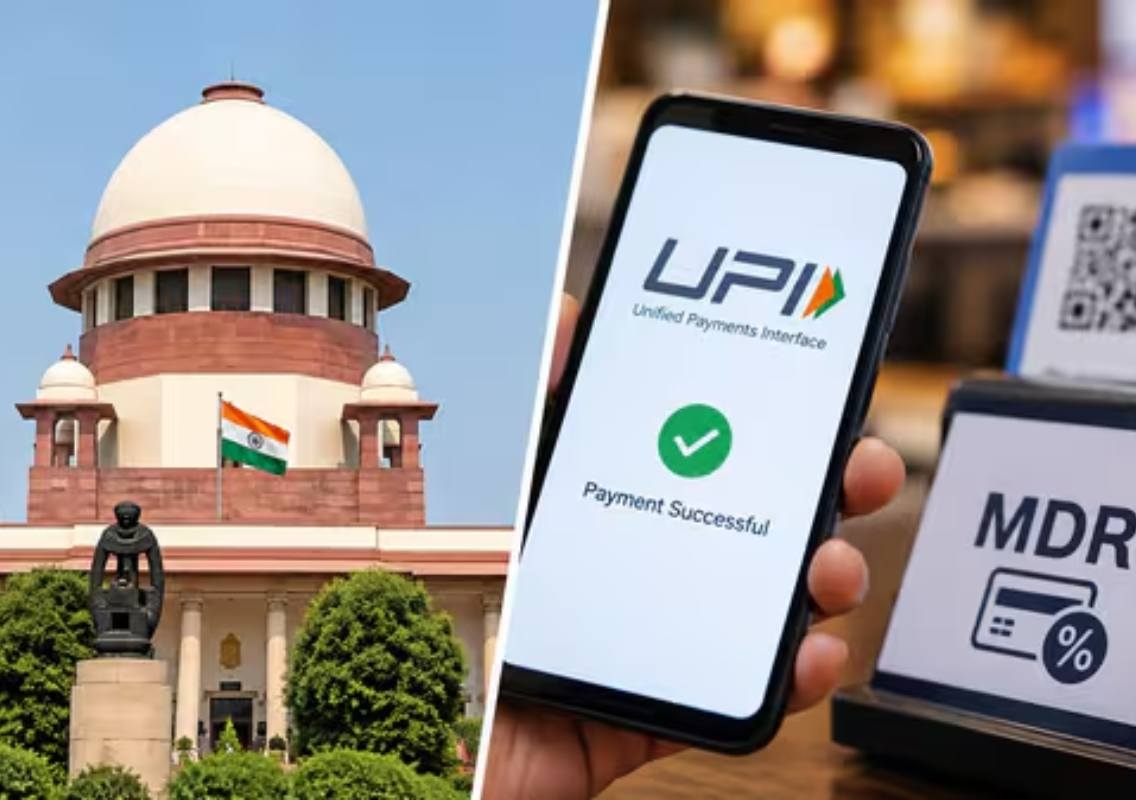


New Delhi: The Supreme Court on Monday issued notices to the Centre, Reserve Bank of India (RBI) and National Payments Corporation of India (NPCI) on a plea challenging the proposed Merchant Discount Rate (MDR) on specified UPI merchant transactions above Rs 2,000.
A three-judge bench headed by Chief Justice of India Surya Kant sought responses from the authorities on the legal and technical basis of the new fee framework. However, the court declined to grant an interim stay on its implementation, which is scheduled to begin from October 15.
The hearing comes days before the new MDR framework is due to take effect and could have implications for how India’s widely used digital payments ecosystem is funded and operated.
Supreme Court seeks clarity on UPI MDR
The court has sought a detailed response from the Centre on several aspects of the proposed charge, including the legal basis for introducing it and the scope of executive power involved.
The bench also sought clarity on the nature of the charge, including questions concerning its taxation, where the financial incidence arises and who ultimately bears it.
The Centre, RBI and NPCI have been directed to file their responses within four weeks. The court’s decision not to stay the framework means the October 15 implementation date remains in place for now.
The challenge was filed against the government’s September 14 notification and the September 15 framework governing MDR on specified high-value UPI merchant transactions. The petitioner has questioned the legal basis and validity of the new arrangement and had sought a stay on its implementation.
What is the new UPI MDR framework?
Under the new framework, a 0.4% MDR will apply to specified UPI person-to-merchant transactions above Rs 2,000.
The charge is subject to a maximum of Rs 300 for transactions of Rs 75,000 and above. The framework does not mean that consumers will automatically be charged for every UPI payment above Rs 2,000.
The MDR is a fee within the payments ecosystem and is intended to compensate entities involved in processing eligible transactions. The government has maintained that the charge is a commercial arrangement rather than a tax collected by the government.
The government has also said that a large majority of UPI transactions will remain outside the new MDR framework. According to government figures reported earlier, around 4% of merchant UPI transactions are expected to be affected.
Government explains why fee is being introduced
During Monday’s hearing, Attorney General R Venkataramani appeared for the Union government and explained the government’s position on the proposed charge.
The Centre argued that the fee is comparable to charges associated with other payment instruments, including debit and credit cards. It said the amount would function as a processing fee for entities such as payment aggregators and banks involved in completing the transaction.
The government also maintained that it would not receive the money collected through MDR.
The distinction is significant because the Supreme Court has specifically sought clarity on the legal character of the charge and the financial flow involved in the arrangement.
The government’s position is that MDR is an administrative and commercial mechanism within the payments ecosystem rather than a government levy. The Attorney General told the court that the government does not receive a share of the fee.
Consumers are not directly charged under the framework
The proposed MDR has triggered concerns about whether merchants could eventually pass the additional cost on to customers.
The government has maintained that the charge is to be borne within the merchant-payment ecosystem and is not a direct fee imposed on consumers. Finance Minister Nirmala Sitharaman had also said earlier that the 0.4% merchant fee would be charged to merchants rather than UPI users.
However, the possibility of indirect cost implications has been one of the concerns raised in the legal challenge.
The Supreme Court’s questions about the incidence of the charge could therefore become important as the case progresses.
UPI remains free for several categories
The new MDR regime is not a blanket charge on all UPI transactions.
The framework specifically concerns eligible person-to-merchant transactions above Rs 2,000. Person-to-person payments remain outside the MDR structure.
Certain recurring payments made through UPI AutoPay, including some mutual fund systematic investment plans, OTT subscriptions and utility payments, are also not covered by the new MDR arrangement.
This means users will not see a universal UPI charge beginning October 15.
The distinction between transaction types will become particularly important for consumers and merchants as banks and payment platforms implement the new system.
RBI and NPCI asked to respond
The Supreme Court has also sought responses from the RBI and NPCI, which are central to the functioning and regulation of India’s UPI infrastructure.
NPCI operates the UPI platform, while the RBI is the country’s banking and payments regulator. Their responses are expected to address the regulatory and operational basis of the new framework.
The court’s order does not currently prevent implementation of the MDR from October 15. Instead, the authorities have been given four weeks to place their positions before the court.
The case will therefore continue even as the new payment framework is scheduled to come into force.
Why the decision matters for India’s digital payments ecosystem
UPI has become one of India’s most widely used digital payment systems, with millions of merchants and consumers relying on it for everyday transactions.
The introduction of MDR for selected high-value merchant payments represents a significant change from the system’s largely fee-free model.
The move is intended to create a revenue stream for payment ecosystem participants and support the longer-term sustainability of digital payments. RBI has backed the introduction of MDR on large-value UPI transactions, while NPCI has notified the 0.4% framework.
At the same time, the change has prompted questions about competition, merchant costs and whether the additional expense could eventually influence pricing.
Reuters reported earlier that payment companies viewed the new fee structure as a potential source of additional revenue, while also noting concerns about the impact on market concentration and smaller players.
October 15 implementation remains unchanged for now
The Supreme Court’s refusal to grant an interim stay means the October 15 rollout remains scheduled unless the government or the court takes a further step before then.
The Centre, RBI and NPCI now have four weeks to submit their responses. The court’s questions indicate that the legal basis, financial structure and incidence of the proposed MDR will remain central to the proceedings.
For UPI users, the immediate takeaway is that not every transaction above Rs 2,000 will attract a fee. The proposed MDR concerns specified merchant transactions, with the charge capped at Rs 300 for transactions of Rs 75,000 and above.
The Supreme Court’s eventual examination could determine how the new fee framework evolves and what safeguards or clarifications may be required for India’s digital payments ecosystem.