


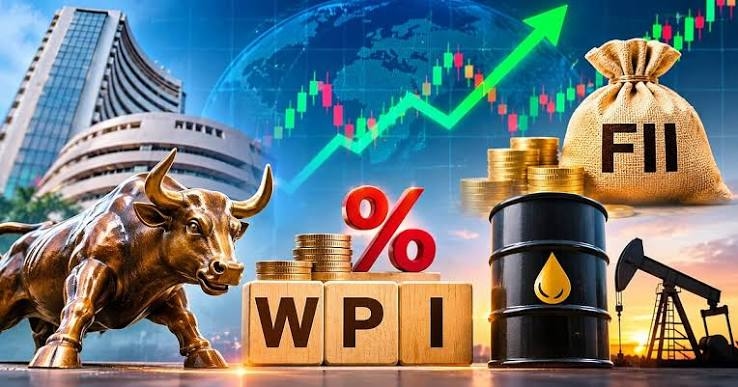


Mumbai: Domestic economic indicators are expected to play an important role in determining the market’s direction, with investors looking for clues about inflation, trade activity and the broader health of the economy.
The October WPI inflation data will be closely watched for indications of price pressures at the wholesale level. The merchandise trade figures will also be important, as they could offer insights into India’s export and import performance.
Ajit Mishra, senior vice president of research at Religare Broking, said investors would closely monitor crude oil prices, the US dollar, Treasury yields and FII flows.
“Movements in crude oil, the dollar, US Treasury yields and FII flows will remain important determinants of market direction. The domestic economic calendar will be busy, with October WPI inflation and merchandise trade data scheduled for Monday,” Mishra said.
Currency movements will remain another important factor, particularly because changes in the dollar and US bond yields can influence the attractiveness of emerging-market investments.
US economic data and Fed minutes in focus
On the global front, investors will monitor a series of US economic releases for clues about the strength of the world’s largest economy and the likely direction of monetary policy.
US retail sales figures and initial jobless claims are expected to provide insights into consumer spending and labour market conditions. These indicators could influence expectations about the Federal Reserve’s future interest rate decisions.
The minutes of the Federal Open Market Committee’s latest meeting will also be closely examined. Investors will look for indications of policymakers’ views on inflation, economic growth and the possibility of further changes to interest rates.
Any indication that US interest rates may remain elevated for longer could affect global financial markets. Higher US yields can make dollar-denominated assets more attractive, potentially influencing the flow of foreign capital into emerging markets such as India.
Investors will also track economic indicators from other major economies. Japan’s gross domestic product figures and inflation readings from the United Kingdom and the European Union are expected to add to the global picture.
Siddhartha Khemka, head of research, wealth management, at Motilal Oswal Financial Services, said Indian equities could continue their gradual upward movement, supported by strong domestic fundamentals, foreign investor buying and encouraging second-quarter corporate earnings.
However, he said market participants would remain attentive to international economic data and developments surrounding monetary policy.
Nvidia earnings to influence technology stock sentiment
Nvidia’s earnings will be another major event for global markets this week. The company’s results are expected to provide investors with an indication of demand for artificial intelligence-related products and the sustainability of spending on semiconductor infrastructure.
Technology stocks have attracted significant investor interest amid rapid developments in artificial intelligence. However, concerns about elevated valuations and the returns expected from large investments in AI infrastructure have also created uncertainty.
Any disappointment in Nvidia’s earnings or its outlook could increase volatility across global technology stocks. Such a correction could affect sentiment towards Indian information technology companies as well.
Investors will therefore assess whether the growth expectations surrounding AI-related businesses remain supported by earnings and future demand.
Global technology market movements could have an impact on Indian equities through changes in risk appetite, particularly among investors with exposure to technology and export-oriented companies.
Foreign investors return to Indian equities
Foreign institutional investors have made a significant return to Indian equities during the first half of November, investing Rs 84,290 crore after recording net outflows in the previous two consecutive months.
The renewed buying has been supported by several factors, including lower crude oil prices, attractive valuations among large-cap stocks and developments in global technology markets.
The return of foreign capital has offered support to domestic equities, although analysts believe the sustainability of these inflows will depend on global financial conditions.
Ponmudi R, chief executive officer of Enrich Money, said movements in US Treasury yields and the dollar would remain crucial for market direction.
Further strength in either could tighten global financial conditions and influence capital flows into emerging markets, he said.
The US bond market will therefore remain an important indicator for investors assessing the prospects of foreign investment in India.
Hariselvan Radhakrishnan, founder and CEO of HST Wealth, also highlighted the importance of US bond yields and crude oil prices. He said movements in these indicators could have significant implications for foreign investment activity, India’s inflation outlook and currency stability.
Crude oil prices and West Asia tensions remain key risks
Crude oil prices will remain a major domestic market trigger because India depends heavily on imports to meet its energy requirements.
A sustained increase in international oil prices could raise the country’s import bill, put pressure on the rupee and contribute to inflationary concerns. It could also affect the operating costs and profitability of companies across sectors that depend on energy and transportation.
Lower crude oil prices, on the other hand, could provide some relief to the economy by reducing import costs and easing pressure on inflation.
Developments in West Asia will also be closely monitored because geopolitical tensions can influence global energy supplies and shipping routes. Any escalation that disrupts oil production or transportation could trigger sudden price movements and affect investor sentiment.
Currency fluctuations will be another consideration. A weaker rupee could increase the cost of imports, while movements in the dollar could influence foreign investors’ returns from Indian assets.
Together, crude oil prices, geopolitical developments and global currency movements are expected to remain important factors for domestic equities.
RBI’s December policy review in focus
Investors will also begin assessing the possible response of the Reserve Bank of India (RBI) ahead of its December monetary policy review.
Vinod Nair, head of research at Geojit Investments, said markets would start evaluating the central bank’s likely approach as the next policy decision approaches.
Inflation trends, economic growth, currency movements and global interest rate conditions will be among the factors shaping expectations about the RBI’s policy stance.
The October WPI data could provide an additional indication of price pressures, although investors will also consider broader inflation trends and other economic indicators when assessing the outlook.
The central bank’s decisions are important for financial markets because changes in interest rates and policy guidance can influence borrowing costs, liquidity and investment activity.
Sensex and Nifty end previous week higher
Indian benchmark indices ended the previous week with gains, providing a positive starting point for the new trading period.
The BSE Sensex advanced 564.43 points, or 0.69%, during the week. The NSE Nifty 50 rose 113.95 points, or 0.45%.
The gains came amid changing foreign investor activity and expectations surrounding domestic corporate earnings.
Analysts believe the market could continue its gradual upward movement if domestic fundamentals remain supportive and foreign investor buying persists. However, global developments and economic data releases could lead to fluctuations during the week.
With several important indicators due across major economies, investors are likely to remain selective and closely monitor institutional flows, crude oil prices, currency movements and technology sector developments.
The combination of domestic inflation data, global economic signals and geopolitical risks is expected to determine the near-term direction of Indian equities.