







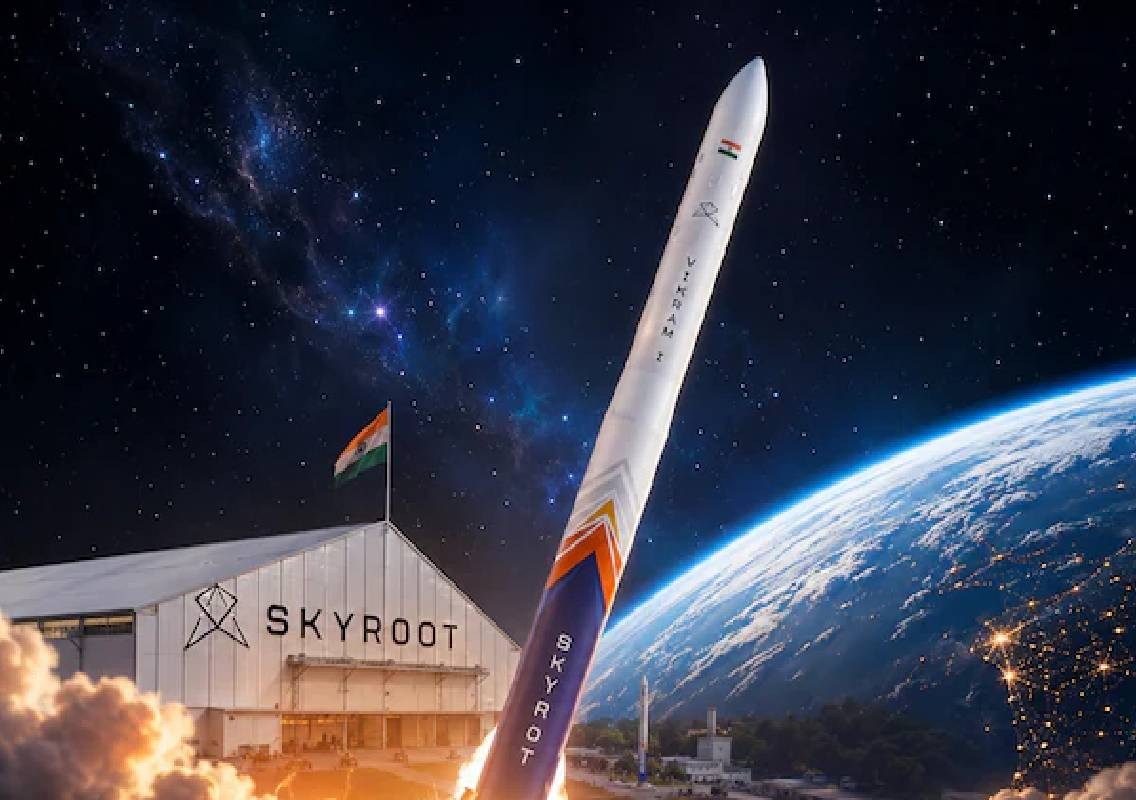


Hyderabad: India’s private space industry is on the verge of a historic milestone as Skyroot Aerospace prepares to launch Vikram-1, the country’s first privately developed orbital rocket. Scheduled for liftoff between July 12 and August 4 from the Satish Dhawan Space Centre in Sriharikota, the mission could redefine India’s commercial space ambitions and usher in a new era for private space technology companies.
Founded in 2018 by former ISRO scientists Pawan Kumar Chandana and Naga Bharath Daka, Hyderabad-based Skyroot Aerospace has emerged as India’s leading private space startup. The company became India’s first space-tech unicorn earlier this year after raising $60 million, taking its valuation beyond $1 billion.
A landmark mission
Vikram-1 is a three-stage launch vehicle designed to carry payloads of up to 350 kilograms into low Earth orbit. The maiden mission, named Mission Aagaman, will carry a mix of domestic and international customer payloads while primarily validating the rocket’s propulsion, guidance, navigation and stage-separation systems.
If successful, Skyroot will become the first private Indian company to place a satellite into orbit, marking a breakthrough comparable to the role SpaceX played in transforming the commercial space industry in the United States.
Private space sector gathers momentum
India opened its space sector to private companies in 2020, allowing startups to access ISRO’s facilities and participate in satellite launches and rocket development. Since then, the ecosystem has expanded rapidly, with companies developing launch vehicles, satellites and space-based technologies.
Skyroot had already created history in 2022 by launching Vikram-S, India’s first privately developed suborbital rocket. Vikram-1 now represents the next major leap by attempting a full-fledged orbital launch.
Industry experts believe a successful mission would boost investor confidence, attract global customers and accelerate India’s emergence as a competitive player in the commercial launch market.
Boost for India’s space economy
The Indian government aims to expand the country’s space economy to nearly $44 billion by 2033, with private companies expected to play a central role in achieving that target. Large industrial players, including Larsen & Toubro and Hindustan Aeronautics Limited, have also entered rocket manufacturing, reflecting growing confidence in the sector.
Beyond launching satellites, Vikram-1 could strengthen India’s position in the rapidly growing small satellite launch market by offering affordable and dedicated launch services to customers worldwide.
Why Vikram-1 matters
Unlike previous orbital launches led by ISRO, Vikram-1 represents a startup-led mission built largely with private capital and innovation. A successful launch would demonstrate that Indian startups are capable of delivering world-class space technology and competing globally.
For India’s deep-tech ecosystem, the mission could become a defining moment—opening new opportunities for investment, innovation and commercial space exploration while reinforcing India’s ambition to become a leading space economy.