







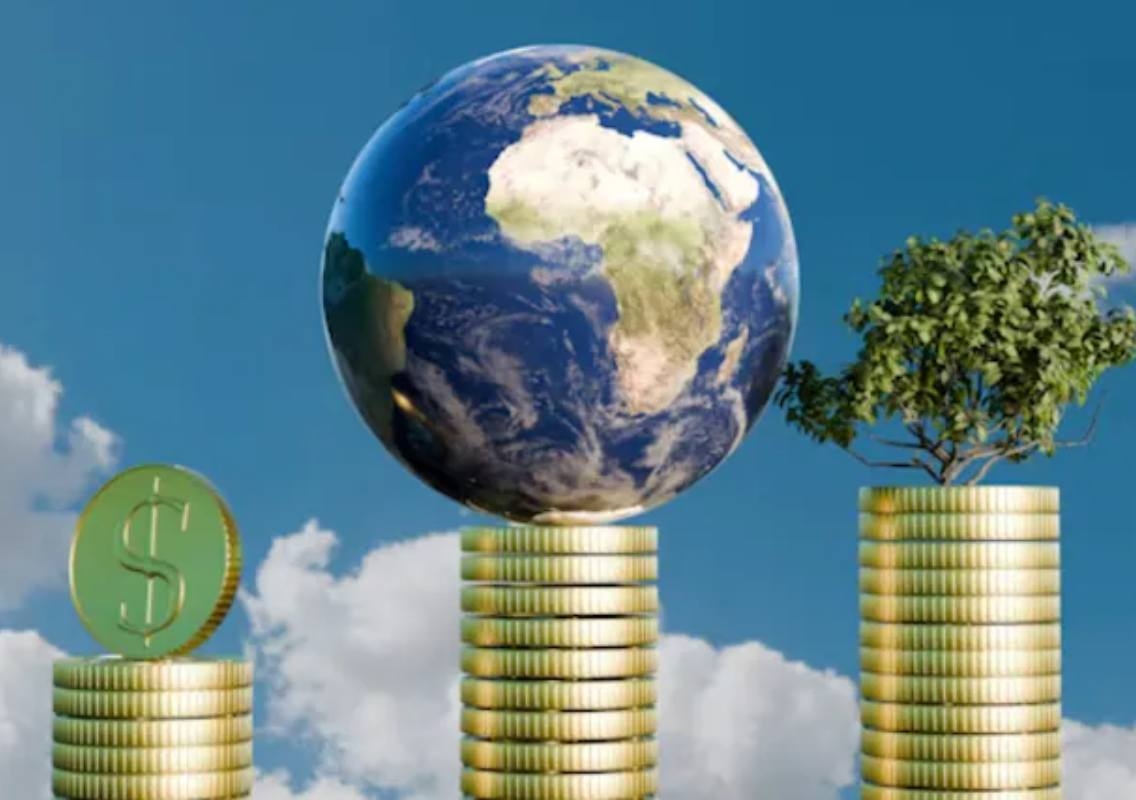


New Delhi: Countries often speak about self-reliance when framing domestic economic policy, but their actions tell a more interconnected story. Across semiconductors, energy, critical minerals, manufacturing and trade, governments are increasingly looking beyond their borders for technology, capital, raw materials and strategic partnerships.
That tension between self-reliance and global cooperation forms the central theme of this week’s economic discussion: no economy is truly an island.
The idea is particularly relevant as countries reassess supply chains following geopolitical conflicts, energy disruptions and growing competition over critical technologies.
India’s semiconductor ambitions need global partnerships
India has made significant efforts to attract semiconductor manufacturing and build a domestic electronics ecosystem. But setting up semiconductor fabrication and assembly facilities is only one part of creating a competitive semiconductor industry.
The next challenge is developing the ecosystem around those facilities, including suppliers, research capabilities, specialised technologies and skilled talent.
This is the thinking behind India’s Semicon 2.0 programme, which seeks to build capabilities beyond simply manufacturing chips.
The experience of countries such as Malaysia illustrates why moving up the semiconductor value chain can be difficult.
Malaysia developed into an important semiconductor assembly and testing hub by attracting international companies through infrastructure, incentives and cost advantages. However, much of the advanced technology and intellectual property remained with the foreign companies operating there.
For India, attracting global companies may therefore be only the beginning.
The bigger challenge will be to learn from international companies, develop domestic capabilities and eventually build Indian companies that can own and control more of the technology.
Europe’s gas security depends on Asia too
The same interdependence can be seen in Europe’s energy market.
Europe has been reducing its dependence on Russian gas and increasing imports from alternative suppliers, including Norway and the United States. But geopolitical developments have created another layer of uncertainty for the continent’s energy security.
The conflict involving Iran has disrupted LNG cargoes from Qatar, reducing the amount of gas available to global markets.
When supplies tighten, countries and regions compete for the same cargoes. That means developments in one part of the world can quickly affect energy prices and availability elsewhere.
Asia plays an important role in this equation.
When Asian demand weakens because LNG prices become too expensive, additional cargoes can become available to European buyers. But when Asian countries begin bidding aggressively for LNG, European buyers face greater competition.
As a result, Europe’s gas security is not determined entirely within Europe.
It is also influenced by energy demand, prices and economic conditions in Asia.
ASEAN looks for multiple partners
The same principle is increasingly visible in Southeast Asia.
ASEAN economies have long maintained relationships with multiple major powers, reflecting the region’s broader approach to strategic autonomy and non-alignment.
Today, the economic value of that approach is becoming even more significant.
China brings enormous manufacturing scale and capital. Japan offers decades of industrial experience and advanced technology. South Korea has strong capabilities in manufacturing, batteries, artificial intelligence and critical minerals.
India brings strengths in services, digital infrastructure and strategic connectivity.
ASEAN is therefore working with all four rather than placing its economic future entirely in the hands of one partner.
The region is strengthening relationships with China, Japan, South Korea and India, giving its economies more options in areas such as investment, technology, manufacturing and supply chains.
But diversification also comes with its own challenge.
The more relationships an economy builds, the more dependencies it has to manage.
Indonesia’s nickel industry offers a lesson
Indonesia’s experience with nickel provides another example of how international partnerships can transform an economy while also creating new strategic considerations.
Partnerships and foreign investment can help countries develop industries, attract technology and move beyond the export of raw materials.
But when one partner becomes dominant in a particular industry, the host country can also find its choices constrained.
That creates an important question for governments: how much dependence on a particular country, company or supply chain is acceptable?
The question is becoming increasingly important as countries compete to secure supplies of critical minerals required for electric vehicles, batteries, renewable energy systems and advanced technologies.
From efficiency to resilience
For decades, economic policy was largely driven by a straightforward question: where can a product or resource be obtained most efficiently?
Globalisation encouraged companies and countries to specialise, source components from wherever they were cheapest and build supply chains across multiple countries.
But geopolitical tensions and supply disruptions have changed the calculation.
Governments are increasingly asking a different question: who can we work with, and how much dependence on any one partner are we comfortable with?
That shift does not necessarily mean abandoning globalisation.
Instead, it points towards a greater emphasis on diversification and resilience.
A country may continue to import a critical product while simultaneously developing domestic capabilities and establishing alternative sources of supply.
Self-reliance does not mean isolation
The growing focus on domestic capacity does not mean countries can realistically produce everything themselves.
Semiconductors require international technology and specialised equipment. Energy markets operate across borders. Critical minerals are distributed unevenly around the world. Manufacturing networks depend on suppliers from multiple countries.
Complete economic self-reliance would therefore be extremely difficult and, in many sectors, inefficient.
The more practical objective is to ensure that dependence on one source does not become a vulnerability.
That means developing enough domestic capability to withstand disruptions while maintaining enough international partnerships to access technology, capital, resources and markets.
India faces the same balancing act
India’s growing role in global supply chains will make this balance particularly important.
The country is seeking to attract investment in semiconductors, electronics, renewable energy, critical minerals and advanced manufacturing while also building domestic capabilities.
Global companies can provide technology, expertise, capital and access to international markets. Domestic companies, meanwhile, need to develop the capabilities required to eventually compete at higher levels of the value chain.
The challenge is not simply to replace imports with domestic production.
It is to create an economy that has multiple sources of supply, strong domestic capabilities and diversified international relationships.
That approach can provide greater resilience without sacrificing the advantages of global economic cooperation.
The real value of diversification
The experiences of India, Europe, ASEAN and Indonesia point towards a common lesson.
Self-reliance and international cooperation are not necessarily opposites.
A country can strengthen its domestic capabilities while simultaneously expanding partnerships with other economies. In fact, diversification may be one of the most effective ways to reduce the risks created by excessive dependence.
For India, the semiconductor sector offers a useful example. Building factories is important, but developing suppliers, research institutions, technology capabilities and Indian companies that can own intellectual property will determine how deeply the country moves into the global value chain.
The same principle applies to energy, critical minerals and other strategic sectors.
In an interconnected world, the goal may not be to become completely self-sufficient. It may be to have enough capabilities and enough relationships that no single dependency becomes a vulnerability.
That could be the most important economic lesson of the week.